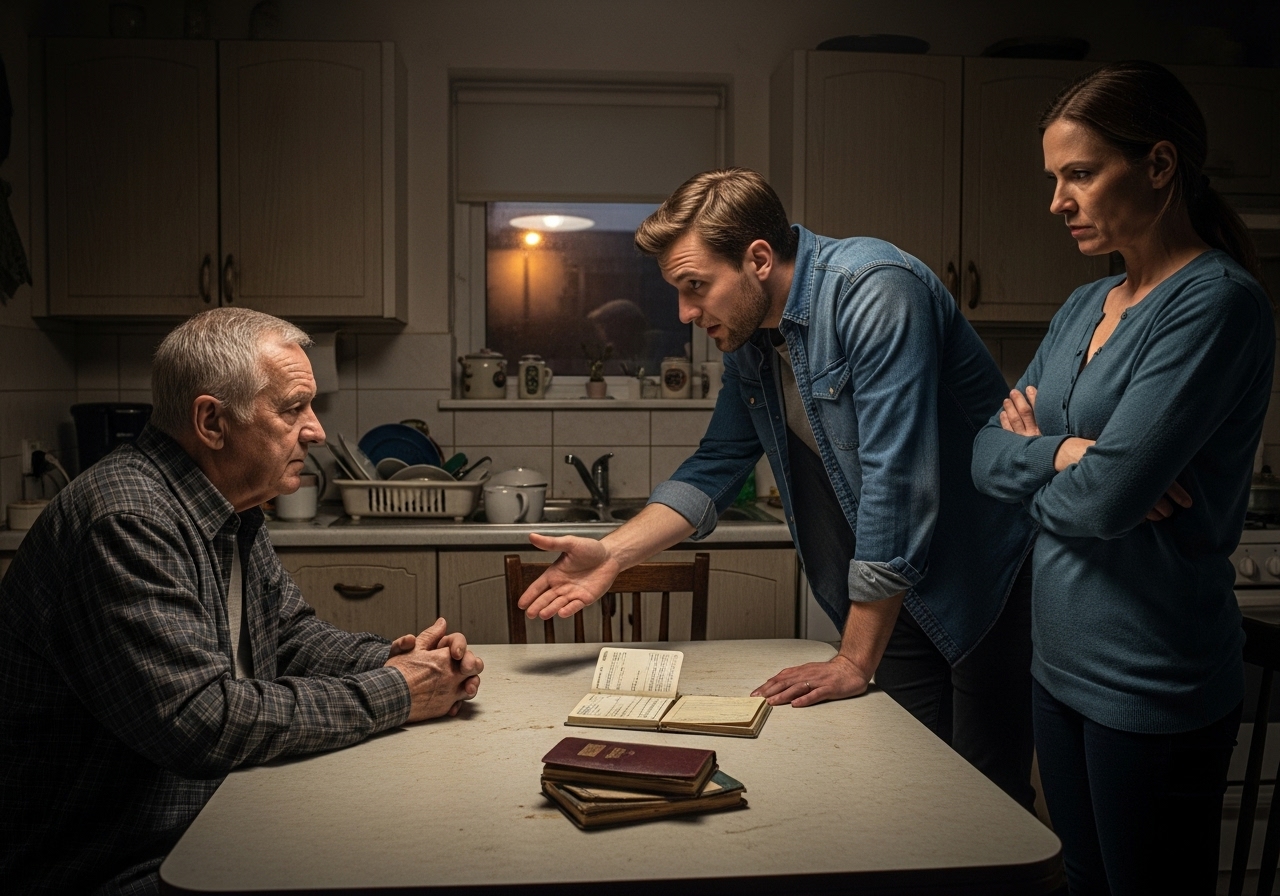
My Son Found Out My Income, So He Arrived With His Wife And Demanded I Give Him All My Savings!
My Son Cut Me Off For 13 Years Until He Learned I Was A New Millionaire. He Showed Up At My Door With Bags And His Wife: ‘As Your Son, I’m Entitled To Some Of This. We’re Moving In – You Have All This Extra Space Anyway. I Smiled… And Did What I Should’ve Done A Long Time Ago.
My Son Found Out My Income, So He Arrived With His Wife and Demanded I Give Him All My Savings!
I’m glad to have you here. Follow my story until the end and comment the city you’re watching from. This is a story about betrayal, justice, and what happens when you underestimate a mother’s strength. My son cut me off for 13 years until he learned I was a new millionaire. He showed up at my door with bags and his wife.
“As your son, I’m entitled to some of this. We’re moving in. You have all this extra space anyway.”
I smiled and did what I should have done a long time ago.
The audacity hit me like a freight train. It was a peaceful Tuesday morning when my doorbell rang. I wasn’t expecting visitors. The lottery win had only been announced in the local paper last week, and I’d been careful about keeping a low profile. 13 years of solitude teaches you the value of privacy.
When I opened the door, the shock nearly knocked me backward. Nathan Jackson stood on my doorstep, designer luggage at his feet, that familiar entitled smirk on his face. Beside him, Rebecca, his wife, hung back slightly, her eyes darting around, assessing the property like an appraiser rather than a longlost family member.
“Mom,” Nathan said as if we’d spoken just yesterday, as if 13 years of silence hadn’t stretched between us like an ocean.
I struggled to find words. My son, my only child, who had once told me I was an embarrassment to his new life, who had called me his baggage, stood before me now, uninvited and unexpected.
“Nathan,” I managed finally. “This is a surprise.”
His smile widened, not reaching his eyes.
“We heard about your good fortune. Thought we’d come congratulate you in person.”
Before I could respond, he gestured to their luggage.
“As your son, I’m entitled to some of this. We’re moving in. You have all this extra space anyway.”
The audacity of it hit me like a freight train. 13 years without a phone call, a birthday card, or even a message asking if I was alive or dead. And now he stood at my door demanding entry into my life as if he had a right to it.
But I wasn’t the same Evelyn Jackson he’d abandoned all those years ago. The broken woman who’d begged for scraps of his attention was gone, replaced by someone stronger, wiser, and much less forgiving.
I smiled, stepping aside.
“Please come in. We have a lot to talk about.”
They wheeled their luggage into my foyer, and I caught Nathan’s reflection in the hallway mirror. For just a moment, he looked uncertain. good, because what he was about to learn would shake that arrogance right out of him.
“This place is smaller than I expected,” Rebecca announced, her eyes already calculating square footage and resale value. She had that look women get when they’re mentally redecorating someone else’s house.
“Is it?” I replied mildly. “It suits me just fine.”
Nathan was doing the same thing, except he was appraising everything like he was already planning an estate sale. If these two thought they were dealing with the same broken woman who’d begged for scraps of their attention 13 years ago, they were in for a surprise that would curl their perfectly styled hair.
I led them to the living room, the same room where Nathan had delivered his parting shot all those years ago.
“Sit,” I said, gesturing to the sofa. “Let’s catch up.”
The irony wasn’t lost on me that this was probably the first time in his adult life that Nathan was following my instructions.
“We heard about your lottery win,” Rebecca began, clearly the designated spokesperson for this little expedition. “Nathan’s been worried about you, haven’t you, honey?”
Nathan nodded with the enthusiasm of a man who’d practiced this speech in the mirror.
“I have, Mom. When I heard about the lottery, I thought she shouldn’t be dealing with all that money alone. It’s dangerous. People might try to take advantage.”
I almost choked on my coffee.
“Take advantage?” I repeated slowly. “You mean like showing up uninvited after 13 years of silence, demanding a place to live and access to money you had no part in earning?”
“That’s not what this is, Mom,” Nathan said quickly. But his eyes darted away from mine.
“This is about family responsibility,” Rebecca interjected. “About making sure you’re protected.”
“Protected?” I set down my cup with deliberate care. “Nathan, the last time we spoke, you told me I was an embarrassment to your new life. You said successful people don’t drag their baggage around, and I was your baggage. Those were your exact words.”
The color drained from his face. Rebecca’s fake smile flickered like a dying light bulb.
“That was different,” he mumbled. “I was young, stressed about the business.”
“You were 32,” I interrupted. “Old enough to know that words have consequences. Old enough to understand that some doors once closed don’t automatically reopen just because circumstances change.”
Rebecca jumped in, her voice honey sweet with calculated concern.
“Evelyn, we all say things we regret when we’re under pressure. What matters is that we’re here now, ready to be a family again.”
Ready to be a family again. That was rich coming from a woman who’d helped orchestrate my exile from their lives.
I looked at these two people sitting in my living room and felt something I hadn’t experienced in years. complete control. They needed something from me, which meant for the first time in our relationship, I held all the cards.
“Tell me,” I said, leaning back in my chair like a queen on her throne. “Exactly how much of my good fortune do you think you’re entitled to?”
Nathan and Rebecca exchanged that look married couples share when they’re about to tag team someone. I’d seen it before, back when they were systematically cutting me out of their lives. The difference was this time I recognized it for what it was. Strategy meeting in real time.
“It’s not about entitlement, Mom,” Nathan said, trying for sincerity and landing somewhere near pathetic. “It’s about family obligation, about making sure this money doesn’t change you or make you vulnerable to the wrong people.”
“The wrong people,” I repeated. “You mean people like my own son and daughter-in-law who disappeared the moment they decided I wasn’t useful anymore?”
Rebecca’s mask slipped for just a second, revealing something sharp and calculating underneath.
“Evelyn, we understand you’re hurt, but we’re talking about your future, your security. This money could last the rest of your life if it’s managed properly.”
“managed properly,” I said. “By whom? You two? The same people who couldn’t manage to send me a birthday card for over a decade.”
Nathan shifted uncomfortably on the expensive sofa I’d purchased last month.
“We’ve been busy building our lives, our careers. We had to focus on our priorities.”
“And now I’m a priority again. How convenient.”
I stood up and walked to the window, looking out at my garden. The roses I’d planted last spring were in full bloom, their deep red petals a stark contrast against the lush green of the lawn. For 13 years, I’d tended this garden alone, planted each bulb, pulled each weed, celebrated each bloom without anyone to share it with.
“Tell me about these lives you’ve been building. This focus on priorities. I’m curious how that’s been working out for you.”
The silence behind me stretched long enough that I knew I’d hit something. When I turned around, Nathan was staring at his hands like they held the secrets of the universe.
“We’ve had some setbacks,” Rebecca admitted, her voice tighter. “Now “The market’s been challenging. Nathan’s consulting business has been slower than expected.”
“Setbacks?” I nodded. “Is that what we’re calling it?”
Because from what I heard through mutual acquaintances, yes, I do still have friends in this town. Your setbacks involve maxed out credit cards, a second mortgage, and a business that exists mainly on paper.
Nathan’s head snapped up, eyes wide.
“How do you know that things?”
“Nathan, you cut me out of your life, not out of your hometown. People talk. They’ve been talking for years.”
I sat back down, enjoying the way both of them seemed to shrink into the sofa.
“They told me about the failed partnerships, the bad investments, the lifestyle you couldn’t actually afford.”
I paused, letting my words hang in the air between us.
“They also told me something interesting about why you really ended our relationship 13 years ago.”
Rebecca’s face had gone pale.
“What do you mean?”
“I mean, the real reason you both decided I was an embarrassment. It wasn’t about success or baggage or any of that nonsense you fed me.”
I smiled, and it felt like the first genuine smile I’d had in years.
“It was about the inheritance you thought was coming from your father’s wealthy uncle.”
The look on Nathan’s face told me everything I needed to know.
“Bingo,” I said softly. “You threw me away because you thought Uncle Robert would leave you his money if you proved you were independent, successful, unencumbered by family obligations.”
I leaned forward.
“How did that work out for you?”
Nathan’s face cycled through several shades of red before settling on a sickly gray. Rebecca, to her credit, tried to maintain her composure, but I could see her frantically recalculating whatever plan they’d hatched in the car.
“Uncle Robert left his money to the animal shelter,” Nathan whispered. “Every penny.”
“Every penny,” I said. “did he now?”
“Turns out he had very strong opinions about people who abandoned their elderly parents for money. Who would have thought?”
Rebecca found her voice first.
“That’s ancient history, Evelyn. What matters is the future. What matters is family supporting each other through difficult times.”
family supporting each other. I rolled the words around like wine I was tasting.
“That’s fascinating coming from you. Remind me, Rebecca, when exactly did you start considering me family?”
Because I distinctly remember you referring to me as Nathan’s burden at your housewarming party.
She flinched.
“You weren’t supposed to hear that.”
“but I did, along with several other enlightening comments about how much better your lives would be once you dealt with the mother situation.”
I stood up again, this time moving to the mantle where I kept my family photos. All of them were from before Nathan’s marriage. I picked up one from his college graduation, his arm around me, both of us beaming.
I spent 13 years wondering what I’d done wrong. 13 years thinking I’d somehow failed as a mother. I traced his young face in the photograph.
“But I didn’t fail, did I? I raised a son who was kind, thoughtful, generous. The failure was what happened after he met you.”
“That’s not fair,” Nathan protested weakly.
“Fair?” You want to talk about fair? Fair would have been a conversation before you cut off all contact. Fair would have been honesty about your motivations. Fair would have been treating your mother like a human being instead of a liability to be managed.
“We made mistakes,” Rebecca said, her voice sharp with growing desperation. “But we’re here now. We want to make things right.”
“Make things right,” I repeated. “With my money?”
“It’s not about the money,” Nathan insisted. But his voice lacked conviction.
“Really? Then let’s do a little experiment.”
I walked to my purse and pulled out my checkbook.
“Let’s say I write you a check right now for $50,000. A generous gift to help with those setbacks you mentioned. Would you take it and leave?”
Their eyes lit up like Christmas morning. The answer was written all over their faces before Nathan even opened his mouth.
“We couldn’t accept such a large amount,” he said, but he was already mentally spending it. “Maybe we could work out some kind of arrangement alone, perhaps.”
Alone, of course.
“And I suppose you’d want to discuss the terms of this loan while living in my house, eating my food, and helping yourselves to my hospitality.”
“Well, we are family,” Rebecca said, as if that explained everything.
“Yes,” I agreed. “We are family, and that’s exactly why what happens next is going to hurt so much.”
I closed the checkbook with a snap that echoed through the room like a gunshot.
Nathan and Rebecca both flinched, and I realized they’d been holding their breath, waiting for me to start writing.
“The thing about family,” I said, settling back into my chair, “is that it goes both ways. Loyalty, support, love. These aren’t one-way streets you can travel only when it’s convenient.”
“Mom, we know we haven’t been perfect,” Nathan started.
“Perfect.” I laughed, and it came out sharp enough to cut glass. “Nathan, perfect would have been calling me on Mother’s Day. Perfect would have been including me in your lives instead of hiding me like a shameful secret. What you two did wasn’t imperfect. It was calculated cruelty.”
Rebecca shifted forward on the sofa, her desperation starting to show around the edges.
“Evelyn, we’re willing to acknowledge our mistakes. We want to build a better relationship going forward.”
Build a better relationship.
I repeated thoughtfully.
“Starting when? Starting the moment you heard about my lottery win. How remarkably convenient that your desire for family reconciliation coincided exactly with my change in financial circumstances.”
Nathan had the grace to look ashamed, but Rebecca was made of sterner stuff.
“People change, Evelyn. People grow. We’re not the same people we were 13 years ago.”
“You’re right about that,” I agreed. “You’re not the same people. You’re older. You’re broker. And you’re more desperate. But fundamentally, you’re exactly who you’ve always been.”
I stood up and walked to the window again, not because I needed to see the view, but because I wanted them to sweat while I spoke.
“You want to know what I did with my time these past 13 years? While you were building your important lives and prioritizing your careers?”
Neither of them answered, but I could feel their attention like heat on my back.
“I learned things. I took classes. I read books. I made new friends. I discovered that I’m actually quite intelligent when I’m not being told I’m a burden.”
I turned around to face them.
“I also learned about investing, about financial planning, about protecting assets from people who might try to take advantage.”
Nathan’s face went carefully blank.
“What do you mean?”
“I mean, I didn’t just win the lottery and stuff the money in a mattress, Nathan. I hired professionals. Good ones. The kind of professionals who specialize in protecting wealthy people from family members who might have questionable motivations.”
“You hired lawyers,” Rebecca said, and her voice had gone flat.
“Among others, I hired financial adviserss, estate planners, and even a private investigator.”
I smiled at their horrified expressions.
“You’d be amazed what a motivated person can learn about someone’s financial situation when they have the resources to find out.”
I reached into the drawer of my side table and pulled out a manila folder.
“Did you know that people’s financial records become quite accessible when you know where to look and have the right professionals asking the questions?”
Rebecca’s eyes fixed on the folder like it was a snake coiled to strike.
“For instance,” I continued, opening the file. “I learned that you’ve been living beyond your means for nearly 5 years now. That consulting business that Nathan claims is just experiencing a slow period. It hasn’t had a legitimate client in 8 months.”
Nathan’s face went white.
“How could you possibly know that?”
“the same way I know about the three credit cards that are maxed out, the loan you took against your car, and the second mortgage on your house that you’re two months behind on.”
I pulled out a sheet of paper.
“The same way I know that you’ve been borrowing money from Rebecca’s parents, telling them it’s for business expansion when it’s actually just to keep the lights on.”
“You had no right,” Rebecca whispered. But there was no real anger in it. Just the hollow sound of someone who’d been caught.
“No right?” I laughed. “Honey, I had every right the moment you decided to show up at my door making demands. Due diligence, they call it in the business world. Something you might have learned if either of you had ever run a successful business.”
Nathan slumped in his chair like a deflated balloon.
“We’re in trouble. Okay, we’re in real trouble. But that doesn’t change the fact that you are my mother. That has to count for something.”
“It does count for something,” I agreed. “It counts for the reason I’m going to give you one chance. Exactly one. To be honest with me, to drop the act, stop the manipulation, and tell me exactly what you need and why.”
They looked at each other, some kind of silent communication passing between them. Finally, Nathan straightened up and met my eyes.
“We’re going to lose everything,” he said quietly. “The house, the cow cars, probably Rebecca’s parents’ money, too. We owe about 300,000, and we have no way to pay it back.”
“$300,000?” I repeated. “That’s quite a hole you’ve dug yourselves into.”
“We made bad investments,” Rebecca added. Nathan’s business partner embezzled most of their capital and disappeared. By the time we figured out what happened, it was too late.
For the first time since they had arrived, they sounded like they were telling the truth. It didn’t make me sympathetic, but it did make me curious.
“And you thought showing up here with demands and suitcases was your best strategy for getting help.”
“We thought,” Nathan said slowly, “that if we presented it as a family reunion, as wanting to spend time with you, it might be easier than admitting we need money.”
“Easier,” I said. “He said, for whom?”
Nathan had the grace to look ashamed.
“For us, we thought it would be easier for us.”
Finally, a moment of actual honesty.
It’s almost refreshing.
I closed the folder and set it aside.
“Well, now we’re getting somewhere. 300,000,” I repeated, letting the number hang in the air like smoke from a house fire. “That’s quite an accomplishment. Most people take decades to accumulate that level of debt.”
Nathan winced.
“We know how it sounds.”
“Do you? because it sounds like two people who made a series of catastrophically bad decisions and are now looking for someone else to pay for them.”
I leaned back in my chair.
“Tell me about this business partner who supposedly embezzled your money.”
“Marcus Thompson,” Rebecca said quickly. “He was Nathan’s college roommate. They started the consulting firm together 5 years ago.”
“Marcus Thompson,” I repeated, pulling out my phone. “Funny thing about having good investigators, Nathan, they tend to be thorough.”
I scrolled through my notes.
“Marcus Thompson didn’t embezzle anything. Marcus Thompson discovered that his business partner was funneling company money into personal expenses and gambling debts. He reported it to the authorities and dissolved the partnership to protect himself.”
The silence in my living room was so complete, I could hear the refrigerator humming in the kitchen.
“That’s not what happened,” Nathan said weekly.
“Isn’t it? Because according to the police report, yes, there’s a police report. You’ve been under investigation for business fraud for the past 8 months. The district attorney just hasn’t decided whether to press charges yet.”
Rebecca’s face had gone the color of old newspaper.
“How do you know about police reports?”
“The same way I know that you’ve been telling your parents Nathan has a rare medical condition that requires expensive treatment. The same way I know you’ve borrowed $50,000 from three different relatives using three different Saab stories.”
I set my phone down carefully.
“You two aren’t just broke, you’re con artists.”
“We’re not criminals,” Nathan protested, but his voice lacked conviction.
“Really? What would you call lying to your family about having cancer to get money? What would you call embezzling from your own business? What would you call showing up here after 13 years with a soba story designed to manipulate me into supporting your fraudulent lifestyle?”
For the first time since they’d arrived, I saw genuine fear in their eyes.
“Good fear was honest. We never meant for it to go this far,” Rebecca whispered.
“But it did go this far. And now you’re here in my house asking me to bail you out of the consequences of your own choices.”
I stood up and walked to the window again.
“Here’s what’s going to happen next.”
I could feel them both holding their breath behind me, waiting for whatever ultimatum I was about to deliver. The afternoon sun was streaming through my kitchen window, highlighting the dust moes dancing in the air. Such a peaceful scene for such an explosive moment.
“You’re going to pack up your suitcases,” I said without turning around. “And you’re going to leave my house. But before you do, we’re going to have a conversation about honesty and consequences.”
“Mom, please,” Nathan started.
“I’m not finished.” I turned to face them, and I could see they were both on the edge of panic.
“You see, the interesting thing about hiring investigators is that you learn all sorts of unexpected information. For instance, I learned that I wasn’t the only family member you cut out 13 years ago.”
Nathan’s Adams apple bobbed like a fishing lure.
“What do you mean?”
“I mean your aunt Olivia. Remember her? My sister? the one who helped pay for your college textbooks and used to send you birthday money every year until you suddenly stopped returning her calls.”
Rebecca shot Nathan a look that could have stripped paint.
“It turns out,” I continued, “that Olivia tried to reach out to you multiple times after you cut me off. She was worried about me, wanted to understand what had happened. You told her to mind her own business and blocked her number.”
“We were establishing boundaries,” Rebecca said defensively.
“Boundaries? Is that what you call it when you discover that a family member might leave you money in their will, so you maintain contact just long enough to make sure you’re still mentioned, then disappear again?”
Nathan’s face went through several interesting color changes.
“How did you know about Olivia’s will?”
“She updated it last month,” I said simply. “Guess whose name got removed?”
“Apparently, she doesn’t approve of people who abandon their mothers for money and then show up again when they need financial help.”
“You turned her against us,” Nathan accused.
“I didn’t have to turn her against you. You did that all by yourselves.”
I walked back to my chair, but this time I remained standing.
“Olivia and I talk every week now, have been for the past 3 years. She’s the one who suggested I hire investigators when I won the lottery. She said I should protect myself from people who might try to take advantage.”
“You’ve been planning this?” Rebecca said, her voice flat with realization.
“Planning what? To be prepared when my aranged son showed up demanding money. Yes, I have been planning that because Olivia warned me it would happen. She said you’d wait just long enough for the news to spread. then show up with some story about family and reconciliation.”
Nathan slumped deeper into the sofa.
“We need help, Mom. We’re in real trouble.”
“Yes, you do. You need professional help. Therapy, addiction counseling, financial planning, probably legal representation.”
I picked up the Manila folder again.
“What you don’t need is an enabler willing to throw money at your problems while you continue making the same destructive choices.”
“So, you’re just going to let us lose everything?” Rebecca’s voice was rising toward hysteria.
“I’m going to let you face the consequences of your own actions. Like adults.”
I opened the folder and pulled out another sheet of paper.
“However, I’m not completely heartless.”
The paper I held contained information that would either save them or destroy them completely. After 13 years of wondering what I’d done wrong as a mother, I finally had the chance to find out what kind of people they really were.
“This,” I said, holding up the document, “is the contact information for a bankruptcy attorney who specializes in cases like yours. He’s expensive, but he’s good. He can help you navigate the legal issues you’re facing and possibly keep you out of prison.”
Nathan looked up with something like hope in his eyes.
“You’d pay for a lawyer?”
“I said he was expensive. Not that I’d pay for him.”
I set the paper on the coffee table between us.
“You want help? Real help. Here’s what I’m willing to do. I will loan you enough money to retain this attorney and enter a debt counseling program. Not $300,000. Not enough to maintain your current lifestyle. Just enough to keep you from going to jail and help you start over with a clean slate.”
“How much?” Rebecca asked immediately.
“$25,000. Half for the attorney, half for a legitimate debt consolidation program.”
I sat down in my chair, finally ready for the most important part of this conversation.
“But there are conditions.”
“What kind of conditions?” Nathan asked, his voice barely above a whisper.
“First, you both enter therapy. Individual therapy, not couples counseling. You need to figure out how you became people who would con your own families.”
I held up a finger when Nathan started to protest.
“Second, you make full restitution to every person you’ve defrauded. your relatives, Rebecca’s parents, the clients you may have overcharged, everyone.”
“That’s impossible,” Rebecca protested.
“We don’t have that kind of money.”
“Which brings me to condition three. You get jobs. Real jobs. Not consulting or entrepreneurship or any other scheme that sounds impressive but doesn’t pay the bills. You get steady employment and you stick with it until everything is paid back.”
Nathan was staring at me like I’d grown a second head.
“You’re talking about years of work.”
“I’m talking about the rest of your lives.” I corrected him. “Because that’s how long it takes to rebuild trust after you’ve broken it this badly.”
“And if we don’t agree to your conditions,” Rebecca asked, her chin tilting up defiantly.
I smiled. And this time it was the kind of smile that made small children hide behind their mothers.
“Then you walk out of here with nothing. And I make sure that everyone in your family knows exactly why. Every relative you’ve borrowed money from, every friend you’ve lied to, every person you’ve conned gets a detailed report about who you really are.”
“You wouldn’t,” Nathan whispered.
“Try me,” I said. “I’ve had 13 years to think about what I’d do if I ever got the chance to teach you about consequences. Don’t test my resolve now.”
The grandfather clock in the hallway chimed four times. They’d been here for 2 hours, and I could see the exact moment when they realized their plan had backfired spectacularly.
“We need time to think,” Rebecca said finally.
“No,” I said. “You need time to choose. You can accept my offer and start rebuilding your lives the hard way, or you can keep looking for easy money and shortcuts. But you can’t do both. and you can’t do either one in my house.”
Nathan looked like he was about to cry. After all these years, after all the pain he’d caused, he looked like a lost little boy.
“For just a moment, I almost felt sorry for him. Almost.”
“There’s one more thing,” I said, just as they were starting to gather themselves to leave. “Something I think you should know before you make your decision.”
I walked to my desk and pulled out a sealed envelope. The return address was from a law firm in Denver, and it was dated 3 weeks ago. This arrived right after news of my lottery win started spreading around town.
I held the envelope like it contained dynamite.
“It’s from a lawyer representing someone who’s been looking for you both for quite some time.”
The color drained from both their faces simultaneously.
“Who?” Rebecca whispered.
“Marcus Thompson.”
I opened the envelope and pulled out the letter.
“You remember Marcus, don’t you? Your former business partner who you claimed embezzled from your company?”
Nathan’s hands were shaking now.
“What does he want?”
“He wants his money back. The $50,000 you took from the company account before you dissolved the partnership. The money he only discovered was missing after his accountant did a full audit following your accusations against him.”
“That’s not what happened,” Nathan said. But his voice was barely audible.
“Isn’t it? According to this letter, Marcus has been working with the district attorney’s office to build a case against you. He’s been waiting to see if you’d voluntarily come forward and make restitution. He heard about my lottery win and wondered if it might motivate you to do the right thing.”
Rebecca was gripping the arm of the sofa so tightly her knuckles were white.
“What does that mean?”
“It means that Marcus is offering you the same choice I am. You can make full restitution and accept responsibility for what you did or he can proceed with pressing criminal charges.”
I put the letter back in the envelope.
“The only difference is his deadline is tomorrow.”
“Tomorrow?” Nathan’s voice cracked.
“He’s given you until 5:00 p.m. to contact his attorney and arrange payment.”
I looked between them, watching the last of their composure crumble.
“So, you see, my offer isn’t just about family reconciliation or teaching you lessons about consequences. It’s about keeping you out of prison.”
The silence that followed was deafening. I could practically hear their brains working, calculating, trying to find some angle they hadn’t considered.
“You planned this,” Rebecca said finally.
“You’ve been in contact with Marcus,” Nathan added, his voice hollow.
“I have,” I admitted. “He reached out to me the day after my lottery win was announced in the paper. He wanted to know if I was aware of what my son had been doing and whether I might be willing to help clean up his mess.”
“And what did you tell him?”
“I told him that depended entirely on whether my son was willing to take responsibility for his actions.”
I stood up and walked to the mantle where I picked up that old photo of Nathan at his college graduation.
“Marcus is a good man, Nathan. He didn’t deserve what you did to him. Neither did your aunt Olivia or Rebecca’s parents or any of the other people you’ve hurt.”
Nathan was crying now, tears streaming down his face.
“I never meant for it to get this bad, but it did get this bad.”
“And now you have to decide what kind of person you want to be going forward.”
I set the photo down and turn to face them both.
“You can accept my help in Marcus’s mercy, work hard to make things right, and maybe salvage some small piece of your integrity, or you can keep running, keep lying, keep looking for easy solutions to problems you created.”
“Some choice,” Rebecca muttered.
“It’s the only choice that matters,” I said. “The choice to be honest.”
Finally, they looked at each other, and I could see 13 years of bad decisions weighing on their shoulders.
“We’ll call you in the morning,” Nathan said, his voice barely audible.
“I’ll expect your call by 9,” I replied. “One way or another.”
After they left, I sat in my living room for a long time, staring at the photo of Nathan’s graduation. The son I once knew was still in there somewhere, buried beneath years of poor choices and the influence of a woman who saw people as resources to be exploited rather than human beings to be cherished.
I hoped he would make the right choice. But either way, I had already made mine. I would no longer be the convenient scapegoot for their failures or the easy solution to their problems.
I was done being baggage. It had taken 13 years and a lottery win, but I’d finally found the strength to say no to my only child. And somehow that felt like the biggest win of all.
After Nathan and Rebecca left, I poured myself a glass of wine and sat on my back porch. The evening air was cool against my skin, a gentle reminder that I was alive, that I had survived 13 years without my son. I could survive whatever came next.
My phone rang at 8:15 the next morning. I’d been up since 5, too restless to sleep. The caller ID showed Olivia’s name.
“They’re going to call you,” she said without preamble. “Nathan reached out to me last night.”
I gripped the phone tighter.
“What did he say?”
“He wanted to know if I was really cutting him out of my will.”
My sister’s laugh was as dry as autumn leaves.
“I told him that ship had sailed the moment he cut you out of his life. Family is a package deal, not a buffet where you can pick and choose.”
“Did he tell you about their situation?” I asked, moving to the kitchen to start a pot of coffee.
“Bits and pieces, enough to know they’re in deeper than the Mariana’s trench. Eevee, are you sure about this? They could drag you down with them.”
I smiled at the childhood nickname. Olivia was the only person who still called me that.
“I’m not jumping into the water with them, Liv. I’m standing on the shore with a rope. Whether they grab it or keep thrashing is up to them.”
“And if they drown,” I paused, watching the coffee drip slowly into the pot.
“Then I’ll mourn the sun I lost years ago and move forward with my life.”
“You’ve changed,” she said softly. “The old Eevee would have jumped in head first.”
“The old Eevee nearly drowned trying to save everyone else.”
I filled my mug, inhaling the rich aroma.
“I learned to swim for myself first.”
We chatted for a few more minutes before hanging up. I had just settled at my kitchen table when the doorbell rang precisely at 9:00. I hadn’t expected them to show up in person. I’d expected a phone call, another round of manipulation from a safe distance.
But when I opened the door, Nathan and Rebecca stood on my porch, looking like they hadn’t slept at all.
“May we come in?” Nathan asked.
The arrogance from yesterday was gone, replaced by something that might almost be humility.
I stepped aside, gesturing them into the living room.
“Coffee, please,” Rebecca said. Her makeup couldn’t quite hide the puffiness around her eyes.
Once we were settled with steaming mugs, an uncomfortable silence stretched between us. Finally, Nathan set his coffee down and looked me directly in the eyes.
“We’re in trouble, Mom. Real trouble. Not just the debt, though. That’s bad enough. I’ve”
He glanced at Rebecca, who nodded slightly.
“I’ve made some terrible decisions. I took money from the business. I lied to people. I’ve been”
He swallowed hard.
“I’ve been gambling.”
“Gambling?” I kept my voice neutral.
“It started small. Sports betting just for fun. Then online poker. I told myself I was networking with clients. Then day trading, which I convinced myself wasn’t really gambling because it was the stock market.”
His voice cracked.
“But it was gambling. All of it. and I kept losing and borrowing to cover the losses and lying about where the money was going.”
Rebecca stared into her coffee cup.
“I knew some of it, not all of it, not the extent, but enough that I should have done something. Instead, I just helped him hide it.”
“Because you benefited,” I said.
She flinched but nodded.
“the lifestyle, the image. I didn’t want to give that up.”
Nathan continued, his words tumbling out like a confession.
“Marcus found out when he noticed discrepancies in the company accounts. He confronted me and I panicked. I accused him of stealing to throw suspicion off myself. By the time he’d cleared his name, I cleaned out what was left of our business account and dissolved the partnership.”
I listened, letting him speak without interruption. This was the most honesty I’d heard from my son in over a decade.
“We did the same thing with Rebecca’s parents, with Aunt Olivia, anyone who would give us money. I kept thinking the next bet, the next investment would turn things around. It never did.”
“And now you owe 300,000,” I said. “To whom exactly?”
Nathan’s eyes darted to Rebecca again. This was the part they were hesitant to share.
“Some of it is regular debt, credit cards, the mortgage, car loans,” Rebecca said. “But about 100,000 is too,”
She took a deep breath.
“To less reputable lenders.”
“loan sharks,” I translated.
Nathan nodded miserably.
“They’ve given us until the end of the month to pay. After that,”
He let the sentence hang.
“After that, they start breaking things,” Rebecca finished, starting with kneecaps.
I sat back in my chair, studying them both.
“And when you heard about my lottery win, you thought you’d found your solution.”
“Yes.” Nathan’s voice was barely audible.
“It seemed like a miracle, the answer to all our problems.”
“So, you packed your bags and showed up on my doorstep, planning to charm or guilt your way into my wallet.”
I set my coffee down.
“Did it ever occur to you to simply tell me the truth? To ask for help honestly?”
“We were ashamed,” Rebecca said, “and afraid you’d say no.”
“So, instead, you tried to manipulate me. How did that work out for you?”
Nathan’s shoulders slumped.
“Not well.”
“No.”
I stood up and walked to the window, watching a pair of cardinals dart between the branches of the oak tree in my yard.
“Not well at all.”
I turned back to face them.
“You’ve told me about your debts and your gambling. Now tell me about Marcus Thompson. What exactly does his letter say?”
Nathan reached into his jacket pocket and pulled out a crumpled envelope.
“He sent us a copy, too. We got it last week, but we”
He passed it to me.
“We were too afraid to open it until last night.”
I removed the letter and scanned it quickly. It was exactly as I described. Marcus offering Nathan a chance to make restitution before he proceeded with legal action. The deadline was indeed 5:00 p.m. today.
“Have you called him?” I asked.
“No, we wanted to talk to you first.”
Nathan leaned forward, his eyes desperate.
“Mom, I don’t know what to do. If I go to prison, Rebecca will be left to deal with the lone sharks alone.”
Rebecca’s face had gone pale at the mention of prison.
“We can’t afford to pay Marcus back in the other debts. Even with your offer of $25,000, it’s not enough to fix everything.”
I refolded the letter carefully.
“You’re right. It’s not enough to fix everything. Nothing could fix this situation quickly or easily, but it might be enough to start.”
“What do you mean?” Nathan asked.
“I mean that you’ve spent years digging this hole. It’s going to take years to climb out of it. There are no shortcuts, no magic solutions. Not even a lottery win can make this disappear overnight.”
Rebecca made a small sound of despair. Nathan just looked defeated.
But I continued,
“If you’re truly ready to change, to do the hard work, to face the consequences, to rebuild your lives honestly. Then maybe we can find a path forward.”
Hope flickered across Nathan’s face.
“You’ll help us.”
“I’ll help you help yourselves,” I clarified.
“My conditions still stand. Therapy, restitution, honest work, and I’m adding another one. Gamblers Anonymous meetings for you, Nathan. At least three times a week to start.”
“Yes,” he said immediately. “Anything.”
“Don’t say anything when you don’t mean it,” I cautioned. “This isn’t about saying what you think I want to hear. This is about actually changing your lives.”
I looked at Rebecca.
“Both your lives. No more con games. No more manipulation. No more living beyond your means.”
Rebecca nodded slowly.
“I understand.”
“Do you? Because this means giving up the designer clothes, the expensive car, the image you’ve cultivated. It means living within your means. Probably in a much smaller house with much less impressive possessions.”
She flinched but held my gaze.
“I know.”
“Good. Then here’s what we’re going to do.”
I reached for my phone.
“First, we’re going to call Marcus and arrange a meeting today. All four of us. We’re going to lay everything on the table and work out a repayment plan.”
“He won’t agree.” Nathan said. “he hates me now.”
“Marcus doesn’t hate you, Nathan. He’s disappointed in you. There’s a difference. And unlike you, he’s a man of integrity. If you show him you’re serious about making amends, he’ll listen.”
I dialed the number from the letter. Marcus answered on the third ring.
“Mr. Thompson, this is Evelyn Jackson, Nathan’s mother.”
There was a pause.
“Mrs. Jackson, I’ve been expecting your call.”
“I have Nathan and Rebecca with me. We’d like to meet with you today to discuss a resolution to this situation.”
Another pause.
“I see. I’m available at noon. My office.”
I glanced at Nathan and Rebecca, who both nodded vigorously.
“We’ll be there. Thank you, Mr. Thompson.”
After I hung up, I turned back to the couple on my sofa.
“That’s step one. Step two is contacting the bankruptcy attorney I mentioned yesterday. You’ll need to be completely transparent with him about all your debts, including the unofficial ones.”
“What about the lone sharks?” Rebecca asked, her voice tight with fear. “They won’t care about bankruptcy proceedings or repayment plans.”
“No, they won’t,” I agreed. “Which is why we’ll need to address them separately.”
“How?” Nathan asked.
“by buying you time.”
I pulled out my checkbook.
“I’m prepared to give you $50,000, not 25,000, as I mentioned yesterday. Half for the attorney and debt counseling. Half to make a good faith payment to your less than reputable creditors.”
Their eyes widened in unison.
But I continued before they could get too excited.
“This is not a gift. It’s not even exactly a loan. Consider it an investment in your rehabilitation. You will sign a formal agreement with specific conditions and repayment terms. If you violate those terms, there will be serious consequences.”
“What kind of consequences?” Rebecca asked cautiously.
“The kind that involve me sharing everything I know about your financial misconduct with the authorities, your families, and anyone else who might have been affected by your deceptions.”
Nathan swallowed hard.
“You’d really do that?”
“In a heartbeat,” I said, my voice soft but firm. “I love you, Nathan. You’re my son, but I will not enable your self-destruction or your mistreatment of others. Not anymore.”
He nodded slowly, accepting this new reality.
“There’s one more thing,” I said. “And you said you mentioned that some of your debt is from credit cards and loans in both your names.”
“Yes,” Rebecca confirmed. “about 150,000.”
I made a quick calculation.
“Then you’ll need to sell your house. Use the equity to pay down those debts. Whatever’s left can go toward a small apartment rental.”
Rebecca’s face crumpled.
“The house is underwater. We owe more than it’s worth.”
“then you’ll need to explore a short sale or deed in lie of foreclosure with your lender. The bankruptcy attorney can advise you on the best approach.”
I looked at them both.
“You cannot keep living as if nothing has changed. Everything has changed.”
They sat in stunned silence, the full weight of their situation finally sinking in.
“This is really happening,” Nathan whispered. “We’re really going to lose everything.”
“Not everything,” I corrected. “You’re losing the trappings of success you never truly earned, but you still have your health, your freedom, and a chance to rebuild. Many people in your situation don’t get that chance.”
Rebecca wiped away a tear.
“I don’t know if I can do this.”
“You can,” I said. “But whether you will is a different question entirely. That’s a choice only you can make.”
The drive to Marcus Thompson’s office was silent. Nathan sat in the passenger seat of my car while Rebecca followed in theirs. He stared out the window, lost in thought.
“What are you thinking about?” I asked, breaking the silence.
“How I got here?” He said quietly. “how I went from the kid who wanted to make you proud to”
He gestured helplessly.
“to this.”
“It didn’t happen overnight,” I said. “No, it was a thousand small choices. Each one seemed reasonable at the time.”
He turned to look at me.
“When did you know that I was gambling?”
“I mean, I didn’t know it was gambling specifically, but I suspected something was wrong about 3 years ago. Olivia mentioned you’d asked to borrow money for an investment opportunity, but were vague about the details.”
Nathan winced.
“I lost that money in two days.”
“I figured it was something like that.”
I signaled for a turn.
“You know, you could have come to me then. I didn’t have lottery money, but I would have helped you get counseling.”
“I was too proud and then too ashamed.”
He looked down at his hands.
“Rebecca didn’t help. She kept pushing for more. A bigger house, better cars, vacation home. Said we needed to look successful to be successful.”
“And you wanted to make her happy.”
“I wanted to be the man she thought she’d married. The successful entrepreneur, the provider,”
He laughed bitterly.
“Some provider. I turned out to be.”
We pulled into the parking lot of a modest office building. Marcus Thompson’s consulting firm occupied the second floor. Rebecca parked next to us, checking her makeup in the rear view mirror before joining us. Even now, facing financial ruin, she was concerned with appearances. I wondered if she would ever truly change.
Marcus met us at the door to his office, his expression carefully neutral. He was a tall African-Amean man with wire- rimmed glasses and a neatly trimmed beard. Nothing about him suggested the villain Nathan had described in his accusations.
“Mrs. Jackson,” he said, extending his hand. “Thank you for coming.”
“Mr. Thompson, thank you for meeting with us.”
He nodded to Nathan and Rebecca without offering his hand.
“Let’s talk in the conference room.”
The meeting was tense but productive. Marcus listened as Nathan confessed to embezzling from the company and falsely accusing him. He admitted to his gambling addiction and outlined our plan for restitution.
“I’m prepared to provide the funds for an initial payment today,” I told Marcus, “as a show of good faith while Nathan and Rebecca begin their financial rehabilitation.”
Marcus studied me thoughtfully.
“May I ask why you’re doing this, Mrs. Jackson. Nathan hasn’t exactly been a beautiful son from what I understand.”
“No, he hasn’t,” I agreed. “But he’s still my son. And I believe in second chances, though not third or fourth ones,”
I glanced pointedly at Nathan.
“The repayment will need to be structured over time,” Marcus said after a moment of consideration. “With interest, of course.”
“Of course,” I agreed.
“and I’ll need a formal admission of wrongdoing in writing from Nathan.”
He turned to my son.
“not to punish you, but to protect myself if questions ever arise about the company’s dissolution.”
Nathan nodded.
“I’ll write whatever you need.”
“What about the police investigation?” Rebecca asked, speaking for the first time since we’d arrived. “Will you drop the charges?”
Marcus adjusted his glasses.
“There are no formal charges yet, just an investigation. If Nathan makes restitution and provides a written statement, I’ll inform the detective that we’ve reached a private settlement.”
By the time we left Marcus’s office, we had a signed agreement. Nathan would repay the embezzled $50,000 plus interest over 3 years, beginning with a $15,000 payment today.
As we walked back to our cars, Marcus pulled me aside.
“Mrs. Jackson, a word.”
I nodded to Nathan and Rebecca to go ahead.
“I just wanted to say,” Marcus began once they were out of earshot. “That you’re doing a brave thing. Many parents would either cut ties completely or bail their kids out with no strings attached. Your approach is unexpected.”
“Life has taught me that true compassion sometimes means letting people face consequences,” I said, “while still offering a hand up.”
He nodded.
“I hope it works. For what it’s worth, Nathan wasn’t always like this. When we first started the business, he was driven, ethical, full of ideas. Something changed a few years in.”
“Rebecca happened,” I said softly.
“Partly, yes. But Nathan made his own choices, too.”
He hesitated.
“The gambling, that’s going to be the hardest part. It’s a powerful addiction.”
“I know. That’s why the therapy and Gamblers Anonymous are non-negotiable conditions.”
“Good.”
He extended his hand.
“You’re a remarkable woman, Mrs. Jackson. Nathan’s lucky to have you in his corner.”
“Thank you, Mr. Thompson for your understanding and your wisdom.”
Back at my house, Nathan and Rebecca were huddled in intense conversation on the porch swing.
“We need to discuss next steps,” I said, joining them. “Starting with where you’re going to live while you sort this out.”
“We can’t stay with you,” Rebecca asked, her voice small.
I shook my head.
“No, that’s not part of the deal. You need to stand on your own feet.”
“But our house,” she began,
“is more than you can afford,” I finished. “You’ll need to find a small apartment, something within your means.”
“On what income?” Nathan asked. “I don’t have a job.”
“The consulting firm is gone, which is why finding employment is your top priority.”
I sat down across from them.
“Both of you.”
Rebecca looked stricken.
“I haven’t worked since we got married. My design business was just a hobby.”
“Then it’s time to make it more than a hobby,” I said. “Or find something else. The point is, you both need steady income.”
“What about the lone sharks?” Nathan asked. “They’re expecting full payment by the end of the month.”
“I told you we’ll buy time. I’ll give you $25,000 to offer as a good faith payment with a promise of regular payments after that.”
“They don’t work that way,” Nathan said, panic edging into his voice. “They want all of it now.”
“Then you’ll need to negotiate,” I said firmly. “Or consider other options like relocating temporarily until you’ve paid them off.”
“You mean run away?” Rebecca sounded horrified.
“I mean prioritize your safety while you work to meet your obligations.”
I leaned forward.
“Unless you have a better idea.”
They exchanged glances.
“Actually,” Rebecca said slowly. “I might have one,”
I raised an eyebrow.
“I’m listening.”
“My parents,” she said, “they don’t know about any of this. They still think Nathan’s business is doing well, just experiencing cash flow issues.”
“If we told them the truth, all of it, they might help. Not with the full amount, but maybe enough to satisfy the lone sharks.”
“More deception,” I asked.
“No,” she said quickly. “The opposite. Complete honesty for once about the gambling, the debts, everything. They’d be hurt and angry. But they love me. They might help if they knew how serious this is.”
I considered this.
“It’s worth trying, but you’ll need to be prepared for them to say no or to offer help with strings attached.”
“Like you did,” Nathan said.
“Yes,” I acknowledged, “like I did, because that’s what responsible love looks like sometimes.”
Rebecca stood up suddenly.
“I need to make a call.”
She walked to the edge of the porch, phone in hand, leaving Nathan and me alone.
“She’s scared,” he said quietly.
“You both should be,” I replied. “But fear can be a powerful motivator for change.”
“I’ve never seen her like this before,” he continued, watching Rebecca pace as she spoke to her parents. “She’s always been so confident, so sure that everything would work out because until now, it always has. She’s always had someone to bail her out. you, her parents, friends.”
Nathan nodded slowly.
“You’re right. I never thought about it that way.”
Rebecca returned, her face a mixture of hope and apprehension.
“They want to meet tonight. They’re driving up from Charleston.”
“That’s good,” I said.
I said,
“In the meantime, we need to get you set up with the bankruptcy attorney and start looking for jobs.”
“I can’t face all this at once,” Rebecca said, her voice rising. “It’s too much.”
“It is a lot,” I agreed. “But it didn’t pile up overnight, and it won’t get solved overnight, either. All you can do is take one step at a time.”
Nathan reached for her hand.
“We’ll figure it out, Becca. Together.”
She pulled away from him.
“Together. You’re the reason we’re in this mess. Your gambling, your embezzlement, your lies.”
“And you were right there with me,” he shot back, “spending money we didn’t have, pushing for a bigger house, more vacations, designer everything.”
I sat back, watching them turn on each other. This was inevitable. The blame game that comes when the fantasy collapses and reality sets in.
“Enough,” I said finally. “Blaming each other won’t solve anything. You both contributed to this situation and you’ll both need to contribute to solving it.”
They fell silent, avoiding each other’s eyes.
“Now,” I continued, “Rebecca, go pack whatever you’ll need for the next few days. Nathan, you’re coming with me to meet with the bankruptcy attorney. I called while we were at Marcus’s office, and he can see us at 3.”
“What about my parents?” Rebecca asked.
“We’ll meet them for dinner, 7:00 at the Riverside Grill. I’ll make a reservation.”
She looked startled.
“You’re coming, too?”
“Yes,” I said firmly. “I am because this isn’t just about money anymore. This is about rebuilding trust and establishing honest relationships.”
And that includes me.
The bankruptcy attorney’s office was in a modern building downtown. Jeffrey Barnes was a balding man in his 50s with kind eyes and a nononsense manner.
“So,” he said after hearing our situation. “You’re in deep, Mr. Jackson. But not irretrievably.”
So, Nathan looked up hopefully.
“You think we can avoid bankruptcy?”
“I didn’t say that.”
Barnes leaned back in his chair.
“Given the extent of your debts and the nature of some of your creditors, Chapter 7 bankruptcy might be your best option for the legitimate debts. It won’t address the unofficial lenders, of course.”
“What about our credit?” Nathan asked. “Won’t bankruptcy ruin it?”
“Yes, for several years. But your credit is likely already damaged from missed payments and high utilization.”
Barnes shuffled through the financial documents we’d brought.
“The more pressing concern is whether all your debts would be dischargeable in bankruptcy.”
“What do you mean?” I asked.
“Debts incurred through fraud or misrepresentation aren’t typically dischargeable,” Barnes explained. “If any creditors can prove that Nathan lied on applications or took out loans with no intention of repaying them, those debts might survive the bankruptcy.”
Nathan pald.
“How would they prove that?”
“Bank records. Timing of loans versus gambling losses. Communications.”
Barnes adjusted his glasses.
“It would be a case-bycase determination by the court.”
“What about our house?” Nathan asked.
“You’d lose it in chapter 7 almost certainly, but given that it’s underwater, that might be a blessing in disguise.”
For the next hour, Barnes outlined our options. By the time we left, Nathan had a clearer picture of what bankruptcy would mean and what it wouldn’t solve.
“I never thought it would come to this,” he said as we drove to meet Rebecca and her parents, “filing for bankruptcy at 35.”
“It’s not the end of the world,” I say. I said, “Many successful people have gone through bankruptcy and rebuilt.”
“I’m not sure I know how to rebuild,” he admitted. “I’ve been running so long, hiding problems, creating new ones. I’m not sure I remember how to just live honestly.”
“That’s what therapy and support groups are for.” I reminded him to help you learn new patterns.
He was quiet for a moment.
“Why are you doing all this, Mom? After how I treated you, why not just let me crash and burn?”
I kept my eyes on the road.
“Because I’m your mother. Because despite everything, I love you. And because everyone deserves a chance to make things right, though not everyone takes it.”
“I want to take it,” he said softly. “I really do. I just don’t know if I can.”
“That’s the problem with addiction and habitual deception, Nathan. They make you doubt your own capacity for change.”
I glanced at him.
“But I believe you can change if you truly want to.”
We arrived at the restaurant to find Rebecca already seated with her parents. Howard and Patricia Mitchell were a distinguished looking couple in their 60s. Howard’s stern expression and Patricia’s red rimmed eyes suggested the conversation so far had been difficult.
“Mrs. Jackson,” Howard said, standing as we approached, “I wish we were meeting again under better circumstances.”
“as do I, Mr. Mitchell, but I’m glad we’re finally speaking honestly with each other.”
Dinner was tense but productive. Rebecca had indeed told her parents everything, the gambling, the debt, the lone sharks, and our plan for rehabilitation.
“We’re prepared to help with the unofficial creditors,” Howard said carefully. “on the condition that Nathan seeks proper treatment for his gambling addiction and that both of you agree to financial oversight for the foreseeable future.”
“Financial oversight?” Rebecca asked.
“Yes,” Patricia said. “We’ll help with this debt, but we won’t fund a continuing problem. You’ll both need to get jobs, stick to a budget, and demonstrate responsible behavior going forward.”
“That’s reasonable,” I said before Rebecca could object. “In fact, it aligns perfectly with my conditions as well.”
Howard nodded approvingly.
“Mrs. Jackson and I seem to be on the same page. No more enabling, no more rescuing, without accountability.”
“So, you’ll help?” Nathan asked, hope evident in his voice.
“We’ll provide $75,000 toward the most urgent debts,” Howard confirmed. “Combined with Mrs. Jackson’s contribution, that should address the immediate threats and give you breathing room to implement the longerterm plan,”
Rebecca burst into tears.
“Thank you, Daddy.”
“Don’t thank me yet,” Howard said grimly. “This help comes with strict conditions, including regular financial check-ins, counseling for both of you, and a complete lifestyle change. No more luxury cars, designer clothes, or expensive vacations. You’ll live within your means from now on.”
“And,” Patricia added, “You’ll need to make amends to everyone you’ve deceived or taken advantage of, starting with your aunt Olivia.”
Nathan nodded solemnly.
“I understand.”
“Do you?” Howard asked. “Because this is your last chance, Nathan. If you relapse or revert to old patterns, there will be no more help, financial or otherwise.”
“I know,” Nathan’s voice was steady, “and I’m grateful for the opportunity.”
As dinner concluded, Howard pulled me aside.
“I owe you an apology, Mrs. Jackson.”
“For what?”
“For not seeing what was happening sooner. Rebecca has always been persuasive. When she and Nathan cut you off, she convinced us it was for the best, that you were controlling.”
I smiled sadly, the irony being that she was the controlling one all along.
“Yes.”
He sighed heavily.
“Patricia and I enabled her too, always bailing her out, never letting her face consequences. I fear we contributed to the problem.”
“We all did in our own ways,” I acknowledged. “But now we have a chance to be part of the solution.”
Back at my house, Nathan and Rebecca gathered their belongings while I prepared the promised check. Howard and Patricia would follow through with their contribution once Nathan had attended his first Gamblers Anonymous meeting, and they’d both met with a financial counselor.
“You’re not staying with your parents?” I asked Rebecca as she loaded a suitcase into their car.
“No, they offered, but”
She glanced at Nathan.
“We need to figure this out together. We’ve rented a small furnished apartment monthtomonth. It’s all we could get on short notice.”
“It’s in a not great part of town,” Nathan added. “But it’s what we can afford right now.”
I nodded, surprised and somewhat impressed by this first small step toward responsibility.
“We have an appointment with Marcus’ lawyer tomorrow,” Nathan continued. “To draft my formal statement about the embezzlement, and I found the nearest GA meeting. It’s tonight at 8:30.”
“Good,” I said. “That’s a solid start.”
As they prepared to leave, I handed Nathan an envelope.
“as promised. $25,000 to address your most urgent debt and $25,000 you for the attorney and other immediate expenses.”
Nathan stared at the check, then at me.
“Thank you, Mom. I know this doesn’t fix everything between us.”
“No, it doesn’t,” I agreed. “Trust takes years to rebuild, but it’s a beginning.”
Rebecca stepped forward awkwardly.
“Evelyn, I I don’t know what to say.”
“You don’t need to say anything.” I told her, “Just do the work. Show up. Be honest. That will speak louder than any words.”
They drove away as the sun was setting, their car disappearing around the bend in my driveway. I stood on the porch, watching the empty road long after they were gone.
My phone buzzed with a text from Olivia.
“How did it go?”
I typed back.
“Better than expected. Worse than hoped. They’ve agreed to everything. Now we wait and see if they follow through.”
“And if they don’t,” I sighed, thinking about the strength it had taken to hold firm, to offer help without enabling, to love without rescuing.
“Then at least I’ll know I tried,” I responded. “That I gave my son every chance to find his way back.”
As I went back inside, I noticed Nathan had left something on the coffee table. It was the photo I’d shown him yesterday, his college graduation, his arm around me, both of us smiling.
On the back, he’d written in a shaky hand.
“I want to be worthy of this picture again. I’m sorry for everything. Love, Nathan.”
It wasn’t much, but maybe, just maybe, it was a start.
After Nathan and Rebecca left, I found myself alone in my house again. The silence that had once felt oppressive now felt almost comforting, a space for reflection rather than loneliness. I poured myself a glass of wine and settled on the porch swing, watching as darkness slowly claimed my garden.
My phone rang just after 9. It was Olivia.
“Did they leave?” she asked without preamble.
“about an hour ago. They’re heading to Nathan’s first GA meeting.”
“Do you think he’ll actually go?”
I sighed, watching a firefly blink in the distance.
“I hope so. He seemed sincere, but then again, he’s always been good at seeming sincere. And Rebecca, that’s harder to read. She’s angry at Nathan, at the situation, probably at me, but she’s also scared, which might be enough to motivate real change.”
Olivia was quiet for a moment.
“Are you okay, Eevee? This can’t have been easy.”
The question caught me off guard. In all the drama, no one had asked how I was feeling, not even me.
“I’m I don’t know, relieved. I think worried, hopeful, maybe it’s complicated.”
“It is,” Olivia agreed. “You’ve done all you can. Now it’s up to them.”
“That’s the hardest part,” I admitted. “Letting go, not trying to control the outcome.”
“You’ve had practice with that,” she said gently. “13 years of it.”
We talked a little longer before hanging up. I was about to head inside when my phone buzzed with a text from Nathan at the GA meeting.
“Scared but here. Thank you for everything.”
It was a small thing, just a few words on a screen, but it was more consideration than he’d shown me in years.
I texted back,
“Proud of you for showing up one day at a time.”
The next morning, I had an appointment with Dr. James Carter, the therapist who had helped me navigate my grief and anger after Nathan cut me off. I hadn’t seen him regularly in years, but this seemed like a good time for a check-in.
Dr. Carter’s office was in a converted Victorian house downtown. He greeted me with the same calm smile he’d worn through all our sessions years ago.
“Evelyn,” he said, gesturing me to the familiar armchair by the window. “It’s good to see you.”
“Thank you for fitting me in on short notice,” I said, settling into the chair.
“Of course, your message sounded urgent. Something about Nathan resurfacing.”
For the next hour, I poured out everything. The lottery win, Nathan and Rebecca’s sudden appearance, the revelations about gambling and debt, and my decision to help with strict conditions. Dr. Carter listened attentively, occasionally asking clarifying questions.
When I finished, he leaned back in his chair, considering.
“You’ve navigated an incredibly complex situation with remarkable clarity,” he said finally. “Many parents in your position would have either slammed the door or opened their wallets without question.”
“I was tempted to do both,” I admitted. “Part of me wanted to throw them out and let them face the consequences of their choices. Another part wanted to just solve all their problems, no questions asked.”
“And yet you chose a middle path,” he observed.
“Why?”
I thought about it.
“Because neither extreme felt right. Cutting them off completely wouldn’t help anyone. Not them, not me. But rescuing them without accountability would just perpetuate the cycle.”
“Boundaries.” Dr. Carter nodded. “You’ve learned a lot about those over the years.”
“The hard way,” I said with a rofful smile.
“The most effective way, usually.”
He made a note in his pad.
“So, what concerns you most now? That they won’t follow through? That Nathan will relapse or Rebecca will bail or they’ll find some new manipulation to try? That I’ll get hurt again?”
“Those are valid concerns,” he acknowledged. “addiction recovery is rarely a straight path. There are usually setbacks.”
“I know. I’ve been reading about gambling addiction since yesterday. The statistics aren’t encouraging.”
“They’re not,” he agreed. “But statistics don’t account for individual determination and support systems. Nathan has both now if he chooses to use them.”
“And if he doesn’t,”
Dr. Carter studied me.
“Then you’ll have to decide again where your boundaries lie, what you’re willing to accept and what you’re not.”
“I’ve already told them this is their last chance.” I said. “I meant it.”
“I believe you did. But enforcing boundaries is often harder than setting them.”
He leaned forward.
“Evelyn, I want to ask you something important. In all this focus on helping Nathan and Rebecca, have you considered what you need?”
The question took me by surprise.
“What I need?”
“Yes. Beyond seeing them get help. What do you need from this relationship going forward?”
I stared out the window, watching a robin hop along the branch of an oak tree.
“I need honesty, respect, some acknowledgement of the pain they caused.”
“Have you told them that?”
“Not explicitly. No.”
“Perhaps you should,” he suggested. “They’re so focused on financial survival right now that they might not understand the emotional restitution that’s also needed.”
He was right, of course. In all the talk of money and repayment plans, we’d barely touched on the deeper wounds, the years of silence, the casual cruelty, the betrayal of family bonds.
“I’ll think about it,” I promised.
As our session ended, Dr. Carter handed me a card.
“This is a support group for families of gambling addicts. They meet Tuesday evenings at the community center. You might find it helpful.”
I took the card, suddenly realizing I wasn’t alone in this struggle. There were others walking similar paths, dealing with the same mixture of love, hurt, hope, and weariness.
“Thank you,” I said. “I think I will check it out.”
That afternoon, I got a call from Rebecca. Her voice was tight, controlled.
“We met with the bankruptcy attorney this morning,” she said. “He’s filing the paperwork tomorrow.”
“That’s good,” I said. “S I said, “A necessary first step.”
“Is it?” Her voice cracked slightly. “It doesn’t feel good. It feels like failure.”
“It’s both,” I acknowledged. “a failure of past choices and a first step toward better ones.”
She was quiet for a moment.
“Nathan went to another GA meeting last night. He’s found a sponsor already.”
“That’s excellent news.”
“I guess,” she sighed. “Our apartment is terrible. Half the size of our master bedroom at home in a building that smells like old cooking oil. I had to use a shared laundry room yesterday.”
I bit back a comment about privilege and perspective. Rebecca was experiencing the natural consequences of their choices for perhaps the first time in her adult life. It wasn’t my place to add to her discomfort with lectures.
“It’s an adjustment,” I said instead. “A temporary one if you both do the work.”
“That’s what my mother keeps saying,” she muttered. “Anyway, I called because Nathan’s trying to reach Marcus about something, but he’s not answering. Do you have another number for him?”
“I have his cell,” I said. “But before I give it to you, may I ask what Nathan needs to discuss.”
Rebecca hesitated.
“He he wants to apologize properly. I mean, not just because he has to for the agreement, but because well, he says he needs to make amends to everyone he’s hurt.”
Something warm and hopeful unfurled in my chest.
“That’s a part of recovery. Step nine in the 12step program, I believe. Is that what this is?”
“It seems to be all he talks about now. the steps, his sponsor, the meetings.”
“That’s actually a good sign,” I told her. “Immersion in recovery is common in the early stages. It’s when addicts don’t take it seriously that you need to worry.”
Another pause.
“How do you know so much about this?”
“I’ve been reading, learning, trying to understand what you’re both going through.”
“Oh.”
She sounded surprised.
“That’s Thank you.”
I gave her Marcus’ cell number, then hesitated before adding,
“Rebecca, how are you doing with all this?”
“Really?” The question seemed to catch her off guard. “Me? I’m managing? Finding a job is harder than I expected. Turns out trophy wife isn’t an impressive resume entry.”
I couldn’t help but smile at her unexpected flash of self-awareness.
“What skills do you have beyond design?”
“I mean, I don’t know. I was good at planning events, networking, managing our social calendar.”
She laughed bitterly.
“All useless now.”
“Not necessarily,” I said. “Event planning is a legitimate field. So is social media management, public relations, client services.”
“Maybe,” she said doubtfully.
“Anyway, I have an interview tomorrow at a catering company. just office work, but it’s something.”
“It is,” I agreed. “A start.”
After we hung up, I sat for a long time thinking about Rebecca. She’d always been the villain in my mind, the manipulative woman who’d helped turn my son against me. But now I was seeing another side, a frightened woman facing the collapse of everything she’d thought was important, trying to find her footing in an unfamiliar reality.
Perhaps there was hope for both of them after all.
The next 3 weeks passed in a blur of meetings, phone calls, and cautious progress. Nathan attended GA meetings daily, sometimes twice a day. Rebecca found work as an administrative assistant at the catering company. They met with financial counselors, legal adviserss, and therapists.
I kept my distance, monitoring their progress through occasional calls and texts rather than direct involvement. This was their journey to navigate, their responsibility to fulfill. My hovering wouldn’t help.
Then on a Tuesday evening, Nathan called.
“Mom, can we meet? There’s something important I need to discuss with you.”
“Is everything okay?” I asked, immediately concerned.
“Yes. Well, as okay as it can be, but this is important in person if possible.”
We arranged to meet at a coffee shop downtown the following afternoon. I arrived early, claiming a quiet table in the corner.
Nathan walked in 5 minutes later, looking both better and worse than when I’d last seen him, thinner with dark circles under his eyes, but with a clearer gaze and more purposeful movements.
“Thanks for coming,” he said, setting down a notebook and a tablet before going to order his coffee.
When he returned, he took a deep breath.
“I’ve been working with my sponsor and my therapist on making amends, real amends, not just apologies.”
I nodded, waiting.
“The thing is,” he continued, “when I started listing the people I’ve hurt, you were at the top. Not just because of the recent stuff, but because of everything. Cutting you off for 13 years. The things I said, the birthdays and holidays I missed.”
“Nathan, please let me finish. This is hard enough.”
He opened his notebook.
“I’ve written it all down because I don’t trust myself to remember everything. The first step is to acknowledge what I did wrong without excuses or justifications.”
For the next 20 minutes, Nathan read from his notebook, detailing every hurtful action, every missed opportunity, every cruel word. It was thorough, specific, and clearly the product of deep reflection. He didn’t blame Rebecca or stress or circumstances. He owned every choice.
When he finished, he looked up at me with tears in his eyes.
“I am truly sorry, Mom, for all of it. I know words aren’t enough, which is why I’ve also prepared this.”
He slid the tablet toward me. On the screen was a document titled a men’s plan.
“What is this?” I asked, scanning the first page.
“It’s my plan for making concrete amends to you over time,” he explained. “Not just saying sorry, but actually trying to repair some of the damage I caused.”
The document outlined specific actions. weekly phone calls, monthly visits, helping with home maintenance projects, creating a digital archive of family photos, even setting aside a small portion of each paycheck to eventually repay my financial help.
“I know it’s not enough,” he said quietly. “Nothing could be, but it’s a start if you’re willing to give me the chance.”
I studied my son’s face, the face I’d memorized as a baby. Watched change through childhood, adolescence, and into adulthood.
Behind the new lines of stress and worry, I could see glimpses of the boy he had been, the man he might yet become.
“Nathan,” I said finally, “I appreciate this more than you know, but there’s something important we need to discuss.”
He nodded, bracing himself.
“Making amends isn’t just about what you do going forward. It’s also about understanding the impact of your past actions. Do you have any idea what those 13 years were like for me?”
He lowered his eyes.
“I I’ve tried to imagine it, but probably not really.”
“No.”
“I lost more than just a son,” I told him, my voice steady despite the ache in my throat. “I lost my identity as a mother, my role in your life, my place at family holidays, my chance to know the man you were becoming. I lost the future I had imagined, grandchildren to love, family gatherings to host, traditions to pass down.”
Nathan’s face crumpled, but I continued.
“For years, I went to therapy twice a week just to function. I moved houses because every room held memories that hurt too much. I started over at 60. Nathan, made new friends, found new purposes, built a life that didn’t include the person I loved most in the world.”
“I’m so sorry,” he whispered.
“I know you are, but here’s what I need you to understand. I’ve already done the hard work of healing. I’ve already created a full life without you in it. So, while I’m open to rebuilding our relationship, it has to be on new terms, equal terms. I’m not just your mother anymore. I’m a whole person with my own needs, boundaries, and expectations.”
He looked up, surprised.
“What that means,” I continued, “is that this relationship needs to be reciprocal. I’m not just here to support you, guide you, or bail you out. I need support, too. Sometimes I need my feelings considered, my time respected, my boundaries honored.”
“That’s fair,” he said.
“More than fair. It also means that trust will be earned slowly over time. I won’t be dropping everything to rush to your aid anymore. I won’t be making myself available whenever it’s convenient for you. We’ll need to build this relationship day by day with mutual effort and consideration.”
Nathan nodded slowly.
“I understand.”
“Do you? Because this is different from anything we’ve had before. Different from what most parents and adult children have because most adult children don’t abandon their mothers for 13 years,”
“he said quietly.”
“Exactly.”
He was silent for a long moment, absorbing everything I’d said.
Then he reached out and gently closed the tablet cover.
“your terms,” he said, “not mine. I want to be in your life again, Mom. Whatever that looks like, however long it takes to earn your trust.”
For the first time since he’d reappeared on my doorstep, I allowed myself to feel a glimmer of real hope. Not just that Nathan would get help, or that Rebecca would find work, but that something genuinely new might be possible between us.
“Then, let’s start small,” I suggested. “Sunday dinner at my house. Just you, me, and honest conversation. Rebecca can join when she’s ready.”
“I’d like that,” he said, his smile tentative but real.
As we said goodbye outside the coffee shop, Nathan hesitated, then asked,
“Can I hug you? Is that okay?”
The question, the simple act of checking rather than assuming, told me more about his progress than anything else could have.
“Yes,” I said. “that would be nice.”
His arms around me felt both familiar and strange, like revisiting a beloved place changed by time and weather. But it was a start.
That evening, I called Olivia to tell her about the meeting.
“He seems to be taking recovery seriously,” I concluded. “The amends process, the GA meetings, all of it.”
“That’s promising,” she said. “What about Rebecca?”
“Still struggling. I think she’s working, which is good, but she resents the lifestyle change. The question is whether she’ll stick with it for the long haul or bail when it gets too hard.”
“And how do you feel about all this?” I considered the question.
“cautiously optimistic, not naive, but hopeful, like maybe, just maybe, something good could come out of all this pain.”
“Do you think you’ll ever fully trust him again?” Olivia asked.
“I don’t know,” I admitted. “I’m not sure that’s even the right goal. Maybe trust isn’t an all or nothing proposition. Maybe it’s something that exists in degrees in specific contexts with clear boundaries.”
“That’s very wise, Eevee.”
“Not wisdom,” I said. “You said just hard-earned experience.”
Two months after Nathan and Rebecca showed up on my doorstep demanding a place in my newly wealthy life, we gathered in my living room for a different kind of meeting. Present were Nathan and Rebecca, Olivia Howard and Patricia Mitchell, Marcus Thompson, and me.
“Thank you all for coming,” Nathan began, standing before us with an uncharacteristic humility. “Today marks 60 days since my last gambling activity and 60 days of working my recovery program. It’s also an opportunity for me to formally make amends to all of you.”
Rebecca sat beside him, her expression a complex mixture of pride, resentment, and uncertainty. She’d stuck with Nathan through these difficult weeks, attending therapy both individually and as a couple, working her new job, adjusting to their dramatically downsized lifestyle.
Whether it was love, determination, or simply a lack of better options, she was still here.
Nathan spoke to each person individually, acknowledging specific harms he’d caused and concrete steps he was taking to make amends. When he came to Marcus, his voice grew especially earnest.
“You were more than a business partner,” he said. “You were a friend, and I betrayed that friendship in the worst possible way by stealing from you and then trying to blame you for my crimes. I can never fully repair the damage I’ve done to your reputation or our relationship, but I’m committed to trying.”
Marcus, who had been understandably wary about attending, nodded in acknowledgement.
“I appreciate your honesty, Nathan. It’s a good start.”
After Nathan finished, we shared a simple meal together, nothing like the elaborate dinner parties Rebecca used to host in their former home, but warm and genuine. Conversation was sometimes awkward, sometimes surprisingly easy. We were, all of us, finding our way in this new reality.
As the evening wound down, Howard pulled me aside.
“He seems to be doing the work,” he observed, watching Nathan clear dishes with Rebecca. “Really doing it, not just going through the motions.”
“Yes,” I agreed. “One day at a time, as they say.”
“Rebecca’s having a harder time,” he said. “She calls Patricia daily, usually in tears about some new indignity of their reduced circumstances.”
I smiled sympathetically.
“It’s a big adjustment.”
“It is, but necessary. We enabled her for too long, much as you pointed out that day at the restaurant.”
He sighed.
“Parenting adult children is complicated.”
“that it is,” I agreed, “especially when they’ve made choices we wouldn’t have made for them.”
“The bankruptcy was finalized yesterday,” he added. “Chapter 7, as the attorney recommended, they’ll be starting fresh, for better or worse.”
“Fresh, but not easy,” I noted.
“The lone sharks have been settled.”
“Yes, with our contribution and yours. Marcus accepted the payment plan for the embezzlement. The rest was discharged in the bankruptcy.”
He looked at me thoughtfully.
“This was quite an expensive lesson for all of us, wasn’t it?”
“Some lessons are,” I said. “The question is whether it will stick.”
Later, as the last guests were leaving, Nathan pulled me into a quiet corner.
“Thank you for hosting this,” he said. “It meant a lot to have everyone here supporting this process.”
“You’re doing the hard work.” I told him. “We’re just witnessing it.”
“Still, having witnesses matters.”
He glanced toward Rebecca, who was saying goodbye to her parents.
“She’s trying, Mom, even though it doesn’t always seem like it.”
“I can see that,” I said. “How are things between you two?”
“Complicated. The counseling helps. We’re learning to communicate instead of manipulate. Learning to be honest about our feelings, our fears.”
He shook his head.
“It’s harder than I expected this honesty business.”
“It usually is,” I agreed, “but worth it in the long run.”
After everyone had gone, I sat on my back porch watching fireflies dance in the summer darkness. Two months since Nathan and Rebecca had appeared with their suitcases and their entitlement. Two months of profound change, difficult truths, and small steps toward healing.
Was it perfect? Far from it. Nathan’s recovery was still in its earliest stages. Rebecca’s commitment remained uncertain. The financial damage would take years to repair, and the emotional wounds, those would always leave scars, even as they healed.
But there was progress. real measurable progress.
Nathan was sober, working a program, making amends.
Rebecca was employed, participating in therapy, learning to live within their means. They were both in their own ways growing up at last.
As for me, I’d learned something valuable, too. I’d learned that forgiveness doesn’t mean forgetting, that boundaries are acts of love, that helping sometimes means not helping at all.
I’d learned that I was stronger than I’d ever imagined, capable of standing firm, even when facing the person I loved most in the world.
The lottery win that had brought Nathan and Rebecca back into my life with dollar signs in their eyes had given me something far more valuable than money. It had given me the chance to reclaim my power, to set things right, to transform a painful past into a more hopeful future.
My phone buzzed with a text from Olivia.
“Proud of you, Eevee. You did good.”
I smiled and typed back.
“We all did. One day at a time.”
Two years later, I sat in another garden. This one behind a small but well-kept bungalow that Nathan and Rebecca had purchased. after slowly rebuilding their credit and saving for a down payment. It wasn’t in the exclusive neighborhood they’d once lived in, but it was clean, safe, and most importantly, within their means.
Rebecca emerged from the house carrying a tray of lemonade. She’d changed over these two years, her designer clothes replaced by simpler attire, her perfectly manicured appearance giving way to a more natural look. But the biggest change was in her eyes, which had lost their calculating hardness.
“Nathan will be home soon,” she said, setting down the tray. “He called to say the meeting ran long. Someone needed extra support.”
Nathan had become a mentor in his GA group, helping newcomers navigate the early days of recovery. He’d also found steady work as an office manager for a local nonprofit. Not as prestigious as his former consulting career, but stable and rewarding in its own way.
“No rush,” I assured her. “This is lovely.”
Rebecca hesitated, then sat across from me.
“I’ve been meaning to talk to you, actually, while we have a moment alone.”
“Oh.”
I sipped my lemonade, curious.
“I never properly thanked you,” she said, her gaze direct for once. “for what you did two years ago. At the time, it felt like the worst thing that could happen to us, but looking back,”
She gestured around at their modest home, their simple life.
“It saved us, saved our marriage, maybe saved Nathan’s life.”
“You did the hard work,” I reminded her. “Both of you.”
“Yes, but you gave us the chance, the framework, the push we needed.”
She twisted her wedding ring. No longer the ostentatious diamond she’d once flaunted, but a simple band they’d chosen together on their 10th anniversary after they’d begun rebuilding.
“I resented you for so long, blamed you for everything that went wrong. It was easier than looking at my own part in it all.”
“And now,” I asked gently,
“Now I’m grateful,” she said simply. “for the wakeup call, for the boundaries, for not giving up on us even when we probably deserved it.”
Before I could respond, Nathan’s car pulled into the driveway. He emerged carrying a small bakery box, his face lighting up when he saw us on the patio.
“Sorry I’m late,” he called, joining us with a quick kiss for Rebecca and a warm hug for me. “Brian was having a rough day, anniversary of when he lost his business to gambling.”
“Is he okay?” Rebecca asked, taking the box.
“Better now.” His sponsor came too. “We talked him through it.”
Nathan sat beside me.
“What were you two discussing so intently when I drove up?”
“The past,” I said. “And how far we’ve all come.”
Nathan nodded, his expression thoughtful.
“Two years ago today, actually. That’s when we showed up at your door with our suitcases and our demands. Seems like a lifetime ago.”
“In many ways, it was.” I agreed.
Rebecca opened the bakery box, revealing a small cake decorated with a simple message.
2 years of honesty.
“We wanted to mark the occasion,” she explained. “Not to celebrate what happened, but to acknowledge how much has changed because of it.”
As we shared the cake in the warm afternoon sunlight, I looked at my son and daughter-in-law with clear eyes, seeing them not as I wish they would be, or feared they would remain, but as they actually were, imperfect people working hard to be better.
Our relationship wasn’t what I’d imagined when Nathan was born. It wasn’t the easy closeness some mothers and sons enjoyed, the uncomplicated love untested by betrayal and abandonment.
It was something different, something forged in fire, tempered by pain, strengthened by honesty.
It was real.
And for now, that was enough.
Later, as I drove home to my own house, still the same comfortable place where this journey had begun, I reflected on the strange, ciruitous route that had brought us here. The lottery win that Nathan and Rebecca had seen as their salvation had indeed changed everything, but not in the way any of us had anticipated.
Sometimes life’s greatest gifts come wrapped in unexpected packages. Sometimes winning means letting go. And sometimes, just sometimes, the things we lose are returned to us, transformed.
I pulled into my driveway where Olivia waited on the porch with a bottle of wine and two glasses. Our weekly sister night, another gift from this journey, a relationship deepened through shared experience.
“How is the anniversary?” she asked as I joined her.
“surprisingly lovely,” I replied, settling into the porch swing beside her. “They’re doing well. Really well.”
“And you?”
She poured the wine, studying me over the rim of her glass.
“How’s my sister doing?”
I smiled, thinking of the fearful woman I’d been 2 years ago, facing my estranged son across this very porch. thinking of the strength I’d found, the boundaries I’d set, the peace I’d claimed.
“I’m free,” I said simply. “And that’s the biggest win of all.”
What would you do if you were in my place? Have you ever been through something similar? Comment below and let me know where you’re watching from. If you enjoyed this story, don’t forget to check out two other channel favorites. My daughter’s husband threatened me until he discovered who I really was. And after 40 years of marriage, my husband asked for a divorce.
I smiled and said, “Perfect timing.”