When my husband died, I thought I’d already reached the bottom of grief. But the real tragedy was only beginning.
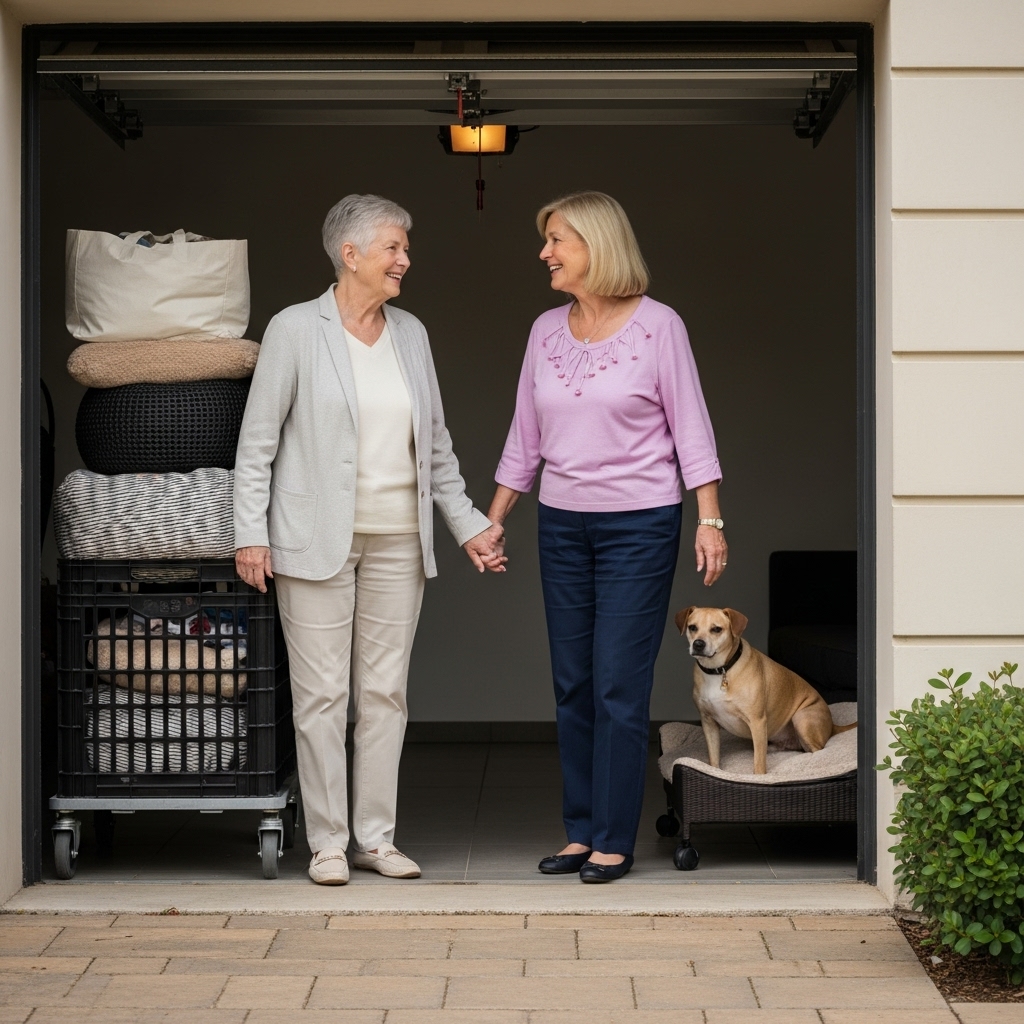
The night after the funeral, my daughter‑in‑law dragged my suitcases across the hardwood floor, shoved open the side door, and tossed my luggage into the garage.
“From now on,” she said, her voice flat and cold, “you’ll be sleeping with the dog.”
I didn’t react. I didn’t argue or plead. I just nodded and smiled.
Because behind my silence, I was holding a far greater secret: the tens of millions of dollars and the Azure Cove villa on the coast of Cancún that Gordon had quietly put in my name.
That night, in the damp chill of the garage, I swore I would rewrite the rules with the calm resolve of a widow who had loved deeply, lost everything, and decided she was done being anyone’s victim.
My name is Cassandra Reed. I’m sixty years old.
I had just buried my husband of forty‑two years, Gordon Reed.
That morning, a light rain fell over Memorial Oaks Cemetery in Houston. Each drop felt as cold as steel on the dark, freshly turned earth. Black umbrellas formed a circle around the flag‑draped coffin while the soft sound of an organ floated from the chapel. The air was thick with the scent of lilies, wet soil, and salt‑stung tears.
I stood at the graveside, gripping my shawl tight against the wind, trying to balance between sorrow and a strange, echoing emptiness. People love to say that after death, love is all that remains. But that day I realized love isn’t the only thing that survives. Ambition does. Hypocrisy does.
Beside me in the front row, my son Nathan sat rigid and silent, his eyes red and swollen. My daughter‑in‑law, Sable, was different. She didn’t cry. Her shoulders never trembled. Her mascara didn’t run. She stared down the line of mourners with the sharp gaze of someone taking inventory.
Her eyes moved from person to person—Gordon’s old business partners, members of the River Oaks country club, a neighbor or two who came out of obligation. It was like she was sorting them into drawers in her mind: useful, not useful, worth calling later, irrelevant.
That wasn’t grief. That was calculation.
As the priest spoke about Gordon’s generosity and devotion to his family, I watched Sable’s jaw tighten. Beneath the thin black veil, her eyes were as cold as stone. A chill ran down my spine—not from the rain, but from the realization that she had been waiting for this moment. Waiting for my husband to be lowered into the ground so she could begin dividing what remained.
When the ceremony ended, people drifted away in pairs and small groups, their umbrellas bobbing like dark petals in the rain. Someone squeezed my hand. Someone pressed a kiss to my cheek. Condolences blurred together.
At last, the crowd thinned. Only a ring of white lilies remained, trembling in the drizzle around the mound of earth that hid Gordon from me.
I leaned over the coffin one last time, laid my palm on the wet wood, and whispered:
“Rest easy, Gordon. I’ll be fine. I promise.”
I had no idea that a few hours later, that promise would become a vow—to reclaim justice for myself.
The black Mercedes rolled slowly through Houston’s familiar streets, its wipers brushing away the steady drizzle. I sat in the back seat, watching downtown’s glass towers fade into low brick buildings and oak‑lined avenues. The whole city looked like it was trapped under a sheet of glass—cold, distant, glossy.
The passenger seat next to Sable was empty. It should have been Gordon’s. He used to drive me to church on Sundays and charity luncheons on River Oaks Boulevard, humming along to old Motown on the radio. Now it was just me in the back, the hollow embrace of leather seats and the meaningless hum of warm air from the vents.
Sable drove, her dark red nails tapping a restless rhythm on the steering wheel. Every so often she checked the rearview mirror, meeting my gaze without a flicker of sympathy. Nathan sat beside her in the front, gripping his phone like it might shield him from what was coming.
No one spoke on the ride home.
When the car turned onto the oak‑lined driveway of our two‑story home in River Oaks—a house where Gordon and I had lived for more than twenty years—my heart clenched. Once, that house overflowed with laughter, the smell of apple pie, jazz floating from Gordon’s old record player every Saturday night.
Now it felt like a battleground.
When the car stopped, I opened the back door and froze.
My three brown leather suitcases—the ones I’d packed to stay at Nathan’s house “for a few days” after the funeral—were already sitting by the garage door in the rain. A thin layer of dust clung to them, as if they’d been set out first thing that morning.
I looked up.
Sable stood on the porch under the shelter of the overhang, arms crossed over her black dress, her veil pushed back. Raindrops glittered on her red heels.
“What’s going on?” I asked, my voice raw after the long day.
She shrugged. A faint smirk tugged at the corner of her mouth.
“Oh, I thought you already understood,” she said lightly. “Now that Gordon’s gone, things have to change.”
Her tone was conversational, almost bored. But every word landed like a blade.
Nathan stood behind her, staring at the floor, hands jammed in his pockets.
“Son,” I said softly. “What does your wife mean by that?”
He avoided my eyes.
“It’s just…temporary, Mom,” he muttered. “We just need to rearrange a few things.”
Before I could ask another question, Sable stepped forward, grabbed the garage handle, and rolled the door up with a clatter. Cold, damp air rushed out.
“You can stay here,” she said, pointing inside. “The room next to the dogs is still empty.”
Then she turned and walked back toward the house, heels clicking sharply against the wet concrete, as if she’d just dropped off a delivery instead of shoving her husband’s mother into the garage.
I stood there for a few seconds in the rain, letting the tremor in my hands subside. Water ran down my face, mixing with tears until I couldn’t tell where the rain ended and my grief began.
Then I bent down, gripped the handles of my suitcases, and dragged them into the corner of the garage—a narrow space where Gordon used to keep his toolbox.
The walls were stained and damp. The air smelled of oil, rust, and concrete dust. A tiny high window looked out toward the wrought‑iron fence behind the house. The floor was bare, cold, unforgiving.
Someone had unfolded an old metal cot and tossed a thin mattress on top. On the small wooden table beside it sat a half‑empty box of dog food.
It was not a place for a mother‑in‑law. It was not a place for anyone.
But I didn’t cry again.
I exhaled slowly and sat on the edge of the cot, feeling the metal frame creak beneath my weight. My fingers brushed the crumbling paint on the wall.
A faint smile tugged at my lips—not because any of this was funny, but because I realized something important.
I had just entered the first stage of a game whose rules only I knew.
That night, I couldn’t sleep.
Rain drummed steadily on the metal roof above the garage, like the ticking of a clock counting down to something I couldn’t yet see. I sat in the dark, my back against the wall, replaying every detail of my life with Gordon.
He had always been a calm, disciplined man. A Houston boy who built an oilfield services company from nothing, who wore starched shirts and shined his own shoes, who balanced risk and caution like an art.
“Cass,” he used to tell me, leaning in close in the quiet moments, “when they think you’re weak, let them. The right kind of silence is your strongest weapon.”
I never thought I’d need that advice.
But sitting there on that narrow cot, listening to the rain and the distant muffled sound of Sable’s heels upstairs, I knew the time had come.
Because no one in that house knew that before Gordon died, he had quietly rearranged everything—accounts, investments, properties, even the Azure Cove villa in Cancún. Every significant asset was in my name.
The total value: nineteen million dollars.
I was the only one who knew the access codes. I was the only one who had the keys.
Sable thought I was just a frail widow living off her son.
I smiled the same smile Gordon once called “the smile of someone who already knows how the story ends.”
When morning came, I was still sitting by the small window, watching the first gray light spread across the driveway. Upstairs, I heard Sable moving around—the clink of dishes, the hiss of the espresso machine, the low murmur of her voice.
She was living in the glow of what she thought was victory.
I was simply waiting for the first card to turn.
I knew exactly what I had to do: stay quiet, watch, remember. And when the time was right, remind them who truly owned this house.
Later that morning, Nathan opened the side door and stepped into the garage. He hesitated just inside the threshold, then cleared his throat.
“I’m sorry, Mom,” he said quietly. “Sable’s just under a lot of stress. Everything will be fine.”
I looked at my son—the same boy who once sobbed into my lap when his first dog died at eight years old—and realized he’d been swallowed by his fear of conflict.
“It’s all right, Nathan,” I said gently. “I know where I belong.”
The words slid out soft as silk, but inside they rang like steel.
He forced a weak smile, nodded, and closed the door behind him. The sound of his car starting drifted through the garage a minute later, then faded down the driveway.
I looked around the cold room, my fingers brushing the locket Gordon had left me. A faint draft seeped under the door, carrying the damp smell of gasoline.
I closed my eyes and whispered to myself.
“All right, Cassandra. Start from here.”
That evening, while Sable and Nathan dined in the spacious formal dining room, I sat downstairs and listened to their laughter through the vents.
I wasn’t jealous. I wasn’t even angry. Not yet.
I sat in the dark and opened a small leather notebook Gordon had given me for our fortieth wedding anniversary. The cover was worn smooth from years of being tucked into my purse, the pages faintly scented with old paper and his cologne.
On the first page I wrote, in careful block letters:
“Day One.
No one remembers who I used to be. They think I’ve lost my worth. But I won’t remind them. I’ll let them find out on their own.”
Then I started writing down every small detail.
“Sable came home at 5:47 p.m. Her coat smelled of expensive perfume. Nathan arrived at 5:52, looking tired, avoiding conflict. Ava and Liam ate dinner at 6:10. Sable talked loudly on the phone with someone and locked the master bedroom door at 7:35.”
The lines looked dry, emotionless—just times and events. But to me each one was a breadcrumb on a path that would eventually lead to the truth.
Later that night, I lay back on the narrow cot listening to the rain. Moist air slid under the door and crept along the floor. I pulled the thin blanket over my shoulders.
The streetlight outside cast my shadow onto the wall: a small, frail woman sitting alone in the dark, invisible, unwanted, forgotten.
I smiled faintly.
I was no longer Cassandra Reed, wife of Gordon Reed, lady of the River Oaks house.
I was the woman pushed down to the lowest floor of the very home I’d helped build.
But from that lowest place, I would watch, learn, and prepare for my return.
The first morning of my new life began earlier than I expected.
At six a.m., the dogs began barking. Their nails scratched against the garage door. Before I could sit up, the door to my little room opened. Sable stood there in a silk robe, holding a cup of coffee.
“You can help me with breakfast,” she said casually, as if giving an order to a hired maid. “I have a meeting at eight.”
She didn’t wait for an answer. Her eyes swept over the cramped space—the cot, the dog food, the stacked boxes—then she turned and walked away.
I changed into an old dress, wrapped a thin scarf around my neck, and climbed the stairs. The chill of the tile seeped through my slippers.
The kitchen looked like something from a magazine spread. Marble counters. Stainless steel appliances. Everything perfectly in place.
On the counter lay everything Sable wanted prepared: eggs, bacon, bread, oranges. A note in her looping handwriting was taped to the refrigerator.
“Eggs Benedict for Nathan.
Kids like pancakes.
I’ll have salad. Light.
The word ‘I’ was underlined twice.
I turned on the stove, hands trembling—not from fear, but from the weight of memory. Gordon used to make breakfast on weekends. He’d stand in this very kitchen in his old Army T‑shirt, brewing strong drip coffee and toasting bread while telling stories from his military days.
Now I was in the same kitchen, but every trace of warmth had been scrubbed away.
When I brought out the food, Nathan came down the stairs.
“Morning, Mom,” he murmured, brushing a quick kiss across my cheek like it hurt to linger.
“Did you sleep well?” I asked.
“Kind of.” He glanced around nervously. “Don’t take it personally. Sable’s just tense.”
“I understand,” I said softly.
The truth was, I understood far more than he thought.
He was trapped between duty and fear. And Sable knew exactly how to make a man feel guilty just for breathing wrong.
When everyone sat down to eat, I stayed by the counter.
Sable looked up from her phone, her tone calm but cold.
“You can clear the dishes when we’re done,” she said. “And don’t forget to feed the dogs.”
No “please.” No “thank you.”
Nathan sipped his coffee, eyes on his phone. Their children, Ava and Liam, stole quick looks at me. Ava’s gaze was timid; Liam’s was curious.
I smiled at them. Ava dropped her eyes. Liam attempted a small smile back.
After they left, the house fell silent.
I stood alone in the kitchen, the only sound the ticking of the wall clock.
I washed dishes, wiped the counters, folded dish towels. Each motion felt like a small ritual of endurance.
By noon, I was hanging laundry in the backyard. The Houston heat had burned off the morning rain, and the air carried the scent of soap and magnolia blossoms. I glanced at the magnolia tree Gordon had planted years ago.
It was taller than the roof now, its white flowers glowing under the midday sun.
I remembered his hand on my back, his deep laugh when he’d said, “This tree will shade you one day, Cass. When you’re old, all you’ll need is to sit beneath it.”
Now I really was old, sitting under that same tree. But the man who promised to sit there with me was gone.
In the afternoon, Ava and Liam came home from school. I had baked cookies for them, just like I used to.
Ava hesitated in the doorway, eyeing the tray.
“Grandma,” she said quietly, “Mom said you don’t have to do that anymore. She said you should rest.”
I smiled.
“I like doing it,” I answered. “Go ahead. They’re still warm.”
The girl glanced toward the hallway, then picked one up and took a small bite. Her face lit up.
Liam rushed in, grabbed two cookies, and slipped them into his pocket.
“Don’t tell your mom,” I whispered with a wink.
They nodded and ran upstairs.
At least there were still two souls in that house who hadn’t been taught that kindness was weakness.
Around six p.m., Sable came home. She walked straight into the living room, heels clicking on the hardwood, and dropped her purse on the glass coffee table. A second later, she was on a video call, her voice shifting from ice to syrup.
“God, I’m exhausted,” she cooed, laughing. “But it helps having a free housemaid around.”
A woman’s laughter echoed from her phone.
I froze mid‑motion, the dish towel slipping from my hand. I wanted to step into the room and remind her that the so‑called free maid had been the woman who’d signed the very first check for the down payment on this house.
Instead, I bent down, picked up the towel, folded it neatly, and kept wiping the same spot on the counter.
She thought I didn’t hear her.
I let her think that.
When night fell, I sat in my small room under the garage, lit only by the weak glow of a yellow lamp. The sound of the TV drifted down from the living room—laughter, clinking silverware, cartoons.
I didn’t feel angry. I just felt empty, like someone had scooped out the inside of my chest and left a quiet, hollow space.
I opened my leather notebook.
On the next page, I wrote:
“Day Two.
No one remembers who I used to be. They think I’ve lost my worth. But I won’t remind them. I’ll let them find out on their own.”
Below that, I noted every detail.
“5:47 p.m.—Sable home, coat smelling of new perfume. 5:52—Nathan home, exhausted, still avoiding conflict. Ava and Liam eat at 6:10. Sable on the phone, laughing loudly. Master bedroom locked at 7:35.”
Late that night, I lay on the cot listening to the rain, the faint buzz of traffic on Kirby Drive, the whistle of the wind through the fence. The streetlight drew my shadow on the wall again.
An old woman in a cramped room.
But now, when I looked at that shadow, I didn’t see someone beaten.
I saw someone waiting.
Each morning after that began the same way.
The coffee machine hummed upstairs. Sable’s heels tapped across the hardwood. The digital clock in the garage glowed 5:30 a.m.
I always woke before the alarm. The room was cold, heavy with the smell of rust and damp concrete. I pulled on an old cardigan, tied back my hair, and went up to the kitchen.
I became the unpaid maid.
Eggs Benedict for Nathan. Pancakes for the kids. A salad with no dressing for Sable. She was terrified of gaining weight, but never skipped her morning whipped‑cream latte from the fancy espresso machine.
I cooked and plated according to the handwritten schedule taped to the fridge. Every task had to be completed down to the minute. If breakfast was five minutes late, Sable would purse her lips and say:
“You really need to manage your time better.”
Nathan usually came downstairs at ten to seven, tie already knotted, cologne still fresh.
“Morning, Mom,” he’d say without looking up from his phone.
“Soft‑boiled or hard today?” I’d ask.
“As usual. Thanks, Mom.”
His “thanks” always landed in the space between us like a coin tossed in a well.
Sable appeared last, always with the air of someone in high demand.
“Press my navy dress, please,” she’d say, already scrolling her emails. “I have a presentation at the club.”
She didn’t look at me. She just poured her coffee and sat with her fashion magazine.
“And clean my nude heels. There’s a stain on the heel.”
No “please.” No smile.
Nathan rarely stayed home after breakfast. He’d leave his plate on the table, grab his keys, and murmur, “I’ve got to get to the office.”
The front door would close. His car engine would fade down the drive.
The house would fall quiet.
I’d hear Sable pacing across the floorboards, always in heels, always tapping. She was often on the phone, her voice a low, aggressive whisper.
One morning, as I wiped down the hallway console table, I heard her clearly.
“I looked into a nursing home in Dallas,” she said. “The cost is way cheaper than keeping her here. No, Nathan doesn’t need to know yet. Men are easy to convince. Just say ‘financial benefit’ and they’ll agree.”
I stood there in the shadow of the staircase, still holding a damp rag. Each word dripped into my ear like acid—slow, burning.
“Cheaper.”
To Sable, that’s what I had become. Not Nathan’s mother. Not the woman who had spent forty‑two years beside Gordon.
An expense she wanted to cut.
At noon that day, I ate a slice of cold bread alone in my room. The air conditioner upstairs rattled faintly.
I opened my notebook.
“Day Seven.
Sable researching nursing homes in Dallas. I am an expense. Not angry—just clear.”
I added, “Do not react. Do not argue. Observe.”
That afternoon, I went upstairs to iron clothes.
Sable’s dressing room smelled like Chanel and new fabric. Her closet doors stood wide open, revealing rows of dresses organized by color, shoes lined up in sharp little armies, handbags displayed like trophies.
I ironed each dress carefully, my hands steady.
On the vanity, a credit card statement lay half open. I hadn’t meant to look, but the bold print drew my eye.
“Spa Serenity – $1,200.
Yoga Retreat, Aspen – $3,450.
Hermès, River Oaks District – $9,800.”
I frowned. Nathan had told me just last week that his company was tightening the budget.
Yet here was Sable, signing for nearly five figures’ worth of handbags.
I didn’t touch anything. I simply took note.
That afternoon, when Ava and Liam came home, I was folding laundry on the living room sofa.
Ava approached, clutching her sketchbook.
“Grandma,” she asked, “why don’t you go back to your own house? Mom doesn’t seem happy with you here.”
I smiled, smoothing a T‑shirt.
“I’m saving money, sweetheart,” I said. “It’s easier to take care of you two this way.”
Ava frowned.
“But Grandma, you don’t need to save. Dad said you have savings.”
I smiled a little wider.
“Did he?” I asked. “Well, sometimes adults save things not to spend them, but to wait for the right time.”
She didn’t understand completely, but she nodded and stayed quiet.
Liam ran up, waving a crumpled worksheet.
“Look, Grandma! I got an A in history!”
I hugged him, feeling something warm stir in my chest.
In this cold house, those two children were the only warmth left.
That evening, Nathan came home late. His tie was loose. Sweat dampened the collar of his shirt.
“Have you eaten?” I asked.
“Not yet, but don’t worry. Sable’s ordering takeout,” he said.
I just nodded.
As he climbed the stairs, I heard Sable’s voice floating from the living room.
“I told you, the cost of keeping your mom here is higher than I expected. If we move her to a nursing home, we can sell the Galveston house. Doesn’t that make more sense?”
Nathan didn’t answer right away. When he finally spoke, his voice sounded exhausted.
“Sable, Mom’s still healthy. It’s not that bad yet.”
“You’re always so soft,” she snapped. “By the time you realize it, the money will already be gone.”
I stood in the shadow of the staircase, listening. I didn’t interrupt.
I’d learned that silence, used wisely, was worth more than a thousand arguments.
After dinner, once the house went quiet, I cleaned the kitchen. The marble counters gleamed. The only sound was the tick of the clock and the faint hum of the refrigerator.
I dried each glass and lined them up in the cabinet, then opened my notebook again.
“Day Eight.
Spa and yoga bills don’t match the story. Nathan seems unaware. Sable mentioned selling the Galveston house.”
On the next line, I wrote three words in all caps:
“START TRACKING EVERYTHING.”
I wasn’t great with technology, but Gordon had taught me how to use online banking and manage investment records. His old office upstairs still held the desktop computer and the leather‑bound ledgers where he’d written down numbers by hand.
I knew the password.
Every night, once the house had gone still and the upstairs lights were off, I crept into Gordon’s office. The pale blue glow of the computer screen lit my face like a ghost.
I checked the joint bank account Nathan and Sable shared—the one Gordon had originally set up to support their tech startup.
It took a few searches, but a pattern emerged.
Every month, there were regular transfers—sometimes a few thousand dollars, sometimes more than ten thousand—wired to a company I’d never heard of.
“Serene Holdings LLC.”
I looked it up. No office. No employees. Just a P.O. box in Dallas.
I sat there for a long time, the hum of the computer fan filling the room. The air smelled like cold coffee and dust.
Then I turned off the monitor, closed the door, and went back down to the garage.
Before sleeping, I wrote:
“Numbers don’t add up. Money is disappearing. Need to confirm. Say nothing to Nathan.”
I set the pen down and glanced around the small room. The streetlight outside cut a sharp beam across the rusty wall.
I lay down and listened to the insects singing outside and the wind brushing against the roof.
I knew they wanted me gone from this house.
But what they didn’t understand was this: when a woman has lost everything, her dignity is the last thing she’ll fight for.
And I, Cassandra Reed, had just begun my battle—not with screams, but with a pen and deadly silence.
I waited until Sable and Nathan left the house before picking up the phone.
The air in the kitchen that morning felt heavy, as if someone had sealed every door and forgotten to leave an exit. On the table, a cup of coffee had gone cold, a thin film floating on top.
I looked out the window at the magnolia Gordon had planted. The blossoms glowed in the early May sun.
Then I dialed.
The man’s voice on the other end made my hands tremble just slightly.
“Morton Law Office, this is Caleb speaking.”
“Caleb, it’s me. Cassandra Reed.”
There was a pause. Then his voice softened.
“Mrs. Reed,” he said, “I’ve been expecting your call. When can you come in? There are a few things you need to see right away.”
I checked the clock—8:40 a.m. Sable had already left for a “meeting.” Nathan would be at the office by now.
“I’ll be there in an hour,” I said.
I hung up, changed into a simple cream‑colored dress, pinned my hair neatly, and picked up my small handbag. Before leaving, I opened the bottom drawer of the dresser in the garage and took out my leather notebook, a pen, and the small brass key Gordon had used for his private safe.
Holding them felt like holding the last piece of myself.
The drive to Morton & Associates wasn’t long. Morning traffic crawled along Westheimer, the sky slowly brightening. Sunlight flickered off glass buildings, flashing across my hands on the steering wheel.
Once, I’d been the woman sitting in the passenger seat while Gordon drove downtown, talking about markets and mergers. Now I was driving alone into the same skyline.
Caleb’s office was in an old red‑brick building in Midtown, tucked between a coffee shop and a florist. A brass nameplate on the door read: “Morton & Associates, Attorneys at Law.”
He greeted me at the door himself—tall, early fifties, gray suit, blue tie. His hair had gone more silver since I’d last seen him, but his calm presence was the same.
“Cassandra,” he said, shaking my hand gently. “It’s good to see you. And my condolences, again.”
“Thank you, Caleb,” I answered. “But I didn’t come today to grieve.”
He nodded and led me into the conference room.
The room was bright, with a long mahogany table, leather chairs, framed Houston skyline photos on the walls. A faint scent of Earl Grey tea and fresh paper hung in the air.
On the table sat a thick blue file labeled in bold black letters: “Assets and Trust of Gordon Reed.”
Caleb opened the file. His voice was slow and precise, the way a man sounds when he’s read the same will a hundred times.
“Gordon set up a fideicomiso,” he explained, “a form of trust under Mexican law. It secures ownership for the beneficiary. That includes the Highland Park estate home, the Azure Cove villa in Cancún, and all associated accounts.”
He slid a stack of documents toward me.
“All stocks, bonds, and investment accounts are in your name,” he said. “Not co‑owned. Entirely yours.”
I sat very still. My ears buzzed.
He handed over another stack of papers bearing a familiar signature at the bottom—Gordon’s slanted, firm hand.
I read slowly, line by line, until I reached a handwritten note at the end.
“Make sure Cass never has to depend on anyone. Never.”
My throat closed. A sob slipped out before I could stop it.
Caleb wordlessly passed me a tissue.
“He prepared these more than a year ago,” Caleb said quietly. “After a heart‑related hospital stay. He told me, ‘I’m not afraid of dying. I’m afraid Cass might have to ask someone’s permission to live in her own home.’”
I couldn’t speak. Pain and warmth spread through me at once, like someone had placed a hot brick in my chest.
Caleb flipped to the last page.
“Even with recent market shifts,” he said, “the estimated total is nineteen million. That includes the Highland Park property, Azure Cove, the energy stock portfolio, government bonds, and retirement accounts—all under your name.”
I swallowed.
“And Nathan?”
“He has a portion, but at a support level,” Caleb explained. “Gordon said, and I quote, ‘If Nathan has a good head on his shoulders, he’ll build his own wealth. If not, giving him too much will only spoil him.’”
I laughed through my tears.
“That’s exactly Gordon,” I said.
Caleb folded his hands.
“I know you’re under pressure,” he said. “My advice: don’t let anyone know about this. Especially not Sable. Keep everything as usual. When the time is right, I’ll guide you through formalizing it all.”
I nodded.
“I understand. Thank you, Caleb. Truly.”
He gave a small smile.
“Gordon told me you were the only person he trusted to use money the right way,” he said. “I believe he was right.”
Outside the building, I stood on the stoop for a long moment. Traffic hissed by. Sunlight slanted across the street, making the world almost too bright.
I wiped my cheeks and took a deep breath.
People say money can’t buy happiness. Maybe that’s true. But it can buy the freedom to choose how you’ll be treated.
On the way home, I stopped at a corner café—a narrow little place off Montrose with mismatched chairs and chalkboard menus. I ordered a cappuccino, the drink Gordon always ordered for me on Sunday mornings after church.
While I waited, I opened my phone, created a new email account with a password long enough to make a hacker cry, and set up automatic backups for the files Caleb had emailed.
Each step felt like laying a brick in a wall.
When I got home, Sable was already there. She sat on the sofa in leggings and a cropped sweatshirt, phone pressed to her ear. Her voice was syrupy sweet.
“Yes, I can move the money by the weekend,” she said. “Just make sure everything’s finalized before next month, okay?”
I walked through the living room quietly, my face neutral.
She glanced up and forced a smile.
“Oh, you’re back,” she said. “I was just about to ask for a small favor.”
That evening, I made a simple dinner—roast chicken, green beans, mashed potatoes. Nathan looked worn down, a crease dug into his forehead. Sable, on the other hand, was buzzing with energy.
“My partner and I are looking at a new project in Dallas,” she said, eyes shining. “If it goes smoothly, with just fifty grand down, the return could double in six months.”
I sliced meat, arranging it neatly on a plate.
“Sounds promising,” I said calmly. “Have you checked the legal side of the project?”
She paused, then laughed too quickly.
“Of course I have,” she said. “I’m not stupid.”
Nathan murmured something noncommittal, clearly clueless about the details.
I listened, adding more vegetables to Ava’s plate while my mind calculated.
If Sable moved money that wasn’t hers, I could trace it. But not tonight.
Tonight, I needed silence more than confrontation.
After everyone had gone to bed, I crept back to the garage, opened my laptop, and saved all of Caleb’s documents to an encrypted drive. I printed hard copies and sealed them in a manila envelope marked only with a small blue dot—a signal Gordon and I used for important documents.
I changed my bank passwords. Turned on two‑factor authentication. Created a hidden account where digital copies of everything could land safely.
Each keystroke felt steady, measured. Not fear, but clarity.
Upstairs, Sable’s laugh echoed through the vents, high and hollow. Nathan’s deeper murmur followed, quieter.
I closed my laptop and smiled to myself.
She thought she was living in victory, that I was just a forgetful old woman waiting to be shipped off.
She didn’t know the game had already begun.
And the first move was mine.
I closed my notebook, slid it under my pillow, and turned off the lamp.
Rain drummed on the garage roof like a drumbeat. In the darkness I heard Gordon’s voice in my mind:
“Never hand your fate to someone who can’t keep their word.”
This time, I listened.
I’ve always believed that the best liars slip up in the smallest details—like the perfume they wear to an afternoon “yoga class.”
One Saturday morning, Sable came downstairs in tight black leggings and an oversized hoodie. But she carried a white leather handbag, wore full TV‑ready makeup—dark red lips, shimmering silver eyelids—and a perfume so strong it drowned out the smell of coffee.
“I’ve got yoga downtown, I might be home late,” she told Nathan, brushing a kiss against his cheek.
He didn’t even look suspicious.
“Have lunch with your client, okay?” she added sweetly. “I’ll see you tonight.”
The garage door shut. Her BMW engine faded down the street.
I checked the clock: 9:52 a.m.
Yoga.
In the trunk of her car, I knew, there was a pair of beige high heels no one in their right mind would wear to a yoga class.
I dried my hands, grabbed my purse, and slipped Gordon’s old phone into it—a clunky model I’d updated with a new SIM card and a discreet recording app.
Late morning heat pressed down on the city. The air shimmered above the asphalt.
I called a cab and told the driver, “Follow that pearl‑white BMW.”
He glanced at me in the rearview mirror, eyebrows raised.
“People only follow someone when they already know what they’re going to find,” he said lightly. “You know that, right?”
“I do,” I replied. “And I’m ready.”
We followed Sable’s car into downtown, past the glass canyons and hotels along the bayou. Eventually, she turned into the valet lane of the Argonaut Hotel, an upscale place where people closed deals—or started affairs.
“Wait for me, please,” I told the driver.
He nodded.
I stepped out into the hot wind. The air smelled of exhaust, asphalt, and the faint sweetness of the hotel’s white orchids.
I stood at a distance from the entrance, sunglasses on, and watched.
Within five minutes, Sable’s BMW pulled up. She stepped out wearing those beige heels and a fitted aqua silk dress that hugged every curve. Her hair was softly curled, her lipstick freshly applied.
She walked straight into the lobby without looking around.
I followed at a safe distance.
The Argonaut’s lobby was dim and polished—dark wood, low lighting, clusters of velvet chairs. In the corner near the bar sat a man I recognized from an online search later that week: Derek Cole, real‑estate broker.
Young. Tall. Slicked‑back hair. The polished grin of someone who believed every room belonged to him.
Sable slid into the seat across from him.
They touched hands across the table. He pushed a thick brown envelope toward her. She laughed.
I paused near a potted palm, pulled out Gordon’s phone, and tapped the screen to start recording.
I couldn’t hear every word over the hum of the lobby, but their faces said enough. Whatever they were planning had nothing to do with yoga or wellness.
Toward the end of their meeting, Derek leaned in and kissed her wrist. Sable’s head tilted back, her laugh soft and intimate.
I had seen enough.
When she stood to leave, I walked back toward the exit and slipped outside, blending into the sidewalk crowd.
On the ride home, I watched the recording in the backseat. The camera had caught everything—the envelope, the lingering touch, the way she checked her phone and smiled when Derek said something I couldn’t hear.
I saved the video twice: once on the phone, once to my hidden cloud account.
By late afternoon, the sky had turned a heavy gray again. Houston was good at that—swinging from bright to brooding in an hour.
Nathan arrived home earlier than usual, shirt sleeves rolled up, collar damp.
Sable was already there in leggings and a tank top, a towel looped around her neck. She stood in front of the mirror, pretending to stretch.
“You know, yoga was packed today,” she told him. “But I feel so much lighter. I should go more often.”
Nathan smiled, believing her without question.
“I’m glad you could unwind,” he said.
I walked by carrying a tray of glasses.
As I set it down on the counter, I looked at Sable and said mildly:
“With perfume that strong today, I think you really do need a detox.”
She froze for a fraction of a second. Then she laughed too brightly.
“You’re always so direct, Cassandra,” she said.
That small line—a tiny blade—was enough to make her slip.
That night, the house was unusually quiet.
Around eleven, I heard Sable’s heels clicking down the hall. They stopped in the living room. I peered through the crack under my door and saw a thin slice of light.
She was on her laptop.
I waited ten minutes after she went back upstairs. Then I stepped into the hallway as quietly as a shadow.
Her laptop sat open on the coffee table, the blue light washing over the leather sofa. No password prompt.
I sat down, heart pounding but hands steady.
The screen showed an inbox open mid‑session. The top subject line read:
“Divorce paperwork nearly finished. Just waiting on the estate confirmation.”
My heart didn’t shatter the way I thought it would.
It simply went cold.
Below, the sender’s name: “David Carrera—Personal Attorney.”
I clicked the email and read.
“Once the asset transfer is complete, you can proceed with the divorce without legal obstacles. As agreed, the portion in your husband’s name can be moved through the shell company established in Dallas. Make sure the mother‑in‑law doesn’t interfere. – D.”
I felt my heartbeat slow.
She didn’t just want to humiliate me.
She was plotting to steal Nathan’s entire life.
I took out my phone, set it to silent, and photographed every screen, every line, every attachment. Then I pulled a small USB drive from my pocket—the kind Gordon had once used for contracts—and plugged it into the side of the laptop.
I copied the entire email folder.
Time crawled. Each mouse click sounded like a hammer stroke in the silent room.
When the progress bar finally reached 100%, I ejected the drive, cleared the recent file list, and closed the email window. Then I shut the laptop carefully, leaving it exactly as I’d found it.
I stood for a moment and listened.
Upstairs, Sable’s laugh floated faintly from the master bedroom—thin and hollow. Nathan didn’t say much.
I went back down to my room, opened my own laptop, and created a new folder named “Lotus”—the flower Gordon used to mention in his letters.
“Cass,” he’d once written, “you’re a lotus rising from mud but never stained by it.”
I saved all the data there, then sent a compressed copy to my secret email account. Another copy went straight to Caleb’s inbox with no body text—just a subject line.
“Keep this for me in case it’s needed.”
Then I leaned back in my chair.
Rain hammered the garage roof. Thunder rumbled faintly over the city.
I smiled.
Sable thought she was the hunter.
But every hunter is being watched by something they don’t see.
From that night on, I slept without fear.
Not because I felt safe, but because I finally had the truth.
The next morning, I heard a sound I hadn’t heard since Gordon died—the creak of his office door opening upstairs.
The soft scrape of wood on wood made my stomach flip.
Nathan rarely went into that room. Since the funeral, the door had stayed shut, gathering dust like a sealed memory.
I was making coffee when I heard his voice call down.
“Mom. Mom, can you come up here a second?”
I wiped my hands and climbed the stairs, my heart racing.
The office door stood wide open. Morning light flooded through the big window, stretching across the oak desk.
Nathan stood behind the desk, a stack of yellowed documents in his hand. His face was pale.
“Mom,” he whispered, holding out the papers, “this house is yours.”
I stepped closer.
I recognized Gordon’s handwriting on the cover page: his original will.
“Yes,” I said quietly. “Your father wanted to protect me. He was afraid I’d be hurt if everything fell into the wrong hands.”
Nathan’s grip tightened on the papers.
Before either of us could say more, Sable appeared in the doorway. Her lipstick was fresh; her hair still a little messy from sleep. But her eyes were sharp.
“What is that?” she demanded. “What are you holding, Nathan?”
He instinctively tried to hide the file behind him. But it was too late.
“It’s…it’s Dad’s will,” he said.
Sable strode into the room and snatched the document from his hands. Her eyes flew across the lines.
After a few seconds, she let out a sharp, disbelieving laugh.
“No,” she snapped. “No way. You—” she pointed at me, her hand shaking “—you hid this. You pretended to be poor to manipulate us.”
I straightened, set my coffee cup down on the desk, and met her gaze.
“Manipulate?” I asked softly. “No, Sable. I stayed silent to see what you’d do when you thought you had power.”
She laughed again, high and brittle.
“Oh, that’s rich,” she sneered. “You expect us to believe you were just ‘observing’ while you let me cook and clean and take care of you like a maid?”
I raised an eyebrow and said nothing.
Nathan stepped between us, his voice shaking.
“Sable, that’s enough.”
“Enough?” she repeated, rounding on him. “How naïve are you, Nathan? She played the victim to make you feel guilty, and now she claims this house is hers. Can’t you see she’s laughing at us?”
I calmly opened my purse and took out an envelope.
Inside were printed stills from the Argonaut Hotel video—Sable laughing with Derek Cole, the envelope between them. Behind those were printed copies of the emails from her attorney.
I laid them on the desk beside the will.
“Maybe,” I said evenly, “you should read these before you tell another lie.”
Silence fell over the room.
Only the ticking clock on the wall and the hiss of the air vent broke it.
Sable’s hands shook as she picked up the photos. Her eyes widened.
“You—you followed me?” she whispered.
“No,” I said. “I went to your yoga class. Turns out that’s where people sign divorce paperwork and divide assets.”
Nathan’s face turned white.
He picked up the printed emails and read the highlighted lines. His eyes moved quickly, then slowed.
“Divorce paperwork nearly finished,” he read aloud. “Waiting on the estate confirmation.”
He looked up at his wife.
“What does that mean, Sable?”
She swallowed hard.
“You don’t understand,” she said. “It’s just a financial plan—”
“It’s betrayal,” I cut in, my voice level. “Betrayal of the husband who trusted you and the mother you treated as a burden.”
Sable took a step back, cheeks flushed.
“You have no right to say that,” she hissed. “You deceived us. You pretended to be broke just to test us. What are you trying to prove?”
“I’m not trying to prove anything,” I replied. “I simply let you show who you really are.”
Nathan sank into the chair in front of the desk, his shoulders slumping.
“I’ve been so stupid,” he whispered.
“No,” I said gently. “You’ve just been silent too long. And silence, Nathan, can be crueler than action.”
He lifted his head, eyes wet.
“Mom, I’m sorry,” he said.
I shook my head.
“Don’t say it,” I murmured. “Just look at how you stayed silent and understand why they felt free to treat your mother like this.”
The room went quiet again.
Sable’s breathing was the only harsh sound.
“You tricked us,” she said finally, her voice rising. “You’re no better than a liar.”
I gave her a small, tired smile.
“No, Sable,” I said. “I didn’t trick anyone. I was patient. I let time reveal the truth.”
I sat down in Gordon’s old leather chair, my hand resting on the scar his fountain pen had left on the desk years ago.
For years, I’d sat beside him here, planning budgets, vacations, Christmas gifts. Today, I sat alone.
But I wasn’t helpless anymore.
Nathan stared at the floor. Sable stood near the wall, chest heaving.
I opened the drawer and took out a small brass key—the key to the safe.
“Inside are the documents for every asset,” I said. “Every account. The villa in Cancún. And this—” I tapped the pile of emails and photos “—is evidence of everything you’ve done. If I choose, one phone call will send it all to my attorney.”
Sable stiffened.
“You think you’ve won?” she spat.
I stood and smoothed my blouse.
“No, Sable,” I said. “I haven’t ‘won.’ I’ve simply taken back what never should have been taken from me.”
Nathan rose slowly and walked out of the room without another word.
The house was quiet.
It was just me and Sable now.
She leaned back against the wall, staring at me.
“I used to think you were weak,” she said hoarsely. “Turns out you were just waiting for the right moment to twist the knife.”
“I didn’t stab anyone,” I replied calmly. “I just stopped letting people step on me.”
She swallowed, turned on her heel, and stormed out. The door slammed behind her, rattling the glass.
I sat alone in the office and looked around.
Everything was as it had been when Gordon was alive—same desk, same books, same photo of us at Galveston on the shelf.
The only difference was me.
I put the papers away, locked the safe, and closed the file on the desk.
When I stepped into the hallway, the air felt different, lighter. As if the house itself had exhaled.
The next day at noon, Houston’s sky hung low and gray again.
I sat in the living room, sorting the documents Caleb had given me—trust forms, property titles, investment summaries.
Upstairs, a door slammed. Heavy steps pounded down the hall.
Nathan came down the stairs, pale but determined.
“Mom,” he said, voice shaking but firm, “I can’t take this anymore.”
I looked up and didn’t say a word.
He swallowed hard and turned toward the staircase.
“Sable!” he shouted. “Come down here!”
His voice rolled through the house like thunder.
A door flew open. High heels hammered down the stairs.
Sable appeared in a bright red dress, lipstick blazing, eyes flashing.
“What are you yelling about?” she snapped.
“Get out of this house,” Nathan said.
She stared at him.
“What?”
“I said, get out of this house,” he repeated, each word steady.
She laughed, a sound full of contempt.
“Get out of this house?” she mocked. “What on earth are you talking about? This house was never hers. Look around, Nathan. Everything here is because of me and you. You just go to work and sit behind your little desk. Without me, this place would look worse than that garage your mother lives in.”
Nathan’s jaw clenched. His knuckles turned white.
I stood up and moved between them.
“Sable,” I said quietly. “You should stop.”
She glared at me.
“You again? That’s enough, Cassandra,” she snarled. “You think a few dusty papers mean you can throw me out?”
“I don’t have to throw anyone out,” I replied. “You’re the one walking yourself out.”
Out of the corner of my eye, I saw Ava and Liam at the foot of the stairs, clutching the railing. Their eyes were wide.
I turned toward them and softened my voice.
“It’s okay, you two,” I said. “Grown‑ups will handle this.”
Ava nodded and tugged Liam back up the stairs, though her small hand was shaking.
Sable stood there, breathing hard.
Then she pulled out her phone, holding it up like a weapon.
“I’ll call my lawyer,” she said. “I’ll prove you forged those documents, Cassandra. You’ll regret this.”
I looked at her for a long moment.
“Maybe,” I said. “But I don’t live on threats, Sable. I live on the truth. And the truth can’t be twisted forever.”
She turned to Nathan.
“You’ll regret siding with her,” she warned.
He didn’t look at her.
“I already regret not protecting my mother sooner,” he said quietly.
The words hit the air like a bell.
For a moment, the whole house went still.
Sable’s face crumpled, then hardened.
“You’ll both pay for this,” she hissed. “I’m not going anywhere. This is my house.”
I pulled my phone from my pocket and dialed Caleb.
“Activate the asset protection,” I told him when he answered. “And change every lock today. If necessary, have someone here to escort Ms. Hart out.”
I hung up and looked at Sable.
“You have fifteen minutes to pack,” I said evenly. “After that, the locks change.”
She stared at me like I’d slapped her.
“You think you’ve won, Cassandra?” she said, voice cracking. “You’ll be alone. You’ve lived your whole life in your husband’s shadow.”
I shook my head.
“No, Sable,” I said. “I’ve learned how to live without anyone’s pity.”
She let out a sharp, wordless sound and stormed upstairs. A few minutes later she dragged a suitcase down, its wheels banging against each step.
Nathan stood aside, saying nothing.
She paused in front of him.
“You’ll miss me,” she said coldly. “But by then it’ll be too late.”
No one replied.
The front door opened and slammed shut. Her car engine roared, then rolled away down the drive.
I watched the white BMW disappear under the gray sky and felt something uncoil inside me.
The house fell quiet.
Not the suffocating quiet that had followed Gordon’s death, but a different kind of stillness—one that felt like relief.
Nathan leaned against the wall, his shoulders sagging.
“I’m sorry, Mom,” he said softly.
I walked over and placed a hand on his shoulder.
“No need to say anything,” I told him. “Just start over. Every wound can heal, Nathan, if you let it.”
He nodded, blinking back tears, then sank onto the sofa, head in his hands.
A stifled sob escaped him.
I went to the linen closet and took out Gordon’s old navy wool blanket—the one he used on fishing trips.
I draped it over Nathan’s shoulders as gently as if I were laying down forgiveness.
“Your father used to say,” I whispered, “‘A strong man isn’t one who never falls. It’s the one who stands back up and isn’t ashamed to cry.’”
Nathan looked up at me, eyes shining.
“Thank you, Mom,” he said.
That night, after everyone had gone to bed, I walked up the hallway to the master bedroom—the room at the end of the hall where I’d slept beside Gordon for forty years.
I opened the door and turned on the light.
The room still smelled faintly of oak and lavender. The cream silk drapes hung the way I’d left them. Our wedding photo sat on the nightstand in a silver frame. Gordon’s armchair waited in the corner by the window.
I moved slowly around the room, touching every object as if I were picking up pieces of myself I’d been forced to leave behind.
This room had once meant peace.
Then it had become off‑limits.
Now I was back.
I changed the lock, checked every latch, then opened the window.
Outside, the rain had finally stopped. Pale moonlight fell over the magnolia tree in the yard. Its leaves shivered in the breeze.
Cool night air drifted in, carrying the damp scent of earth.
I drew a deep breath and tasted a simple freedom I hadn’t felt in a long, long time.
That night, I lay in the old bed listening to the steady tick of the clock on the dresser. Downstairs, the house breathed—wood settling, air vents humming, the distant sound of a car on Shepherd Drive.
For the first time in months, there were no footsteps pacing like a metronome, no sharp laughter, no muttered complaints.
Just stillness.
In my mind, I saw Gordon sitting at the edge of the bed, smiling at me like he always used to when he thought I was worrying too much.
“You did well, Cass,” he said in my memory. “You stood up at the right time.”
A single tear slid down my cheek.
For the first time in months, the Reed house was truly quiet.
I whispered to the dark:
“Welcome back, Cassandra. This is your home.”
And that night, I slept soundly.
Truly soundly.
Three days after the confrontation, my phone rang.
It was Caleb.
“Cassandra, everything’s ready,” he said. “I’ve filed for protective orders and a restraining order with the county court. Sable and Derek Cole won’t be able to come near you or any member of your family for two years. If they violate it, the police will handle it.”
I sat on the front porch, looking out at the magnolia tree. Its leaves gleamed in the late‑morning sun.
“Thank you, Caleb,” I said. “I don’t want to see them ever again.”
He chuckled softly.
“You won’t have to,” he said. “The law can be slow, but when it finally moves, it’s powerful.”
That afternoon, Nathan drove downtown to sign the final divorce paperwork.
When he came home, he sat at the dining table, shoulders heavy but eyes clearer than before.
“It’s done, Mom,” he said hoarsely. “I gave them everything—emails, the video, the recordings. The attorney says this will move fast. Sable doesn’t have much room to fight.”
I nodded.
He stared at his hands for a long moment, then said quietly:
“You know, the hardest part isn’t the divorce. It’s realizing I let you go through that alone for so long.”
I looked at my son—a thirty‑eight‑year‑old man with gray creeping into his hair, guilt carved into his face.
I laid my hand over his.
“You faced it,” I said. “That’s the first step to healing. Don’t keep punishing yourself. Everyone has to learn to say ‘I’m sorry’ and then live it.”
He nodded, tears in his eyes.
The next week, the Houston Chronicle ran a headline.
“Real Estate Broker Derek Cole Investigated for Financial Fraud and Extortion.”
There was a photo of him leaving the courthouse, head down, face drawn. Another paper ran a smaller line under the fold.
“Source reveals whistleblower is widow of late businessman Gordon Reed.”
I folded the paper and set it aside. I didn’t feel triumphant—just relieved.
I hadn’t done any of this for a headline.
I’d done it so the truth had a place to stand.
Caleb called that afternoon.
“The investigation is widening,” he told me. “The Dallas casino confirmed Derek owes two hundred thousand dollars and once impersonated a partner. Police are reviewing additional fraud charges.”
“Good,” I said simply. “No joy in watching someone fall. But there is a quiet relief when the truth is put back where it belongs.”
In the weeks that followed, the Reed house found a rhythm again—one it hadn’t had since Gordon was alive.
Every sound felt gentler. The clink of plates at dinner. The murmur of Nathan talking to Ava about her homework. Liam’s laughter echoing down the hall.
Ava and Liam still went to school as usual, but there was something different in their eyes when they looked at me. The hesitation was gone. In its place was warmth.
One afternoon, Ava came to me in the kitchen.
“Grandma,” she asked, “why do you and Dad talk so much now?”
“Because sometimes grown‑ups have to relearn how to talk like kids,” I said, smiling. “Honestly. Without hiding.”
She nodded.
“I like it when you tell the truth,” she whispered. “My mom…my old mom…she said things that weren’t true.”
I hugged her.
I knew the scars inside her wouldn’t vanish overnight.
But I also knew I could help her learn the difference between love and exploitation—a lesson that had taken me nearly a lifetime.
A few weeks later, Caleb and I sat in his office again.
On the table in front of us lay a new file, this one thick and cream‑colored.
“Reed Foundation Scholarship and Educational Trust,” the cover read.
Caleb slid it toward me.
“Everything’s in order,” he said. “This will fund scholarships for Ava and Liam, and for other children if you choose.”
I picked up Gordon’s old fountain pen, its gold nib slightly worn, and signed beneath the word “Founder.”
As the ink soaked into the paper, I felt something settle inside me.
“He would be proud, wouldn’t he?” I asked.
Caleb smiled.
“I believe so,” he said. “He used to say, ‘Cass doesn’t just preserve assets. She plants value.’”
I left the office feeling lighter than I had in years.
I knew I’d done the right thing—not just to set things right, but to build something new out of the ashes.
Nathan started therapy on his doctor’s advice. At first he went reluctantly, but slowly I watched him change. He spoke more carefully. Listened more closely. Learned how to apologize without drowning in shame.
One evening, he knocked on my bedroom door.
“Mom,” he said when I opened it, “I just wanted to say thank you…for not giving up on me.”
I smiled.
“I had no reason to give up,” I replied. “Just remember—forgiving isn’t forgetting. It’s stopping the past from running your life.”
He nodded and smiled, softer now, more like the boy he used to be.
I also hired a housekeeper—Estelle, a Dominican woman in her fifties with kind eyes and a quiet manner.
“Do you want me to clean the downstairs room too?” she asked one day, gesturing toward the garage.
“No,” I said. “Leave it as it is. I want it empty. A reminder that I was pushed down there. And that I walked back up.”
Estelle nodded and didn’t ask any more questions.
The house began to bloom again.
Every morning, the smell of fresh bread or cinnamon rolls drifted from the kitchen. Ava and Liam’s laughter filled the hallways. I no longer felt like the maid in my own home.
I was its true mistress.
But more than that, I was a woman who had reclaimed her dignity.
One night, I sat alone in Gordon’s study.
On the desk sat a small wooden box he’d left me. Inside, among a few cufflinks and an old watch, was a yellowed letter in his handwriting.
“You’ll be free,” it read, “if you wait until you’re truly clear‑headed. Don’t strike back in anger, Cass. Only when you see everything clearly will you truly win.”
I read the lines over and over.
Outside, wind rustled the magnolia leaves.
“I waited, Gordon,” I whispered. “And I did it.”
Then I smiled.
The smile of someone who had survived a storm and stepped out the other side.
Three months after things settled down, I packed my bags.
No fuss. No dramatic goodbye.
“Nathan,” I told my son, “I need a few months to set things straight—in my head and in my heart.”
He nodded, pulling me into a long hug.
“Go, Mom,” he said. “Call me when you feel at peace.”
The flight from Houston to Cancún took less than three hours.
But to me it felt like traveling across a lifetime.
From the plane window, the Gulf unfurled below, an endless sheet of blue. Gordon used to say, “If there’s one place on earth where time stops for me, it’s Azure Cove.”
Now I was going there alone.
The taxi from the airport wound along a coastal road lined with palm trees and bright bougainvillea. The sea stretched out to my right, shimmering turquoise under a sky so blue it hurt to look at.
Azure Cove Villa sat above a quiet curve of beach—white walls, red tile roof, wide windows facing the ocean. Gordon had bought it for our fortieth anniversary, insisting it was “an investment in peace.”
When I stepped inside, the scent of salt and old wood wrapped around me. Sea light poured through the windows, painting ripples on the tiled floor.
I threw open the balcony doors. Warm wind rushed in, billowing the white curtains.
On the wall hung a hand‑painted canvas by a local artist—a couple standing at the water’s edge, their faces turned toward the horizon. Beside it sat an oak rocking chair Gordon had picked out from a little shop in town.
Our wedding photo stood on a console table, the glass catching the sun.
I stood there for a long time and whispered:
“I’m home, Gordon.”
On my first afternoon in Cancún, I walked down to the beach.
The sand was soft as flour beneath my feet. The water lapped at my ankles, cool and clear. I slipped off my sandals and let the sea rinse away the dust of hard years.
People say the ocean can wash away wounds. I don’t know if that’s true.
But as the waves slid around my legs and retreated, I did feel lighter.
The next day, I hired a local couple—a wife and husband named Lucía and Mateo—to help maintain the villa.
Lucía was petite, with long black hair and gentle eyes. Mateo was quiet, with weathered hands and a shy smile.
As I showed them around, Lucía paused in the living room and looked around.
“This house has a soul, señora,” she said in accented English. “It feels like it’s been waiting for someone to return.”
“Maybe that someone is me,” I said.
From that day on, the villa was no longer empty.
Every morning, Lucía opened the shutters to let in the sun. Mateo trimmed the bougainvillea and raked the sand on the path down to the shore. The sound of waves, the smell of coffee, the soft clatter of dishes in the kitchen wove together into a new rhythm of life.
I settled into my own.
At six a.m., I took my tea out onto the porch and watched the sun climb slowly out of the sea. The first light was pale gold, reflected in the glass framing my wedding photo.
Sometimes I carried Gordon’s old straw hat down to the shoreline and walked with the surf nibbling at my toes. The waves erased my footprints almost as soon as I made them.
A reminder that the past can’t be held. Only learned from.
At noon, I began volunteering at a small clinic in town—a place where tourists came when they twisted ankles on rocks or stayed in the sun too long, and where local families waited on plastic chairs for hours.
They needed an English speaker to help translate for visiting Americans.
“I can do that,” I told the head nurse.
It wasn’t heavy work. But it made me feel useful.
I helped an elderly woman from Minnesota figure out her blood pressure medication. I comforted a young man from Ohio who’d broken his leg trying to dive from a rock he had no business climbing. I sat with a frightened mother while her little boy got stitches in his chin.
One day, a young nurse said to me:
“Señora Reed, you bring a sense of peace. Everyone who talks to you leaves lighter.”
“Maybe because I’ve weathered a lot,” I said with a smile. “People who’ve known storms learn to speak softly.”
In the evenings, I sat on the porch and watched the sunset melt over the sea.
The sky shifted from gold to pink to violet, then darkened to deep indigo. Lights from fishing boats dotted the horizon like drifting stars.
That’s when Nathan usually called on video.
Every Sunday, his face appeared on my screen—tired, but calmer than before. Behind him, Ava and Liam jostled, trying to fit into the frame.
“Grandma, I got an A in history!”
“Grandma, I got the lead in the school play!”
I listened, smiling until my eyes blurred.
“You seem happier than ever, Mom,” Nathan said one night.
“Maybe because I’m not afraid anymore,” I answered. “You know, only when fear is gone do we really live.”
Sometimes I sent money from the Reed Foundation to help pay tuition for children in town. Lucía helped me choose which families needed it most.
I didn’t want to be the rich American recluse who lived above the beach.
I wanted to be someone who used what she’d been given in the right way.
Each time I signed a transfer, I remembered Gordon’s words.
“Money is just a tool, Cass. The real value is how you use it.”
Nathan changed too.
Therapy, time, and distance had chipped away at his guilt. On our calls, he no longer avoided my eyes. His voice was steadier when he talked about work or the kids.
Every night, he read one of Gordon’s old letters aloud to Ava and Liam—a way of letting them know the grandfather they’d almost lost to a lie.
In the third month, I hosted a small dinner at Azure Cove.
Lucía grilled fish with lime and spices in the Yucatán style while Mateo opened a dusty bottle of red wine Gordon had left in the cabinet.
I put on soft music and opened all the windows to let the sea breeze wander through the rooms.
We ate at the big wooden table by the balcony, the sky turning from blue to orange outside. The smell of grilled fish and wine mingled with salt air.
I raised my glass.
“Thank you for being here,” I told Lucía and Mateo. “For helping this house come back to life.”
Lucía pressed a hand to her heart.
“No, señora,” she said. “You are the one who warmed this place up.”
That night, after they left, I walked through the villa alone.
High ceilings. White walls washed with moonlight. The sound of the sea breathing in and out.
I stepped onto the balcony and looked at the dark water. Boat lights flickered in the distance.
I inhaled the salty air and felt something I hadn’t felt in years.
Peace.
Before going to bed, I didn’t lock the door.
Not because I was careless.
But because I finally didn’t feel like the world was something I needed to defend myself against every second.
Under that roof, with the sea outside and Gordon’s photo on the nightstand, I lay down on the wide bed and pulled the soft blanket up around my shoulders.
The window was cracked just enough to let the breeze in. The sound of the waves was slow and steady, like a heartbeat.
“I’m still a mother,” I whispered. “A grandmother. And a free woman.”
For the first time in years, I slept without waking in the middle of the night reaching for a locked door.
Mornings at Azure Cove always start with the sound of the waves.
They’re never loud—just steady, like the heartbeat of a place that has learned how to forgive.
I usually make a cup of tea, take it out to the porch, and watch the sun climb up over the horizon. The first light turns the wedding photo of Gordon and me on the small table into a little gold mirror.
One morning like that, Ava sat beside me.
She’d grown taller. Her hair was tied back in a neat ponytail. She watched the waves for a long time before speaking.
“Grandma,” she asked in a small voice, “are you still mad at Mom?”
I set my tea down and looked out at the water.
“No,” I said. “I’m not mad.”
“But you haven’t forgotten,” she said.
I smiled.
“Not forgetting doesn’t mean staying angry,” I told her. “It means remembering so we don’t get lost again. Some wounds don’t need ointment. They just need us to stop touching them.”
She thought about that, then rested her head on my shoulder.
A few weeks later, Nathan brought the kids to stay at Azure Cove for a while.
He looked healthier—his shoulders straighter, his laugh easier.
At lunch one day, I took out a thick envelope and set it on the table.
“Nathan,” I said, “these are the papers transferring the Houston house. The River Oaks home is yours now, along with a fund to maintain it until Ava and Liam are grown.”
He stared at me.
“Mom, no,” he protested. “That’s your house. You should keep it.”
I shook my head.
“Your father wanted you to learn to stand on your own,” I said. “You’ve done that now. This is the rest of the lesson. I don’t need that house to feel safe anymore.”
He was quiet for a long time.
Then he stood up and hugged me, holding on like he was afraid I’d vanish.
“I promise I won’t let you and Dad down again,” he whispered.
That afternoon, Ava sat with me at the kitchen table while Liam hovered by the stove.
I showed Ava how to keep a journal.
“You don’t have to write well,” I told her. “Just write honestly. Some things are hard to say out loud. When you put them on paper, they get lighter.”
She smiled and wrote her first line.
“Today, Grandma taught me to write about feelings instead of being scared of them.”
Liam, who loved hovering near the frying pan, burned his first pancake.
“Why is cooking so important?” he asked, frowning at the blackened circle.
“Because it’s one of the simplest ways to show love,” I said. “People who cook learn to wait, to care, to listen.”
He nodded seriously, then tried again.
By late afternoon, we all cleaned the kitchen together. Ava taught me how to use TikTok—how to scroll, how to like, how to read comments.
“Grandma, don’t tap the ads by mistake,” she warned.
I feigned seriousness.
“So I’m modern now, huh?”
The kids burst out laughing.
“Grandma, you’re more trending than Mom,” Liam said.
I laughed so hard my sides hurt.
But there were quiet afternoons too.
When the kids returned to Houston, I stayed alone in the white villa with the sea for company. The waves still broke. The wind still blew.
But something in me had changed.
One evening, my phone buzzed on the nightstand.
A text from an unknown number.
“Cassandra, I’m sorry for everything.”
The sender’s name: Sable.
I stared at the screen for a long moment.
My thumb hovered over “Reply.”
Then I quietly deleted the message.
Not out of anger.
But because I no longer needed her apology.
Some apologies arrive too late—not because they’re insincere, but because the person receiving them has already healed without them.
That night, I sat in the little study off the bedroom—the one Gordon used when he wanted to write in peace.
On the desk lay a few blank sheets of stationery and his favorite black fountain pen.
I picked it up, uncapped it, and began to write.
“Gordon,
I kept what you left me—my dignity.
It took me years to learn that winning isn’t revenge. It’s standing up without losing your kindness.
Nathan has learned how to love again. Ava and Liam are growing in the light, without fear.
As for me, I’m not angry at anyone anymore. Not even myself.
Azure Cove is a place of peace now, not a place of painful memories.
Thank you for believing I was strong enough to walk this road.
Love,
Cass.”
I folded the letter and placed it in the nightstand drawer next to our wedding photo.
In the picture, I’m laughing at something Gordon just said. He’s looking at me with the gentle gaze of a man who knows the woman beside him will never bow to injustice for long.
That night, I opened the balcony door.
The waves pulsed in the dark. The moon laid a silver path across the water.
I sat on the bed and rested my hand on the drawer where the letter lay.
Inside me, there was no emptiness anymore. No gnawing ache.
Just the stillness of someone who has crossed a storm without losing her heart.
Lucía was right.
This house has a soul.
But I think I’m the one who was brought back to life here.
Off the coast, the waves kept breaking and fading, like thousands of tiny needles stitching the torn places inside me closed.
The needles of time.
Of forgiveness.
Of love.
I closed my eyes and whispered:
“Gordon, I’ve mended my life.”
And for the first time, sleep came as softly as a breath—peaceful, warm, whole.
The next morning, Cancún’s sky was clear as crystal. Early sunlight poured through the window and lit our wedding photo on the table.
I touched the cool glass and smiled at his face.
I stepped out onto the porch.
The sea glittered. The wind carried salt and the faint sweetness of jasmine from the little vase Lucía had set on the table.
Everything at Azure Cove was the same.
But I wasn’t.
I was no longer the woman trembling in a damp garage beside bags of dog food.
I was the woman who had walked back up the stairs, quiet and steady, and taken back the right to live with dignity.
At noon, Nathan called on video.
Ava and Liam squeezed into the frame, their faces tanned from Houston summers.
“Grandma, we grew tomatoes,” Liam announced. “They’re almost as tall as me!”
I laughed.
“Good,” I said. “Everything beautiful starts with planting.”
Nathan looked at me, his smile warm.
“I think you planted the most precious thing,” he said. “Self‑respect. And love.”
“No,” I said. “Your dad planted it. I just tended the soil.”
In the afternoon, I walked the beach again, leaving footprints and watching the waves erase them.
Life is like that.
Old wounds fade. Lessons remain.
I stopped by the big rock where I like to watch the sunset and murmured:
“Gordon, do you see? I did it.”
The sun sank, spilling pale gold across the water.
From a distance, I heard Lucía call:
“Señora Cassandra, dinner is almost ready!”
I turned back toward the villa, smiling.
It felt like closing a long book—not with a slammed cover, but with a quiet breath.
That night, I wrote the last lines in my journal.
“I lost what I thought I could never get back—trust, respect, family.
But in losing, I found myself.
Some victories don’t roar. They’re just a regular woman learning to laugh again after the storm.”
I closed the journal and set it on the table.
Outside, the waves kept answering, beat after beat, like Gordon’s reply.
Like the breath of a new life.
I turned off the light, left the window cracked to let in the sea air, and lay down.
Tomorrow morning, I’ll step onto the porch, pour a cup of tea, and smile at the sunrise like a promise to myself—to live, to love, and to keep telling my story with peace.