Grief has a way of changing a person from the inside out. Before it happened to me, I thought loss was something you lived through, something time eventually softened. I did not understand how it could reshape your days, your home, even the way you breathe.
placeholder-127″ data-inserter-version=”2″ data-placement-location=”under_first_paragraph”>
More than three decades ago, I was a husband and a father, the kind who took pride in simple routines. I double checked the locks at night. I folded small pajamas straight from the dryer. I believed that even when life was unfair, it still followed certain rules. If you worked hard, loved your family, and tried to do right by people, the world might bruise you, but it would not break you.
Then one rainy evening, a phone call ended that version of my life.
A terrible traffic incident took my wife and my little girl in an instant. I remember standing in my hallway afterward, staring at ordinary things that suddenly felt unbearable. Tiny shoes by the door. A coloring book on the coffee table, half finished. My wife’s mug on the counter, as if she had simply stepped outside for a moment and would come back in, smiling, asking about my day.
In the early weeks, people showed up with food and gentle words. They meant well. But when the casseroles were gone and the hugs stopped, I was left alone with a silence so heavy it seemed to have its own weight. The house felt less like a home and more like a quiet exhibit of a life that had ended without warning.
For a long time, I did not live in any meaningful sense. I functioned. I went to work. I paid bills. I nodded politely. I watched the seasons change through the window as if they belonged to someone else’s world. Years moved forward, but I stayed stuck.
Eventually, I learned something that surprised me. Grief is not only sadness. Grief is love with nowhere to go. It is all the care you still carry, all the protecting you still want to do, with no place to put it.
That realization is what led me, years later, to consider adoption.
It did not feel like replacing anyone. Nothing could replace my wife or my daughter. The idea felt different. It felt like giving my love a new purpose, like opening a shuttered house to sunlight again. I told myself I was only exploring. No promises, no pressure, no expectations.
But the day I walked into the orphanage, my hands were sweating.
A staff member led me down a hallway painted with cheerful murals that tried hard to hide how tired the place really was. Children played in groups, some laughing, some bickering, some running wild with the kind of energy kids can summon even in difficult places. Then we reached a quieter corner near a large window, away from the noise.
That is where I saw her.
A little girl sat alone in a wheelchair, her feet dangling slightly above the floor. She was not crying. She was not calling out. She was simply watching the world outside with a calm that did not match her age. It was the kind of patience you see in someone who has learned not to expect too much.
When she turned her face toward me, something inside my chest cracked open.
It was not only the wheelchair. It was her expression. Her eyes were wide and thoughtful. The curve of her mouth reminded me of my daughter in a way that made my breath catch. Not identical, but close enough to stir a memory I had kept buried.
The caregiver beside me spoke softly. Her name was Lily. She was five. She had been injured in an accident. Her father had passed away, and her mother had surrendered her. Lily had been there for a long time. Most families, the caregiver said carefully, did not want a child with special needs.
Lily kept looking at me like she was trying to decide whether I was real.
I crouched down so my eyes were level with hers. “Hi,” I said, my voice rough. “I’m Thomas.”
She did not smile. She studied me for a moment, then asked, very quietly, “Do you talk loud?”
The question caught me off guard. “Not usually,” I said.
“Good,” she replied. “Loud people don’t stay.”
A five year old should not know how to say something like that. The words landed like a stone.
I swallowed. “If I stayed,” I asked gently, “would you let me?”
Her fingers tightened around the armrest. Then she nodded once, small and certain, like she had made a decision.
That nod became the beginning of everything.
The paperwork mattered, of course. The home visits. The interviews. The judge’s final approval. But none of those steps felt as real as that moment in the hallway by the window. Lily had looked at me and given me permission to try.
Bringing her home was not a storybook transformation. We were strangers learning how to share a life. My house was too quiet, and Lily moved through it carefully, as if she was afraid to disturb something that might break. She apologized too often. If she spilled a drink, her face would go pale, like she was bracing for anger.
That is when I realized something important about parenting an adopted child. It is not about rescuing them. It is about proving, day after day, that your love is steady. It is about being the adult who does not disappear.
I built ramps. I widened doorways. I learned how to tie shoelaces around braces. I learned how to make a wheelchair feel less like a barrier and more like a tool that gave her freedom. I celebrated victories that other people might not notice: the first time she laughed so hard she snorted, the first time she rolled herself across the living room with confidence, the first time she called me “Dad” without hesitating.
Slowly, the house changed.
The silence did not vanish, but it softened. The museum of my past became a home again. Photos returned to the walls. Music returned to the air. Lily began to look out the window with something brighter in her eyes.
By the time she was twelve, she had become the kind of kid who made friends everywhere. She joined debate club. Teachers relied on her because she was sharp, polite, and compassionate. She had a way of noticing the lonely students and including them without making them feel like a project. She did not seek attention, but people were drawn to her.
What still amazes me is that Lily never allowed her wheelchair to set limits on her dreams.
If anything, she aimed higher.
In college, she studied social work with a focus on accessibility and family services. She spoke about building a community center one day, a place where kids with disabilities would not feel like an inconvenience to the world. When she talked, it did not sound like a fantasy. It sounded like a plan.
Then she met Evan.
Evan was kind in a steady, quiet way. Not the kind of kindness that performs for praise, but the kind that shows up and stays. He never treated Lily like she was fragile. He listened to her. He respected her opinions. He did not try to manage her. He simply loved her.
When I first met him, he shook my hand and said, “Thank you for raising her.” He said it as if he understood what Lily was: a gift.
Their engagement was joyful. Lily planned a wedding full of thoughtful details, elegant without being showy. On the morning of the ceremony, I saw her in her gown, hair pinned back, eyes shining, and my throat tightened. Pride and grief can live in the same place. They can share the same breath.
I walked her down the aisle with my hand resting gently on her arm. The room rose around us, warm and full of love. When we reached Evan, Lily glanced back at me and mouthed, “I love you.”
In that moment, I thought, This is why I survived.
The reception was held in a bright hall strung with lights. People laughed and toasted. Lily rolled onto the dance floor with Evan, and he danced with her as if nothing in the world was more natural. She glowed with happiness.
At one point, I stepped away to breathe, overwhelmed in the best way. I stood near the entrance hall, letting the noise and music fade for a moment.
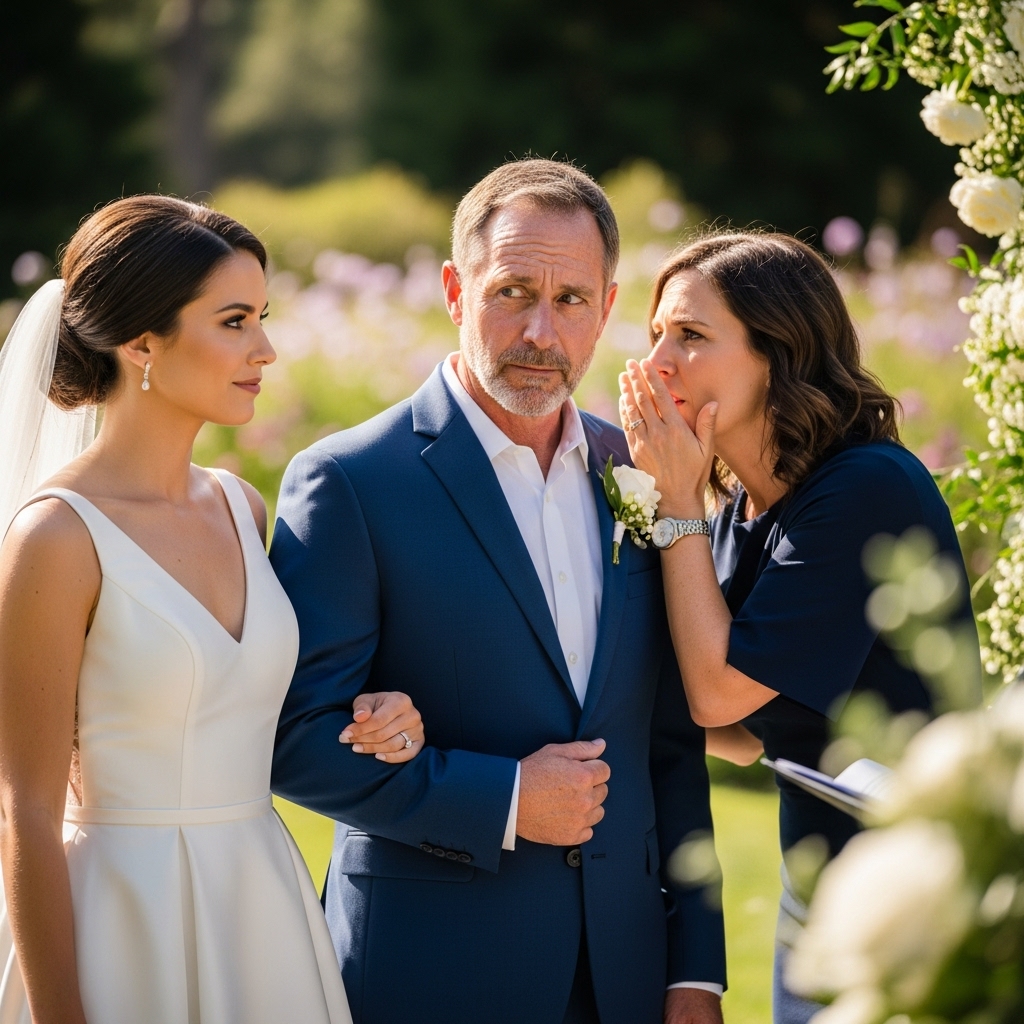
That is when I saw a woman I did not recognize.
She did not look like a guest. No familiar smile, no easy conversation, no sign that she belonged. She scanned the room like someone searching for a face she was not sure she deserved to see.
I assumed she was from Evan’s side and moved toward her, ready to offer help. Before I could speak, she noticed me and walked straight over.
Up close, she looked to be in her late forties or early fifties. Her face carried the kind of tiredness that comes from years of hard choices. Her hands trembled slightly.
“Could we step aside?” she asked. Her voice was unsteady. “Please. I need to talk to you.”
Something in her tone made my stomach tighten. I followed her a few steps away beneath a soft wall light.
“I know we don’t know each other,” she said, “but you need to listen. This is about your daughter. You have no idea what she’s been hiding from you.”
The warmth of the wedding hall suddenly felt far away. My mind raced through every fear a father can imagine. I kept my voice low, but it came out sharp. “Who are you? What are you talking about?”
Tears filled her eyes. “There’s something from her past,” she whispered. “And you deserve the truth.”
I gripped the edge of a nearby table to steady myself. “Then say it,” I told her. “Whatever it is, say it.”
She reached into her purse and pulled out a worn envelope, folded and softened at the edges as if it had been handled many times. She held it out to me like it was both a burden and a confession.
“This was written twenty three years ago,” she said. “It was meant for you, or for whoever became her father.”
My name was not on it. Lily’s name was, written in careful slanted handwriting.
I did not take it right away. “Why would you have that?” I asked.
Her face crumpled. “Because I’m the reason Lily ended up there,” she said.
My chest tightened. “What does that mean?”
She swallowed hard. “I’m her biological mother.”
For a moment, everything inside me shifted, slow and disorienting. I studied her face again, really looked this time. The shape of her mouth, the spacing of her eyes. And I saw faint echoes of Lily, like a resemblance you miss until someone points it out.
“You came here to tell me this today?” I asked, struggling to keep my voice steady.
She flinched. “I didn’t come to ruin her wedding,” she said quickly. “I came because Lily asked me to.”
That stopped me.
“She asked you?” I repeated.
The woman nodded, tears spilling now. “She found me two years ago. She didn’t want a relationship at first. She wanted answers. She wanted to know why. And when she learned the truth, she cried. Not because she hated me. Because she understood.”
“Understood what?” I asked.
The woman clutched the envelope. “I didn’t give her up because I didn’t love her,” she whispered. “I did it because I loved her more than my pride.”
She told me what happened after the accident. Lily’s father was gone. Lily needed therapy and equipment she could not afford. She was alone and overwhelmed. She worked, she begged relatives, she asked for help, and she still could not keep up. A caseworker told her she had a choice: surrender Lily temporarily so Lily could receive proper care, or risk losing her in a way that would be even more painful.
“I thought I would get stable and come back,” she said through tears. “But life didn’t improve. By the time I had anything to offer, she was already deep in the system. And I was ashamed. I was terrified she’d see me as a failure.”
My anger stirred, then softened into something heavier.
“So what did Lily hide from me?” I asked, quieter now.
“That she found me,” the woman said. “That she’s been carrying this letter for years. She didn’t want you to feel like your love wasn’t enough.”
Across the room, Lily laughed at something Evan said. Her joy was bright and easy, and it hit me like a wave. All those years, she had been carrying something tender and complicated, and she had kept it quiet for my sake.
Before I could speak again, the lights dimmed and the DJ announced Lily had something special prepared. A screen lit up. The room quieted.
A video appeared of Lily sitting in our living room, wearing a simple sweater. Her face looked younger. Her hair was shorter. Her hands were folded tightly in her lap.
“Hi,” she said with a small smile. “If you’re watching this, it means it’s my wedding day.”
Soft laughter rolled through the room.
Then Lily took a breath. “Dad,” she began, and my chest tightened, “I wanted to tell you something, but I didn’t want to do it in a way that hurt you. So I’m doing it like this, because you taught me that hard conversations should be handled with care.”
She explained she had found her birth mother and learned the truth about why she had been placed for adoption. She said she did not search because something was missing in her life. She searched because she wanted to understand her story, the part that came before me.
Then she said something that undid me.
“You didn’t just raise me,” Lily told the camera. “You gave me a home. You gave me safety. You gave me the kind of love that stays.”
The room was completely still.
“I kept this to myself because I was afraid you’d feel replaced,” she said, her voice trembling. “But you can’t be replaced. You are my father. You are the reason I believe love is real.”
When the video ended, I realized tears had been running down my face. People applauded, but it was not party applause. It was the kind that sounds like gratitude.
I looked toward the woman in the shadows, Lily’s birth mother, crying silently with her hands over her mouth. Then I looked back at Lily, watching me with wide nervous eyes, like that five year old by the window again, still waiting to see if love would stay.
And in that moment, something became clear.
Lily was not hiding something to deceive me. She was protecting everyone else’s feelings, carrying pain that was never hers to carry.
I walked to her, not caring who saw my tears. When I reached her, she whispered, “Are you mad?”
I crouched beside her wheelchair and took her hands. “No,” I said, my voice thick. “I’m proud of you. And I’m sorry you felt like you had to carry this alone.”
Her eyes filled. “I didn’t want to hurt you,” she said.
“You couldn’t,” I told her, and I meant it with every part of me.
Evan stood nearby, one hand on her shoulder, giving us space.
I looked back toward Lily’s birth mother and surprised myself with what I did next. I extended my hand.
She froze, as if she did not believe she was allowed to move.
“Come over,” I said simply. “This is Lily’s day. If Lily wanted you here, then you belong here.”
The woman shook her head, sobbing. “I don’t deserve it.”
“None of us deserve the people who save us,” I said softly. “And Lily saved me too.”
When she took my hand, her fingers were trembling. Lily saw us together, and her face changed in a way I will never forget. It was relief so deep it looked like years of worry falling away.
Later that night, Lily asked for one more dance.
Not with Evan.
With me.
The DJ played a slow song. Lily rolled onto the dance floor, and I held her hands gently as we swayed. The lights overhead shimmered like small stars.
“I thought you’d feel replaced,” she whispered.
I shook my head. “Love doesn’t work that way,” I said. “It makes room. It grows bigger.”
She smiled, small and shaky and beautiful. “I love you, Dad.”
“I love you too,” I told her. “Always. No matter what your story was before me, I’m grateful I get to be part of it now.”
As we moved together on the dance floor, I realized something I never expected to learn in the later chapters of my life.
Healing does not always come from pretending the past never happened.
Sometimes healing comes when the truth is finally handled with care, shared with love, and met with steady arms that do not let go.