I am fifty five years old, and I am learning how to say a sentence I never expected to speak this soon.
For most of my adult life, the word “husband” meant Greg. It meant a familiar voice in the next room, a steady presence in the passenger seat, a hand at the small of my back when we crossed a busy street. We were married for thirty six years, and our love was not flashy. It was not the kind that begs for attention or demands an audience. It was built from small routines and quiet loyalty, from shared errands and whispered check ins, from the way he always chose the chair closest to the aisle in restaurants as if he could shield me from the world simply by sitting in the right place.That is why his passing felt impossible to accept.
One phone call on a rainy Tuesday afternoon, and everything I knew about my life changed. Suddenly I was in a funeral home, staring at samples of fabric for a casket lining, making choices that felt both practical and unreal. I remember thinking, in a strange detached way, that the human mind will cling to any detail it can manage when the larger truth is too heavy to hold.
By the morning of the funeral, I felt emptied out. I had cried until my eyes burned and my face looked unfamiliar. The kind of grief that comes in waves had stopped feeling like waves. It felt like the ocean had moved into my chest and decided to stay.
When I arrived at the chapel, the viewing had already begun. Soft music floated through the room. People spoke in low voices. Friends and relatives approached carefully, touching my shoulder as if I might crack. Everyone meant well, but I could barely hear them. Their words landed somewhere far away.
And then I saw him.
Greg lay beneath the lights, still and quiet, wearing the navy suit I bought him for our last anniversary. His hair had been combed the way he did before weddings. His face looked calm, almost peaceful, which somehow made everything worse. Greg was never still in life. He always had motion in him. Fixing something around the house. Tapping his fingers while thinking. Clearing his throat before speaking, like he was preparing to say something important even if it was only about the grocery list.
That stillness did not belong to him.
I told myself I needed one last moment. One final act that felt like mine alone. A small goodbye I could control.
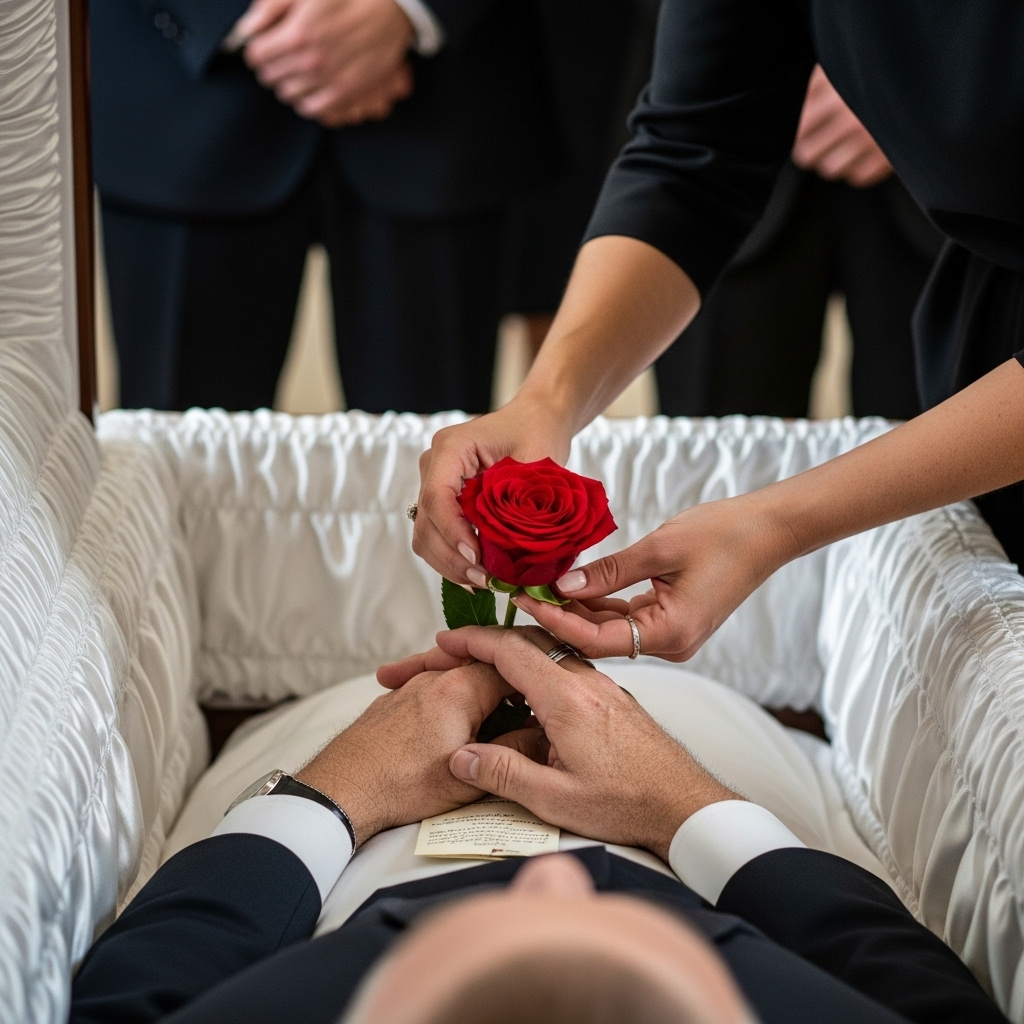
When the line of visitors thinned, I stepped forward with a rose in my hand. I leaned over the open casket, planning to place it between his folded hands.
That is when I noticed something unusual.
Tucked beneath his fingers was a pale rectangle of paper, hidden carefully as if someone had placed it there with intention. At first I assumed it was a card from the funeral home, something about the service or a private note of condolence.
But as I leaned closer, my stomach went cold.
It was folded like a message. A note.
My heart began to pound. Who would slip a note into my husband’s hands and not tell me? Why would it be hidden? I stood there for a long moment, frozen between fear and disbelief.
Then I told myself the one thing I needed in order to move.
I have the right.
He was my husband. My life. My home. My person for thirty six years. If there was something in his hands, meant to be unseen, I had the right to know.
With as much care as I could manage, I slipped the folded paper free. My hands shook. I kept my face composed because I could feel eyes on me, but my body was vibrating with panic.
I walked straight to the bathroom down the hall and closed the door behind me.
The click of the lock sealed out the murmur of voices and the soft music. Under the harsh light above the mirror, I unfolded the paper, smoothing the creases against the counter. It had been folded into tight squares, the kind of folding you do when you carry something close for a long time.
And there, in Greg’s familiar handwriting, I saw my name.
Mara.
Greg was the only person left who still called me Mara the way he did, like it was more than a name. Like it was something he treasured.
My breath caught as I read.
He wrote that if I was holding the note, it meant he did not get to tell me something himself. He apologized. He asked me not to let them bury him with it because it was meant for me.
Then came the line that made my knees weak.
There’s something I should have said years ago. The right time never came.
He told me there was an envelope in the back pocket of his brown winter coat, the one I always teased him about because it was old and stubbornly plain. He asked me to take it home and open it when I was alone.
And then, as if he knew exactly what my mind would do, he added one more request.
Please don’t hate me before you know everything.
I folded the note quickly, pressing it into my purse as if it might burn through my skin. When I stepped back into the hallway, my sister Elaine was there, studying my face.
“You look like you’ve seen a ghost,” she said softly.
“I just needed air,” I replied, forcing a calm nod.
I sat through the service in a blur. People spoke about Greg’s kindness and reliability, his steady presence, the way he always showed up for others without needing recognition. I listened, but all I could think about was the note in my purse and the envelope waiting for me at home.
That evening, after the last guests left and the casseroles lined my counters like a strange parade of kindness, the house went quiet in a way that felt unfamiliar.
For thirty six years, I had never truly been alone in that house.
I stood in the kitchen for a long time, staring at the walls, listening to the refrigerator hum. Grief pressed in from every corner. But beneath it, something else stirred.
A need to know.
I walked to the closet.
Greg’s brown winter coat was still hanging there, smelling faintly of rain and his aftershave. My hand slid into the back pocket, and my fingers touched thick paper.
An envelope.
It was heavier than I expected, the kind of weight that suggests more than a single letter. On the front, in Greg’s neat writing, it read simply:
For Mara.
I sat at the kitchen table holding it for what felt like an hour. My mind spun through every possibility. A second family. A betrayal. A secret debt. A story that would make me question everything I thought I knew.
Finally, I tore it open.
Inside were several legal documents, a small velvet pouch, and another letter.
Greg wrote that if I was reading this, he had failed at protecting me from pain. But he also failed at trusting me with the truth.
My chest tightened, but I kept reading.
He explained that twenty two years earlier, my father had come to him terrified. My father had admitted to making serious mistakes, mistakes that could reach our family. He had something he had been hiding, and he asked Greg to keep me and the children safe.
My hands were trembling when I opened the velvet pouch.
Inside was a ring.
Delicate. Old. Set with a deep blue stone.
My mother’s ring.
I had seen it once in an old photograph from before she passed away. She had mentioned it had a story, but she never lived long enough to tell me what it was.
Greg’s letter explained that the ring was connected to my mother’s family estate, and it should have been passed down to me long ago. But it never was.
My throat tightened as I read on.
Greg wrote that my uncle had used the ring as collateral. He made risky choices. He became tied to people who frightened my father. My father panicked, realizing those choices could ripple outward and land on my doorstep.
Greg stepped in.
He paid what needed to be paid so the burden would not touch me. He absorbed the mess himself so I could keep raising our children without fear. He carried it quietly, year after year, as if it was simply another part of being my husband.
I pressed my hand over my mouth, tears spilling down my face.
Greg had held this alone.
He wrote that he did not tell me because he was afraid I would blame myself, afraid I would try to fix it, afraid I would run toward danger out of loyalty to family. He described me with a tenderness that made my grief sharper and warmer at the same time.
He said I run toward fires, and he wanted me safe.
The final lines broke something open in me.
He wrote that he loved me every day we were married. If he kept secrets, it was never because I was not enough. It was because he wanted me to keep carrying light.
I sat at that table long after the letter ended. The ring lay in my palm, cool and heavy, as if it carried not only history but all the years Greg had protected me without asking for anything in return.
Two days later, my uncle showed up at my door.
I did not invite him in.
He tried to speak with the casual confidence of someone who expected forgiveness to come easily. But I stood in the doorway and felt something steady rise in me, something Greg would have recognized.
“I know,” I said calmly. “And you’re not welcome here.”
For the first time in my life, I did not soften my words. I did not apologize for setting a boundary. I did not make excuses for someone else’s behavior.
My uncle left.
That night, while I was searching for something else in Greg’s nightstand, I found a small box tucked in the back of a drawer.
Inside were dozens of tiny notes, folded and stacked like treasures. The kind of notes you write when you think no one will ever see them.
Remember she likes extra lemon.
She smiled today.
Make sure she’s taken care of.
I sat on the edge of the bed holding those scraps of paper, and I cried until morning.
A week later, I went to the cemetery alone. I slipped my mother’s ring onto my finger before kneeling beside Greg’s grave. The wind moved through the grass, and the sky looked too wide, too ordinary for a world that had lost him.
“I’m mad at you,” I whispered. “And I miss you so much I can’t breathe.”
I let the silence answer the way it always does.
Then I added the truth that had settled in me since finding the note.
“But I understand,” I said softly. “Not all of it. But enough.”
I stood, brushed dirt from my knees, and walked back to my car. The grief was still there, heavy and real, but it no longer felt like an empty hole. It felt like a weight I could carry, one step at a time.
I do not have a husband anymore.
But I have the truth he left me. I have the strength he believed I could grow into.
And after all those years of being protected, I am learning how to stand on my own, not because I want to, but because love sometimes asks that of us when the person we leaned on is gone.