I met the man who would become my husband when we were still teenagers, back when the future felt wide open and uncomplicated. We were seniors in high school, old enough to believe our feelings were serious and young enough to think love alone could carry us anywhere. We talked about college campuses we had never seen, tiny apartments with unreli
able plumbing, and careers we barely understood. Everything felt possible.He was my first love. I was his. When he smiled at me across the cafeteria, the world felt steady and safe, as if nothing truly bad could happen as long as we stayed together.
Then, just days before Christmas, everything changed.
He was driving to visit his grandparents on a snowy evening. There was black ice on the road, a truck that could not slow down in time, and a moment that altered the rest of our lives. The details were hazy, but the outcome was not.
The accident left him unable to use his legs.
I remember the hospital vividly. The sharp, clean smell. The steady rhythm of machines. The way his hand trembled when I held it, like his body was still trying to understand what had happened. When the doctor explained his condition, the words felt unreal, like they were meant for someone else’s life, not ours.
“He will not walk again.”
I was still trying to absorb that sentence when my parents arrived.
They stood stiffly at the foot of his hospital bed, their concern already slipping into something colder. On the drive home that night, they did not ask how he was feeling. They asked how I was coping.
“This isn’t the future you deserve,” my mother said, her tone calm but final.
“You’re young,” my father added. “You can meet someone healthy. Someone without complications. Don’t throw your life away.”
My parents were well known professionals in our city. They valued control, reputation, and appearances. Overnight, the boy I loved became a problem in their eyes, something to be managed or removed.
I told them I loved him.
They told me love was not enough.
When I refused to leave him, they did exactly what they warned they would do. They cut off financial support. My college fund disappeared. Doors I had never thought about closing were suddenly locked. And then they told me, plainly, not to contact them again.
So I packed a bag and went straight back to him.
His parents welcomed me without hesitation. They gave me a small spare room and never once made me feel like a burden. Together, we learned how to adapt. I helped with his daily needs, learned how to assist with therapy exercises, learned how to be strong on nights when his frustration and fear spilled over.
I worked part time. I studied when I could. I learned how to stretch every dollar and how to live without the safety net I had always assumed would be there.
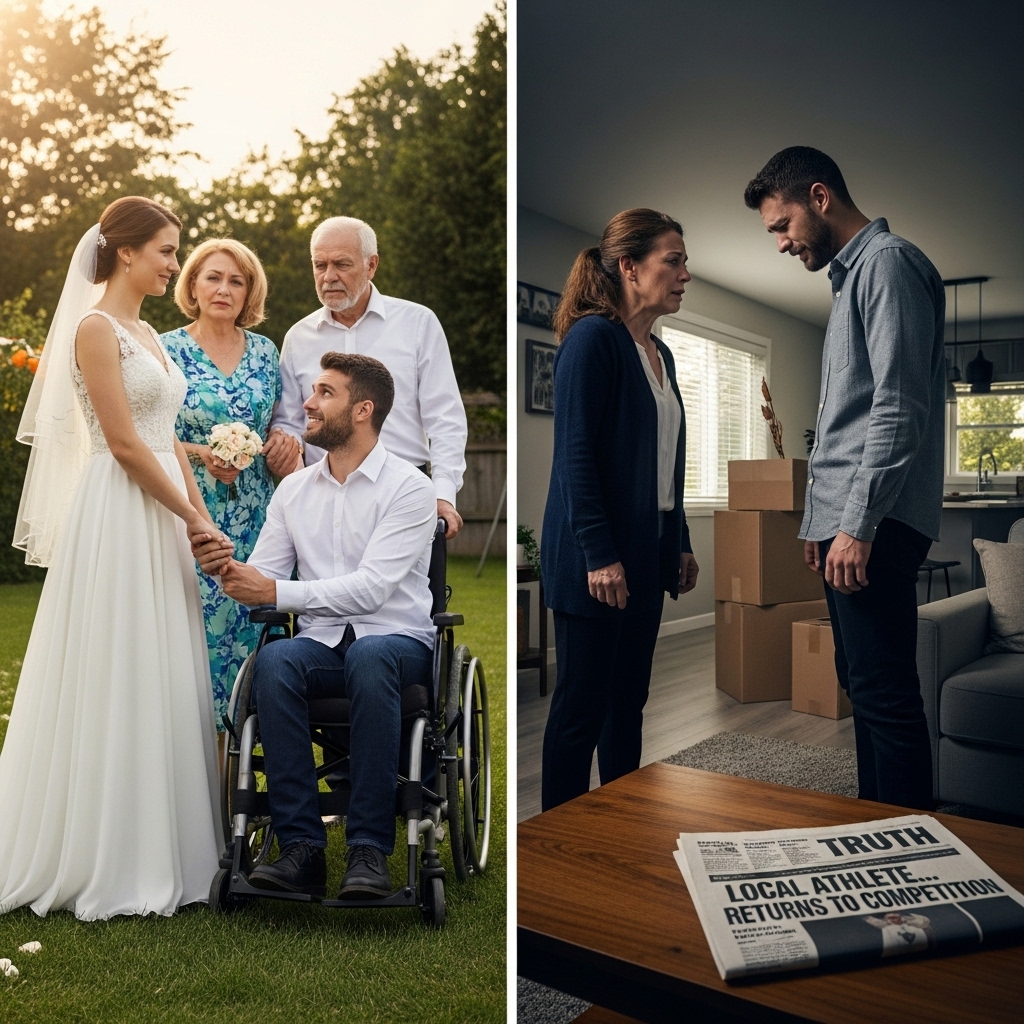
When prom came around, I convinced him to go.
People stared when we arrived. Some whispered. Some looked away. I ignored all of it. To me, he was still the man who made me laugh, who challenged my thinking, who believed in me when I doubted myself. Nothing about that had changed.
We married young. Quietly. Without my parents present.
Our life together was not easy, but it felt honest. We built it slowly. We welcomed a child. I waited, year after year, for my parents to reach out. A birthday card. A phone call. A message acknowledging my child.
Nothing ever came.
Fifteen years passed.
I believed that what we had endured made us unbreakable. I believed that after everything we survived, there were no secrets left between us. I trusted that the hardest parts of our story were already behind us.
Then one ordinary afternoon unraveled everything.
I came home early from work. As I stepped inside, I heard raised voices in the kitchen. One of them stopped me cold.
It was my mother’s voice.
I had not heard it in fifteen years.
She was standing there, red faced and shaking with anger, pushing a stack of papers toward my husband. Her composure was gone.
“How could you lie to her like this?” she shouted. “How could you deceive my daughter for all these years?”
I stood frozen in the doorway.
“Mom?” I whispered. “What are you doing here?”
She turned to me, her expression sharp and controlled.
“Sit down,” she said. “You deserve to know who you married.”
My husband looked pale. His hands gripped the edge of the table as if he needed it to stay upright.
“I’m sorry,” he said softly. “Please forgive me.”
My heart began to race.
I picked up the papers my mother had brought. My hands shook as I flipped through them. Medical reports. Legal documents. Notes from specialists.
Then I saw the line that made my vision blur.
The injury had not been permanent.
According to the records, he had regained partial function less than two years after the accident. With intervention and intensive rehabilitation, he had been expected to walk again, perhaps not perfectly, but independently.
I looked up at him, my chest tight.
“You told me there was no chance,” I whispered. “You told me this was forever.”
He broke down.
“I was scared,” he said through tears. “Your parents hated me. I thought if you knew there was hope, you’d wait and then resent me if I failed. I was terrified of losing you.”
“So you lied,” I said quietly. “For fifteen years.”
He nodded, unable to meet my eyes.
My mother slammed her hand on the table.
“He came to us,” she said bitterly. “Two years after the accident. Asked us to help pay for treatment. He made us promise never to tell you.”
I turned toward her in disbelief.
“You knew?” I asked.
She looked away.
“We thought you were trapped,” she said more quietly. “We thought this was the only way to protect you. From him. And from yourself.”
The room felt smaller, like the walls were pressing in.
Every sacrifice I had made. Every night I worked myself to exhaustion. Every moment I defended him to others. All of it rested on a lie I was never allowed to question.
“I chose you,” I said to him, my voice breaking. “I stayed when everyone else walked away.”
“I love you,” he said desperately. “I always have.”
“But you didn’t trust me,” I replied.
That was the truth I could not ignore.
That night, I did not yell. I did not throw anything. I did not make speeches.
I packed a bag.
I took our child.
And I left.
The separation was quiet but devastating. He admitted everything. There was no denying what had happened. Trust, once broken at that depth, could not be repaired with apologies alone.
In the aftermath, something unexpected happened.
My parents reached out, not with control or demands, but with regret. For the first time, they acknowledged that they had taken away my right to choose. They apologized for interfering, for keeping information from me, for believing they knew better than I did.
I did not forgive them immediately. Some wounds need time and distance before they can even begin to heal.
Years later, I built a new life. One grounded in honesty and self respect. One where my choices are informed, not managed by fear or withheld truth.
I do not regret loving my high school sweetheart.
But I learned something essential.
Love cannot survive without honesty.
And sacrifice means nothing if it is built on a lie.