I took in my best friend’s children thinking the hardest part would be the grief. I thought the sleepless nights, the sudden responsibilities, the school drop offs, and the quiet breakdowns in the pantry would be the biggest challenges I would ever face.
-ad-placeholder-127″ data-inserter-version=”2″ data-placement-location=”under_first_paragraph”>
For a long time, I was sure I understood Rachel’s life. I believed I knew her history, her heart, and the reasons she did what she did. After all, we had been best friends since we were teenagers. We had shared secrets, laughter, and the kind of loyalty that felt unbreakable.
But years after I adopted her four children, a stranger showed up at my front door and proved how wrong I was.
Rachel and I met on the first day of high school. She sat beside me in the cafeteria because the other tables were full, and we bonded over a shared love of books and the kind of cafeteria food that could make you question humanity. From that day on, she became part of my life in a way that never faded. We moved through the seasons of growing up together, crushes, heartbreaks, graduation, jobs, marriages, motherhood.
Rachel was the kind of woman people instantly trusted. She had a steady, gentle way about her. She remembered birthdays and favorite snacks. She was the friend who could calm a room just by walking into it. Even when things were chaotic, she somehow made them feel manageable.
And no one loved being a mother more than Rachel.
I saw it in the way she held her babies close, like they were the most important thing in the world. When she had her first child, she cried with happiness. By the time her fourth arrived, she joked that her heart had stretched so far it might burst, but she always said it with a smile.
Her husband Daniel adored her. Together they made a home that felt alive. Their house was always a little cluttered, always loud, always full of kids running through the hallways and toys underfoot. My husband and I had two children of our own, and the two families blended naturally. We spent holidays together. We took vacations that were messy and wonderful. We hosted backyard cookouts where the kids ran wild while Rachel and I sat on the porch, talking about everything and nothing.
It felt like the kind of life you could depend on.
Then one ordinary afternoon, the foundation cracked.
Daniel was in a traffic incident on his way home from work and never made it back. I still remember the phone call. Rachel did not sound hysterical. She did not scream or sob. Her voice was worse than that.
It was empty.
Flat.
As if her spirit had stepped out of her body and left her words behind.
The days that followed blurred into something unreal. There was a funeral. There were casseroles, condolence cards, and the constant hush of people trying to say the right thing. Rachel tried to hold herself together for the children, but grief hollowed her out. She lost weight quickly. She barely slept. Some days she looked straight through me, like she was staring at a world I could not see.
I did what best friends do. I showed up.
I brought groceries. I helped with laundry. I drove the kids to school and sat in her kitchen while she pushed food around her plate without eating. I hoped time would soften the sharp edges. I hoped love and routine would keep her standing.
Then life dealt her another blow.
An aggressive illness. Advanced. The kind that does not leave much room for denial or long term plans.
I shifted into pure survival mode. I became the extra set of hands Rachel’s household needed just to function. I cooked meals that went untouched some days, and I cleaned up anyway. I learned the schedules, the medicine lists, the appointments. I sat beside her during treatments, holding her hand while she tried to joke through her discomfort.
Rachel never complained. Not once. Not even when her hair fell out. Not even when her body weakened. She was still Rachel, still trying to protect her children from seeing how frightened she was.
Six months later, she was gone.
I was beside her hospital bed when her breathing changed. Her hand felt small and cold in mine. She looked at me like she was trying to press something into my heart that would outlast her.
“Promise me,” she whispered, so softly I almost missed it. “Promise me you won’t let them be alone.”
I did not hesitate. I did not weigh my options. I did not stop to think about the size of what she was asking.
“I promise,” I told her. “I swear.”
In that moment, I believed it was the hardest promise I would ever make.
I was wrong.
Rachel and Daniel had no close relatives who could take in four grieving children. Some family members were distant. Others were unwilling. Some offered sympathy, but sympathy does not change the reality of raising children who have just lost everything familiar.
When social services reached out, my husband and I looked at each other and knew our answer before anyone finished the question.
We took all four.
We adopted them.
Overnight, our family doubled. Suddenly we had six children under one roof. Six sets of emotions. Six different personalities. Six beds to make, six lunches to pack, six hearts to hold through the night.
The early days were hard in a way I did not fully understand until I lived it.
There were tantrums that came out of nowhere. There were moments of silence that felt like a wall. There was clinginess that left me unable to take a shower without a small hand on the bathroom door. There was anger that showed up in slammed drawers and sharp words, not because the kids were “bad,” but because grief is confusing when you are young and you do not know where to put it.
Rachel’s youngest cried at bedtime for months. Her oldest withdrew in a way that frightened me. Teachers called. Counselors offered support. I sat on the edge of beds night after night, telling them the same thing in as many ways as I could.
You are safe here.
You are loved.
You are not alone.
There were nights I lay awake staring at the ceiling, wondering if love was enough. I worried that I would fail them. I worried that I could never fill the space Rachel left behind.
But slowly, something began to shift.
Not all at once. Not like a movie scene where everything becomes easy.
It was gradual.
The kids started sleeping through the night more often. They began to laugh again, real laughter, not the forced kind. They grew into the rhythms of our home. They started calling me Mom, sometimes quietly, sometimes without thinking, and every time it happened it made my throat tighten.
We built new traditions. We celebrated birthdays with their favorite desserts. We hung photos of Rachel and Daniel where the kids could see them, because pretending the past did not exist only makes it heavier. We told stories about their parents at the dinner table, the funny ones and the tender ones. We made room for their grief without letting it swallow them whole.
Years passed. Life stabilized.
I started believing, finally, that the storm had moved on.
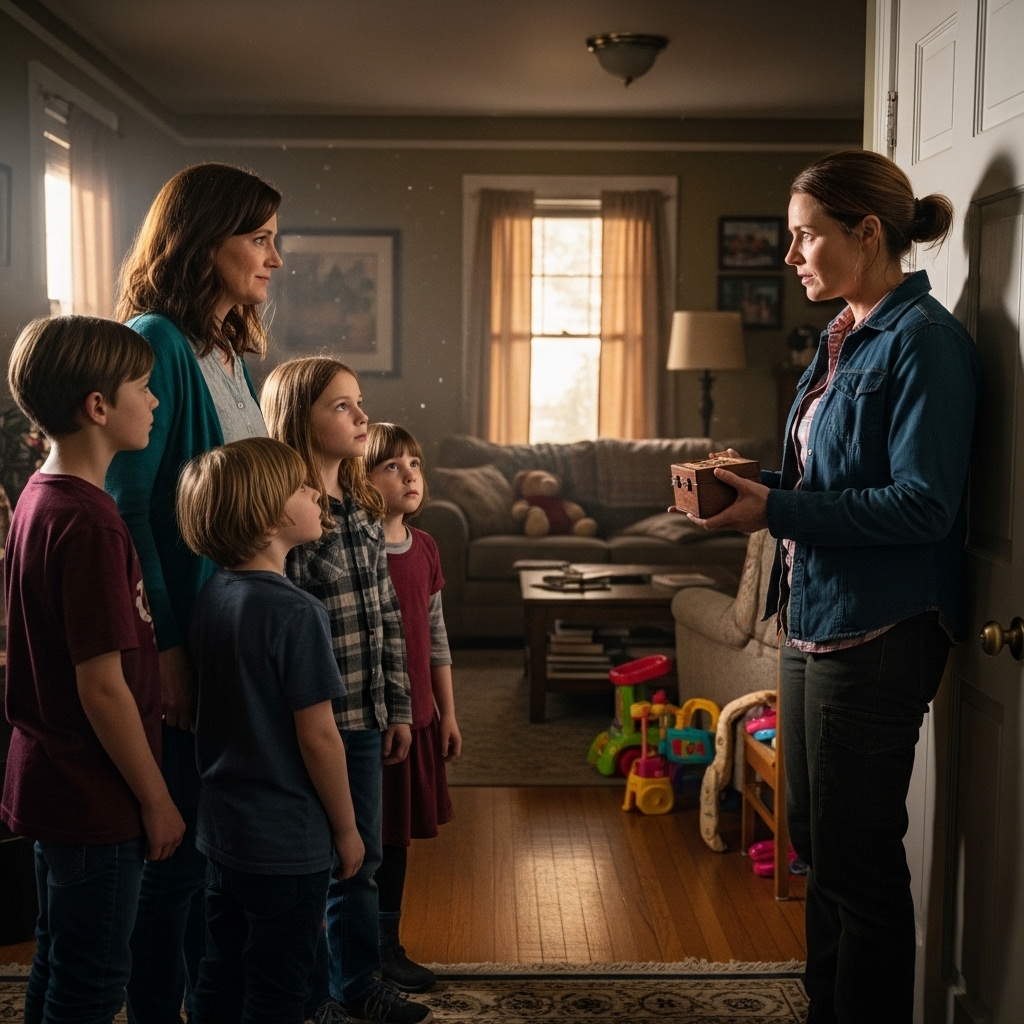
Then one quiet afternoon, when the house was unusually still and I was home alone, someone knocked at my front door.
Not a casual tap. A firm, deliberate knock.
When I opened it, a woman stood on my porch who did not look like a neighbor or a friend. She was well dressed and composed, the kind of person who seemed used to being listened to. Her expression was controlled, but there was something sharp in her eyes, like she had rehearsed this moment.
“You’re Rachel’s friend,” she said. It was not a question. “The one who adopted her children.”
My heart stuttered. “Yes,” I managed.
“I knew her,” the woman continued. “And you deserve to know the truth. I’ve been trying to find you for a long time.”
The air felt tighter around me. “What truth?”
She held out an envelope.
“She wasn’t who she said she was,” the woman said quietly.
Before I could ask another question, she turned and walked away. Just like that, leaving me standing there with an envelope in my hand and a terrible feeling spreading through my chest.
I closed the door and stared at what she had given me.
The handwriting on the envelope was familiar.
Rachel’s.
My knees went weak. I sat down at the kitchen table before I opened it, because something in me knew this was going to change how I saw the past.
Inside was a letter.
And as I read, I felt like the ground under my life shifted.
Rachel wrote about a part of her story she had never shared with me. A life before the one I knew. A family with wealth and influence, but also control and expectations that suffocated her. She described growing up in a world where appearances mattered more than peace. Where choices were made for her, not with her. Where love came with strings attached.
She wrote that she and Daniel had left that life behind. They changed their names. They disappeared into an ordinary community on purpose. They started over quietly and built the warm, messy home I had always believed was simply their natural happiness.
For years, it worked.
Until it did not.
Rachel explained that Daniel’s fatal traffic incident had not been as random as everyone assumed. She did not go into dramatic details in the letter, but her meaning was clear enough. There were people from her past who had not accepted her leaving. People who had resources. People who believed they could pull her back into that world, or punish her for escaping it.
And then, when she became ill, she understood her time was short in more ways than one. She was not only facing the end of her life. She was racing against the fear that someone might come for her children.
That is when the letter reached its most painful truth.
Rachel had chosen me.
Not because I was a convenient option. Not because she had nowhere else to turn. She chose me because she believed I was the safest person in the world for her children.
She wrote that I was ordinary in a way that protected us. That I was not connected to her old life. That I would not be visible to the people she feared. She wrote that I loved her children without conditions, and that love was the only thing she trusted completely.
She also wrote that she had prepared everything. Legal protections. Paperwork. Plans that would make it difficult for anyone to challenge the adoption or disrupt the children’s lives. She had built a quiet wall around them, not with drama, but with careful planning.
By the time I reached the end of the letter, I was crying so hard I could barely see the words.
It was not betrayal.
It was trust.
Rachel had trusted me with the most precious thing she had left.
That night, I tucked all six children into bed, one after another, kissing foreheads and smoothing blankets. I did not tell them what I had learned. Not yet. They had grown into stability, and I was not going to shake it without care.
But as I turned off lights and closed doors, I whispered the same promise I had made years earlier.
You are safe.
You are home.
And I am not going anywhere.
In the days that followed, I read Rachel’s letter again and again. I thought about the woman on my porch and what it meant that she said she had been looking for me. I thought about all the ways Rachel had protected her children in silence, even while her body was failing.
I looked at the kids differently, too. Not because they had changed, but because I finally understood the full weight of what they had survived before they ever came to my house. They were not only children who lost their parents. They were children whose parents had carried fears I never saw, and still managed to choose love as their last act.
Rachel had not been running away from her past.
She had been running toward her children’s future.
And once I understood that, something inside me settled.
I did not need to know every detail of what she escaped to honor her. I did not need to chase a mystery to prove my devotion. My job was the same as it had always been.
Protect the children.
Keep life steady.
Make home a place where they can breathe.
The truth was not a threat.
It was a reminder of why Rachel put her faith in me.
And if someone ever came knocking again, I already knew my answer.
I would open the door, stand my ground, and do what I promised.
Because those children were never just “Rachel’s kids” anymore.
They were mine.