Part 1 — The Card
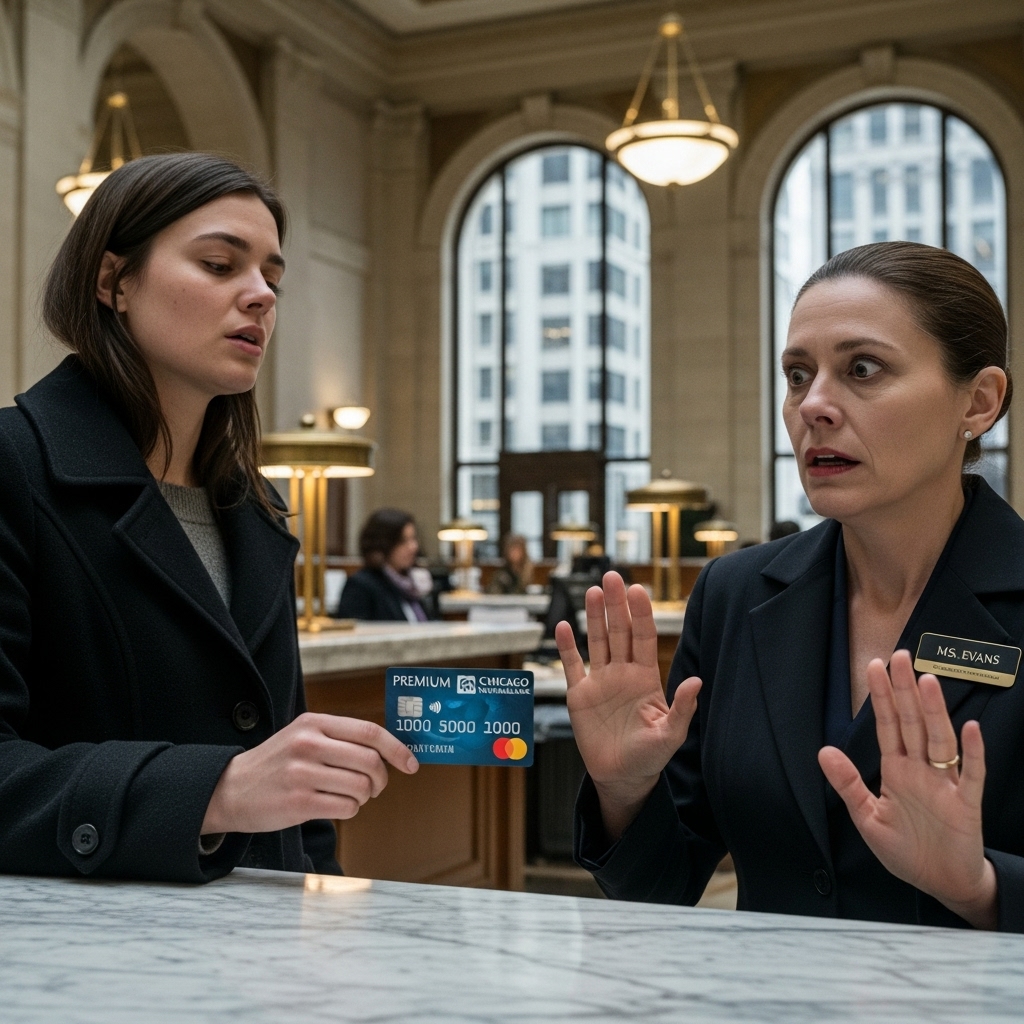
The banker’s smile vanished the moment she swiped the card.
Her fingers froze over the keyboard. The color drained from her face so fast I thought she might faint.
“Ma’am,” she whispered, leaning closer, her voice shaking. “Please don’t leave.”
I stared at her, confused.
“I’m just here to cancel it,” I said. “It’s only $1,000.”
She swallowed hard and glanced toward the glass-walled offices behind her.
“No,” she said softly. “It’s not.”
And in that moment—standing inside a warm bank lobby with my past burning in my pocket—I realized my father had lied to me about everything.
My name is Clare Donovan. I’m thirty-one years old, and I serve in the United States Army.
That morning, the wind cut through downtown Chicago like a blade. It slipped under my coat, crawled up my spine, and reminded me why I hated winters here. The city smelled like exhaust and cold stone, and my boots echoed sharply as I pushed open the heavy glass doors of Liberty Union Bank.
I hadn’t been inside a bank like this in years.
The lobby was warm—too warm—and filled with the quiet confidence of money. Marble floors, soft lighting, men in tailored coats speaking in low voices, as if the air itself cost something. The smell of expensive cologne hung over everything, thick and unfamiliar.
I suddenly felt very aware of myself.
My coat was Army issue—clean but worn. My hair was pulled back tight, regulation-neat, no loose strands. I stood straight out of habit, shoulders squared, hands steady.
Still, I could feel eyes flick toward me and then away again.
People always noticed the uniform and then decided what kind of person they thought I was.
I walked up to the counter and waited my turn. When the teller finally called me forward, she looked young: perfect makeup, nails done. Her smile was professional, practiced, and just a little tired.
“How can I help you today?” she asked.
I reached into my wallet and pulled out the card.
It was old. Scratched. The edges were worn white, the plastic slightly bent from years of being shoved into the back pocket of a wallet I almost never opened.
I placed it gently on the counter like it might break if I wasn’t careful.
“I want to close this account,” I said, “and cancel the card.”
Her eyes dropped to it, and something shifted.
Not shock. Not concern.
Just a flicker of judgment—quick and sharp.
She picked it up with two fingers like it might be dirty.
“This card hasn’t been used in a long time,” she said, clicking at her keyboard. “Are you sure it’s still active?”
“Yes,” I replied quietly. “I’ve never touched it.”
She raised an eyebrow.
“Never?”
“No.”
She gave a small, amused huff under her breath—the sound people make when they think you’re lying, or stupid.
“Well,” she said, “let’s take a look.”
As she slid the card into the reader, my mind drifted—against my will—back to the night I’d sworn never to use it.
Five years ago, I stood in the foyer of the house I grew up in, holding that same card in my shaking hand. The air smelled like lilies and old wood. Funeral flowers were still everywhere—on tables, against walls—wilting slowly, as if even they were tired of pretending this was a place of comfort.
My grandfather was dead.
He was the only one who had ever called me his daughter without hesitation.
He was the man who taught me how to balance a checkbook, how to change a tire, how to stand up straight and look people in the eye. He used to say, “Character is what you do when no one’s watching.”
After the funeral, when the last guest left and the house finally fell quiet, my father shut the front door and turned the lock.
That was when his face changed.
No tears. No softness.
Just calculation.
“The house is mine now,” he said flatly, as if reading from a grocery list. “Everything’s been settled.”
I remember nodding, still numb.
“Okay.”
Then he reached into his jacket pocket and tossed something at me. I caught it out of reflex.
“A debit card,” he said. “Your grandfather left you something. One thousand dollars.”
He paused, then added, “That’s generous, considering.”
“Considering what?” I asked.
His eyes hardened.
“Considering you’re not blood.”
The words landed harder than any slap.
He went on, voice cold and precise, explaining how the house would be renovated, how he planned to sell some of my grandfather’s things, how it was time I moved on.
“You’re an adult,” he said. “The Army will take care of you. This”—he nodded toward the card—“is more than enough.”
I remember my throat tightening.
“Can I at least keep his watch?” I asked. “He promised it to me.”
“No,” my father said. “That stays.”
Then he opened the door and pointed outside.
“You should go,” he said. “Tonight.”
I walked out into the cold carrying nothing but my uniform bag and that card burning in my palm like an insult.
Back in the bank, a sharp electronic chirp snapped me back to the present.
Then another sound followed.
Not a decline.
An alarm—soft but unmistakable, something internal, something serious.
The teller’s smile disappeared completely.
Her fingers froze over the keyboard.
Her eyes widened as she stared at the screen.
“What is it?” I asked, suddenly uneasy.
She didn’t answer right away.
Her face had gone pale.
She leaned closer to the monitor, then glanced up at me. Really looked at me this time—not at my coat, not at my card, at my face.
“Ma’am,” she said quietly, “how did you get this card?”
“My father gave it to me,” I said. “Five years ago.”
Her lips parted slightly. She swallowed.
“I need to ask you to wait here,” she said. “Please.”
“For what?” I asked.
She lowered her voice, eyes darting toward the offices behind her.
“This account isn’t marked as a standard checking account,” she whispered. “It’s flagged.”
“Flagged how?”
She hesitated, then said the sentence that made my stomach drop.
“This isn’t a one-thousand-dollar card,” she said. “It’s tied to a trust.”
I felt the room tilt.
“A trust?” I repeated. “That’s not possible.”
She was already reaching for the phone beneath the counter.
“I need to call my manager,” she said. “Right now.”
As she dialed, I stared down at the card resting between us on the marble counter.
The same card I’d refused to touch for five years out of pride and pain.
The same card my father had thrown at me like charity.
And suddenly, for the first time since my grandfather’s funeral, I wondered if the humiliation I’d carried all this time had been built on a lie.
The bank lobby faded from my mind as soon as the teller picked up the phone. While she whispered urgently into the receiver, my thoughts dragged me backward five years—to the night everything I believed about family collapsed.
It had been raining earlier that day, a cold autumn drizzle that soaked into the black soil around my grandfather’s grave. By the time the funeral ended, the clouds had thinned, leaving the sky pale and empty, like it had nothing left to give.
People hugged me, told me how strong I was, how proud my grandfather would have been to see me in uniform. I nodded, thanked them, smiled when I was supposed to.
But the only voice I wanted to hear was gone.
The house felt wrong without him—too quiet, too large. His laughter no longer echoed down the hall. His boots were gone from the mat by the door. Even the clock in the living room seemed to tick more loudly, as if it were angry about the silence.
My father moved through the rooms like a stranger claiming territory. He barely looked at me while he gathered papers from the dining table, stacking them neatly into a folder.
I stood near the fireplace, hands clasped behind my back—out of habit, posture drilled into me by months of military training.
“Where am I supposed to go?” I asked quietly.
He didn’t answer right away. He adjusted his glasses and slid the folder under his arm.
“You’re enlisted,” he said finally. “You’ll figure it out.”
I swallowed.
“I’m still on leave. I thought maybe—”
“This isn’t your home anymore,” he cut in.
The words were blunt, clean, final.
I stared at him, waiting for something—regret, hesitation, anything.
But his face was set, jaw tight with resolve.
“That house belongs to me now,” he continued. “Your grandfather made that very clear.”
I took a breath.
“He told me he wanted me to have a place here,” I said. “He said—”
“He said a lot of things,” my father snapped, “but legally it’s settled.”
Then he reached into his jacket and pulled out the card.
He didn’t hand it to me.
He tossed it.
It bounced once against my chest before I caught it—more surprised than hurt.
“One thousand dollars,” he said. “That’s what he left you.”
My fingers curled around the plastic.
“That’s it?”
“It’s more than fair,” he replied. “Given the circumstances.”
“What circumstances?” I asked, though my chest already felt tight.
He exhaled sharply like he’d been waiting for this moment.
“You were adopted,” he said. “You know that.”
“Yes,” I said slowly. “But he was my grandfather.”
“He was kind to you,” my father corrected. “That doesn’t make you his responsibility.”
The room seemed to shrink.
“I took you in,” he continued. “I fed you. I put a roof over your head. And now you’re grown. You have your own life.”
I felt heat rise behind my eyes.
“I never asked for anything,” I said.
“No,” he agreed. “You just stood there and took it.”
That hurt more than anything else he’d said.
I looked down at the card.
“I don’t want this,” I whispered.
“Don’t be dramatic,” he replied. “Take it and go.”
I asked him if I could at least pack a bag.
He shook his head.
“You can come back for your things later. Right now, I need space.”
Space from me.
I remember stepping outside and feeling the cold air hit my lungs like a shock. The door closed behind me with a heavy click, and I realized he had locked it.
I stood on the porch for a long moment, staring at the wood grain of the door I’d opened a thousand times growing up.
Then I walked away.
I didn’t cry. Not right away.
I walked until my legs burned and my chest ached from holding everything in. I walked past the park where my grandfather used to teach me how to throw a baseball. Past the corner store where he bought me candy when he thought my father wasn’t looking. Past the bus stop where he hugged me goodbye the day I left for basic training.
When my phone finally buzzed, it was my friend Marissa.
“Where are you?” she asked, worry sharp in her voice.
“I don’t know,” I said honestly.
“Come to my place,” she said. “Now.”
That night, I sat on her couch wrapped in a borrowed blanket, staring at the card in my hand. The numbers on it felt heavy—accusatory.
One thousand dollars.
That was what my grandfather’s love had been reduced to.
Marissa offered me food. I shook my head. She asked if I wanted to talk. I said no.
Later, when the apartment went quiet and I was alone with my thoughts, I took the card out of my wallet and held it up to the light.
“This isn’t mine,” I whispered.
I bent it slightly—just enough to leave a white crease down the center. My hands trembled, not from cold, but from rage.
I thought about using it, thought about proving my father wrong by surviving with his charity.
Then I thought about my grandfather’s voice—about pride, about standing on your own two feet.
I slid the card into the bottom of my duffel bag and zipped it shut.
“I’ll never use you,” I said aloud.
The next morning, I left before my father woke up. I didn’t leave a note. I didn’t ask for forgiveness.
I took the bus to the recruitment office and signed the final papers that made my service official.
If I was going to be on my own, I would do it with my head held high.
Back in the bank, the teller covered the receiver and looked at me again, her expression unreadable.
“My manager is coming,” she said. “Please don’t go anywhere.”
I nodded slowly, my heartbeat loud in my ears.
The card lay on the counter between us—silent and unassuming.
For five years, I had believed it was nothing more than an insult.
I was about to find out just how wrong I’d been.
I didn’t see my father again after that night. I didn’t call. He didn’t reach out.
The silence between us settled quickly, like it had always been waiting for permission to exist.
I spent the first few weeks after leaving his house sleeping on Marissa’s couch, waking up before dawn out of habit—my body still running on military time.
Every morning, I folded the borrowed blanket with precision and set it back on the armrest, pretending I was just a guest passing through instead of a daughter who had been erased.
Marissa never asked how long I planned to stay. She never mentioned money. She simply made coffee, slid a mug toward me, and talked about normal things—work traffic, the neighbor’s loud dog—as if my world hadn’t just collapsed.
That quiet kindness kept me standing.
Two weeks later, I shipped out.
Basic training didn’t scare me.
I welcomed it.
The yelling, the exhaustion, the rules—it all made sense in a way my family never had.
In the Army, no one cared where I came from. They cared whether I showed up on time, whether I followed orders, whether I pulled my weight.
For the first time, expectations were clear.
I learned quickly that pain was temporary, but discipline stayed with you. Blisters healed. Bruises faded. What remained was the certainty that I could endure more than I ever thought possible.
At night, when the lights went out and the barracks fell quiet, I sometimes reached into my duffel bag and touched the edge of the old debit card.
I never took it out.
I didn’t need to see it to remember what it represented.
Pity.
I told myself I would rather go hungry than use it.
The years passed in a blur of training cycles, deployments, and temporary housing that never quite felt like home.
I learned how to stretch a paycheck, how to save every spare dollar, how to live with only what I could carry.
My life fit into lockers and duffels, and I liked it that way.
Possessions couldn’t be taken from you if you didn’t cling to them.
I advanced slowly but steadily.
I wasn’t flashy. I wasn’t loud.
I did my job, and I did it well.
My superiors noticed. They always do eventually.
There were nights I came back to my barracks room sore and bone-tired, my hands shaking as I unlaced my boots.
On those nights, I would think of my grandfather sitting at the kitchen table reading the newspaper with his glasses perched too low on his nose.
“You don’t need applause to know you’re doing right,” he used to say. “You just need to sleep at night.”
I slept.
Not always well, but honestly.
I heard things about my father through the grapevine—how he renovated the house, how he hosted dinners for neighbors I barely remembered, how he liked to talk about his discipline and values, about raising me like his own.
Sometimes people would ask why I never went home on leave.
I told them the truth in the simplest terms possible.
“I don’t have one.”
Five years went by like that.
I never touched the card.
Not when my car broke down and the repair wiped out my savings.
Not when I sprained my ankle and lost a week of pay.
Not when I stood in the pharmacy counting bills in my hand, deciding which prescription I could afford that month.
I wore my independence like armor, even when it cut into my skin.
Then, six months ago, my father called.
I almost didn’t answer. The number wasn’t saved, but I recognized it immediately. Some things lodge themselves into you and never leave.
“Clare,” he said, as if we’d spoken yesterday.
“What do you want?” I asked.
“I need you to sign something,” he replied. “It’s about the house.”
My jaw tightened.
“I don’t want anything to do with it.”
He sighed, irritated.
“You’re still listed on some old paperwork. It’s just a formality.”
“I’m not signing anything,” I said.
There was a pause. Then his tone sharpened.
“You always were ungrateful,” he snapped, “after everything I did for you.”
The words rolled off him easily—practiced.
“That card I gave you,” he continued, “that was your inheritance. Don’t act like you were cheated.”
I hung up without responding.
But his call stirred something I hadn’t felt in a long time.
Unfinished business.
Not anger.
Something colder.
I realized then that as long as that card existed, my past still had a thread tied to me—a loose end, a reminder of how small he’d tried to make me feel.
I didn’t want the money.
I wanted closure.
So when my next block of leave came up, I made a decision.
I would go to the bank.
Not to withdraw a cent.
Not to check a balance.
I would close the account, cancel the card, end it.
It felt symbolic. Final.
I walked into Liberty Union Bank that morning with the same steady posture I used during inspections.
I didn’t dress up. I didn’t dress down.
I wore what I was: someone who had survived.
As I waited in line, I felt calm—grounded, ready to let go.
I had no idea the card I’d carried as a burden for five years was about to become something else entirely.
Because when the teller swiped it and her face drained of color—when she told me it was tied to a trust—I realized something that made my chest tighten.
My grandfather had never been careless.
And if he’d given me that card, even in silence, it meant there was more to the story than I’d ever been told.
The bank manager arrived faster than I expected.
He was a tall man in his late forties, silver hair neatly combed, tie loosened just enough to suggest authority without arrogance.
He didn’t smile when he saw me.
Instead, his expression tightened with something closer to concern.
“Miss Donovan?” he asked.
“Yes.”
“If you’ll come with me,” he said, gesturing toward a glass-walled office near the back, “we should talk somewhere private.”
The teller avoided my eyes as I followed him across the lobby.
Conversations around us dropped into awkward whispers.
I could feel curiosity prickling at my back—the subtle shift that happens when people sense something unusual unfolding.
Inside the office, the manager closed the door gently and motioned for me to sit.
“I want to be very clear,” he began, folding his hands on the desk. “You came in today to cancel this card. Is that correct?”
“Yes,” I said. “I’ve never used it. I don’t want it.”
He nodded slowly.
“That much is obvious.”
I frowned.
“What do you mean?”
He turned his computer monitor toward me. The screen was filled with lines of text and numbers that meant nothing to me at first glance—account codes, dates, legal language.
“This card,” he said carefully, “is not connected to a standard checking account.”
My shoulders stiffened.
“Then what is it connected to?”
He took a breath.
“A trust.”
The word echoed in my head, hollow and unreal.
“That’s not possible,” I said. “My father told me it was one thousand dollars. That’s it.”
The manager’s mouth tightened.
“Your father may have believed that,” he said. “Or he may not have.”
My pulse began to pound—slow and heavy.
“What kind of trust?” I asked.
“One that matured last month,” he replied, “after five years.”
Five years.
The number landed like a physical blow.
I stared at the screen, my vision blurring at the edges.
“You’re saying this account has been sitting here this whole time?”
“Yes,” he said. “Untouched.”
I let out a shaky laugh.
“There’s nothing in it,” I said. “It was a symbolic gesture, a mistake.”
He didn’t laugh with me.
“Miss Donovan,” he said quietly, “the current balance is not one thousand dollars.”
I swallowed.
“Then what is it?”
He hesitated just long enough to scare me.
“Before I answer that,” he said, “there’s someone else who needs to be present.”
He picked up the phone on his desk and dialed a number from memory.
“Mr. Adler,” he said when the line connected, “she’s here.”
My stomach dropped.
“Who?” I asked.
He covered the receiver briefly.
“The attorney assigned to this trust,” he said. “He’s been waiting for this day.”
Waiting for me.
While we sat in silence, my thoughts spiraled—images from the past five years colliding in my mind: counting change at a gas station, sleeping in temporary housing, stretching meals, turning down help because pride was all I had left.
All of it framed now by a single question I was afraid to ask.
Why?
The knock on the door was soft.
The man who entered was older than the manager, his hair white at the temples, his posture slightly stooped but deliberate.
He carried a leather briefcase that looked heavy—not just with paper, but with purpose.
“Clare,” he said gently.
I stood instinctively, my military reflex kicking in.
“Sir.”
He smiled faintly.
“Your grandfather used to do that, too.”
My chest tightened at the sound of that word.
He sat across from me and placed the briefcase on the desk between us.
For a moment, none of us spoke.
“I was instructed not to contact you,” he said finally, “not until you came to the bank on your own.”
“Instructed by whom?” I asked, though I already knew.
“Your grandfather,” he replied.
My throat went dry.
“He anticipated that this card would feel like an insult,” Mr. Adler continued. “He also anticipated that you wouldn’t use it.”
I shook my head.
“Why would he do that to me?”
“Because he knew your father,” Mr. Adler said simply. “And he knew you.”
The manager slid a document toward me.
“This trust was funded through the sale of assets, insurance policies, and long-term investments,” he said. “Your grandfather structured it carefully—aggressively.”
I scanned the page, my eyes catching on one line.
Current balance: $4,870,000.
The room tilted.
“That’s wrong,” I whispered.
“It isn’t,” Mr. Adler said softly. “And that isn’t the final figure.”
I pressed my palm flat against the desk, grounding myself.
“I lived on nothing,” I said. “I struggled for years.”
“I know,” he said. “He knew you would.”
Anger flared—sharp and hot.
“Then why didn’t he tell me?” I demanded. “Why let me think I was abandoned?”
Mr. Adler opened his briefcase and withdrew a sealed envelope.
“He wrote you a letter,” he said. “But he didn’t want you to read it until you were ready to walk away.”
The envelope trembled in my hands as I took it.
My grandfather’s handwriting stared back at me—familiar and steady.
I broke the seal.
My brave girl, it began.
Tears blurred the page.
If you’re reading this, it means you survived—not because I made things easy, but because you are stronger than the people who tried to define you.
I squeezed my eyes shut.
He wrote about my father’s resentment. About his fear that money would change people. About his certainty that my father would take whatever he could claim.
I had to protect you from him, the letter continued, and from the version of yourself that might believe you needed saving.
My hands shook as I read the final line.
This trust was never meant to rescue you. It was meant to reward the woman you became.
I lowered the letter slowly, my chest aching.
For the first time in five years, I understood.
The card wasn’t charity.
It was a test.
And I had passed it without even knowing I was being tested.
I sat there for a long time after finishing the letter.
No one rushed me.
The bank manager quietly stepped out, closing the door behind him.
Mr. Adler remained seated across from me, his hands folded, his expression patient in a way that felt almost reverent.
My grandfather’s words echoed in my head.
Not to rescue you.
To reward the woman you became.
I pressed my fingers against my eyes, willing the sting to fade.
“I thought he abandoned me,” I said hoarsely. “I thought he let my father humiliate me.”
Mr. Adler shook his head slowly.
“He knew exactly how your father would act,” he said. “And he knew exactly how you would respond.”
I looked up.
“Then why leave the house to him?”
Mr. Adler opened his briefcase again and pulled out a thick folder, heavier than the letter.
He set it on the desk and slid it toward me.
“He didn’t,” he said.
I frowned.
“But my father lives there.”
“He occupies it,” Mr. Adler corrected. “There’s a difference.”
He flipped the folder open, revealing pages of legal documents neatly tabbed and highlighted.
“Your grandfather placed the house into a conditional living trust,” he explained. “Your father was granted residency and limited control, but ownership remained with the trust.”
My breath caught.
“So my father doesn’t own it.”
“No,” Mr. Adler said calmly. “He never did.”
I felt something loosen in my chest, followed immediately by a surge of anger.
“He told me it was his,” I said. “He threw me out like it was his right.”
“He assumed you would never know,” Mr. Adler replied. “And frankly, for a while, he was correct.”
I leaned back in the chair, trying to process everything at once.
“What were the conditions?” I asked.
Mr. Adler’s gaze sharpened.
“Your father was required to maintain the property, preserve its contents, and uphold what your grandfather described as basic standards of decency.”
I let out a short, humorless laugh.
“That didn’t last long.”
“No,” he agreed. “It didn’t.”
He turned to another page.
“There were also specific clauses regarding your treatment,” he said. “If you were evicted under punitive circumstances, the trust allowed for immediate review.”
I stared at him.
“You mean when he threw me out?”
“Yes,” Mr. Adler said. “That action alone triggered the first warning.”
My hands curled into fists.
“Then why wasn’t anything done?”
“Because your grandfather added a final safeguard,” he said. “Time.”
He explained that the trust was structured to observe behavior patterns. One mistake could be explained away. A series could not.
“Over the past five years,” Mr. Adler continued, “your father has violated nearly every condition of residency.”
I closed my eyes, imagining the renovations I’d heard about—the antiques sold, the refinanced loans.
“He took out three lines of credit against the house,” Mr. Adler said, confirming my thoughts. “All without proper authorization.”
My heart pounded.
“So what happens now?”
Mr. Adler folded his hands.
“Now that the trust has matured—and now that you’ve identified yourself—the trustee has the authority to act.”
“What does ‘act’ mean?” I asked.
“It means the trust can reclaim the property,” he said simply.
The words hung in the air between us.
Reclaim.
I thought of the front porch where I’d been ordered to leave—the door that had closed behind me, the lock turning.
When I asked, Mr. Adler glanced at his watch.
“The process has already begun.”
I sucked in a breath.
“My father doesn’t know.”
“Not yet,” he said. “But he will soon.”
The room felt suddenly very small.
I had spent five years believing my past was sealed—that the house was lost to me forever.
And now, without lifting a finger, the ground beneath my father’s feet was shifting.
“I don’t want to hurt him,” I said quietly.
Mr. Adler studied me.
“I believe that,” he said. “But I also believe you won’t allow yourself to be hurt again.”
I swallowed.
“What are my options?”
He slid another document toward me.
“You can let the trust proceed on its own,” he said. “Repossession will occur. The house will be auctioned.”
“And the other option?”
“You may step in,” he replied. “Acquire the property directly through a holding entity. Quietly.”
My stomach twisted.
“He would never know it was me.”
“Not until the deed is transferred,” Mr. Adler confirmed.
I looked down at my hands.
They were steady.
Strong.
These were the hands that had hauled gear, cleaned weapons, carried wounded soldiers—hands that had learned restraint.
“What did my grandfather want?” I asked.
Mr. Adler smiled faintly.
“He wanted you to choose.”
I closed my eyes and pictured my father standing in the living room, tossing the card at me like spare change.
“Blood matters,” he’d said.
I opened my eyes.
“Do it,” I said.
Mr. Adler nodded once.
“Very well.”
As he gathered the paperwork, I felt something unfamiliar settle over me.
Not triumph.
Certainty.
For the first time since the night I was thrown out, I wasn’t reacting.
I wasn’t surviving.
I was deciding.
And somewhere deep inside, I knew my grandfather had been waiting for this moment all along.
Part 2 — The Notice
The notice went up three days later.
A plain white envelope, taped to the front door of the house I once called home.
By the time my father saw it, the decision had already been made.
I wasn’t there when it happened.
I didn’t need to be.
Mr. Adler kept me informed with quiet efficiency, updating me through secure emails and brief phone calls that cut straight to the point.
“He believes it’s a mistake,” Mr. Adler said during one call. “He’s been contacting the bank nonstop.”
That didn’t surprise me.
My father had always believed mistakes happened to him—never because of him.
According to the trustee’s report, he spent the first day in denial. He marched into the local branch demanding answers, waving documents that no longer meant what he thought they did.
When that failed, he called lawyers—old friends who stopped returning his calls once they realized the scope of his debt and the condition of the title.
By the second day, panic set in.
He started calling relatives, neighbors—anyone who might listen.
He talked about betrayal. About being set up. About how unfair it was that after everything he’d done, this was happening to him.
No one offered help.
People remember how you treat others when you think no one is watching.
On the morning the sheriff arrived, I sat in the backseat of a black sedan two blocks away, watching the street through tinted glass.
My uniform was pressed.
My coat was tailored and simple.
I wore no insignia—no rank, no name.
Just myself.
The house looked smaller than I remembered.
The paint was chipped.
The hedges were overgrown.
The windows that once glowed warm at night now reflected only gray sky.
A moving truck idled at the curb, its engine humming softly—patient and indifferent.
Two officers stood near the front steps, speaking calmly while my father paced behind the door.
Even from this distance, I could recognize his posture—the sharp movements, the clenched jaw, the way he leaned forward when he spoke as if force alone might bend reality back into place.
When the door finally opened, his voice carried down the street.
“This is my property!” he shouted. “You can’t do this!”
One of the officers held up a hand, speaking evenly.
“Sir, we’ve explained the situation. You’ve been notified multiple times.”
“I never received anything!” my father yelled. “This is harassment!”
I exhaled slowly.
Five years ago, he hadn’t needed explanations.
He hadn’t needed paperwork.
He’d simply pointed at the door and told me to leave.
Now, he was begging the law for mercy.
The sedan door opened quietly, and I stepped out onto the pavement.
The sound of my boots on concrete drew his attention immediately.
He turned and froze.
For a moment, he didn’t recognize me.
Or maybe he did, and his mind refused to accept it.
His eyes narrowed, scanning my face, my posture, the calm way I stood with my hands at my sides.
Then realization struck.
“Clare,” he said, his voice cracking.
I didn’t answer.
I walked past the officers and stopped a few feet away from him—close enough that he could see there was no anger on my face, no hesitation.
Only resolve.
“What are you doing here?” he demanded. “Did you do this?”
I met his gaze steadily.
“I didn’t have to,” I said. “You did it yourself.”
He scoffed, but there was fear behind it now.
“This is my house.”
I shook my head once.
“It never was.”
His mouth opened, then closed again.
“You don’t understand,” he said quickly. “Your grandfather wanted me to have it. He trusted me.”
“He trusted me too,” I replied.
He laughed bitterly.
“You?”
Then his voice turned sharp—ugly in its desperation.
“You were a responsibility,” he said. “Someone I took in. He pitied you.”
Five years ago, those words would have shattered me.
Now they meant nothing.
“You threw me out because I wasn’t blood,” I said. “You told me family was about DNA.”
He shifted uncomfortably.
“I didn’t mean—”
“You did,” I cut in. “And I listened.”
I reached into my coat pocket and removed my phone.
With a few taps, I pulled up the file Mr. Adler had prepared.
Video footage.
The screen showed the front hallway of the house.
Five years ago.
My father standing exactly where he stood now.
The door open.
My duffel bag at my feet.
His voice echoed clearly from the recording:
“Take the money and go. You were never family.”
The color drained from his face.
“Turn it off,” he whispered.
I lowered the phone.
“You said blood mattered,” I continued calmly, “so I made sure the law listened to you.”
His knees buckled slightly.
He reached out, grabbing the porch railing to steady himself.
“Clare,” he said, his voice suddenly pleading, “please. We can fix this.”
I shook my head.
“That’s the difference between us,” I said. “You still think this is about fixing.”
The officers stepped forward, placing gentle but firm hands on his arms.
As they guided him down the steps, he looked back at the house one last time—at the door he had slammed in my face, at the place he thought defined his worth.
I didn’t look away.
The gates closed behind him with a dull metallic sound.
And just like that, the house stopped being his.
The street emptied slowly after that.
The officers finished their paperwork.
The moving truck pulled away with a low groan of gears.
Neighbors lingered at a careful distance, pretending to check their phones or adjust their coats while trying to understand what they had just witnessed.
I stayed where I was.
When the last car drove off and the noise faded, silence settled over the house like a held breath.
I walked up the front steps alone.
The door stood open.
The lock had been freshly changed.
For a moment, I hesitated—not out of fear, but out of respect.
This place carried memories that weren’t all mine to claim.
It had been my grandfather’s sanctuary long before it became my father’s weapon.
Inside, the air smelled of stale dust and old paint, something faintly chemical from recent cleaning attempts.
The warmth was gone, replaced by a hollow echo that followed my footsteps down the hallway.
I didn’t rush.
I moved room by room, letting the past surface where it wanted to.
The living room where my grandfather used to nap, the television murmuring low.
The kitchen table where he helped me with homework, his finger tracing numbers patiently, as if time itself were generous.
Most of the furniture was gone.
The good pieces had been sold years ago.
What remained felt like leftovers—objects chosen not for love, but for convenience.
I climbed the stairs slowly and stopped outside the bedroom at the end of the hall.
My grandfather’s room.
The door creaked softly when I pushed it open.
Sunlight filtered through thin curtains, casting pale stripes across the bare floor.
The bed was gone.
The dresser, too.
But the air was different in here.
Familiar.
I crossed the room and knelt beside the old cedar chest he’d always kept locked.
My father had never been able to open it.
He’d complained about it often, calling it stubborn and pointless.
The key was exactly where my grandfather had always said it would be.
I lifted the lid.
Inside were things no one else would have thought valuable.
Letters.
Photographs.
A folded flag.
A small wooden box with a brass latch.
I picked up the top envelope.
For Clare.
My hands trembled as I opened it.
If you’re standing in this room, he’d written, then you did more than survive. You chose yourself.
Tears blurred the page.
He told me he was proud of me—not for enduring hardship, but for refusing to become bitter.
He wrote about watching me grow quietly strong, about seeing my father’s resentment take root long before it finally showed itself.
I couldn’t stop him from revealing who he was, the letter read, but I could make sure you would never mistake his cruelty for truth.
At the bottom of the chest, I found his watch—the one he’d promised me.
I fastened it around my wrist.
The familiar weight grounded me in a way money never could.
Part 3 — The Name
I didn’t stay long after that.
The house wasn’t meant to be reclaimed as a monument.
It was meant to be released.
Within weeks, I made my decision.
The property was transferred into a foundation bearing my grandfather’s name—a place for children like I had once been: adopted, overlooked, told they were less because they didn’t share someone’s blood.
The trust would fund scholarships, housing assistance, and legal aid for kids aging out of the foster system.
Quiet help.
Real help.
As for my father, I didn’t follow his downfall.
I didn’t need to.
I knew enough.
I returned to base shortly after, slipping back into the rhythm of early mornings and long days.
My rank hadn’t changed.
My responsibilities hadn’t lessened.
I was still just one soldier among many.
And I liked it that way.
Sometimes late at night, I think about the girl I was five years ago—standing on a porch with a card in her hand, convinced she had been discarded like excess weight.
I wish I could tell her this:
You were never unwanted.
You were being protected.
Family isn’t who keeps you close when it’s convenient.
It’s who prepares you to stand when no one else will.
Greed doesn’t announce itself loudly.
It whispers.
It convinces.
And then it consumes everything in its path—including the people who believe they deserve more than others.
And resilience—resilience is built quietly, in silence, in moments where you choose dignity over desperation.
I didn’t chase revenge.
I took back my name.
If this story stirred something in you—if it reminded you of a moment where you were made to feel small—I’d love to hear from you.
Where are you reading from?
What part of this journey stayed with you?
We share stories like this every day: stories about truth, strength, and finding your footing after betrayal.
So if you want to keep walking this road with us, stay close.
We’re just getting started.