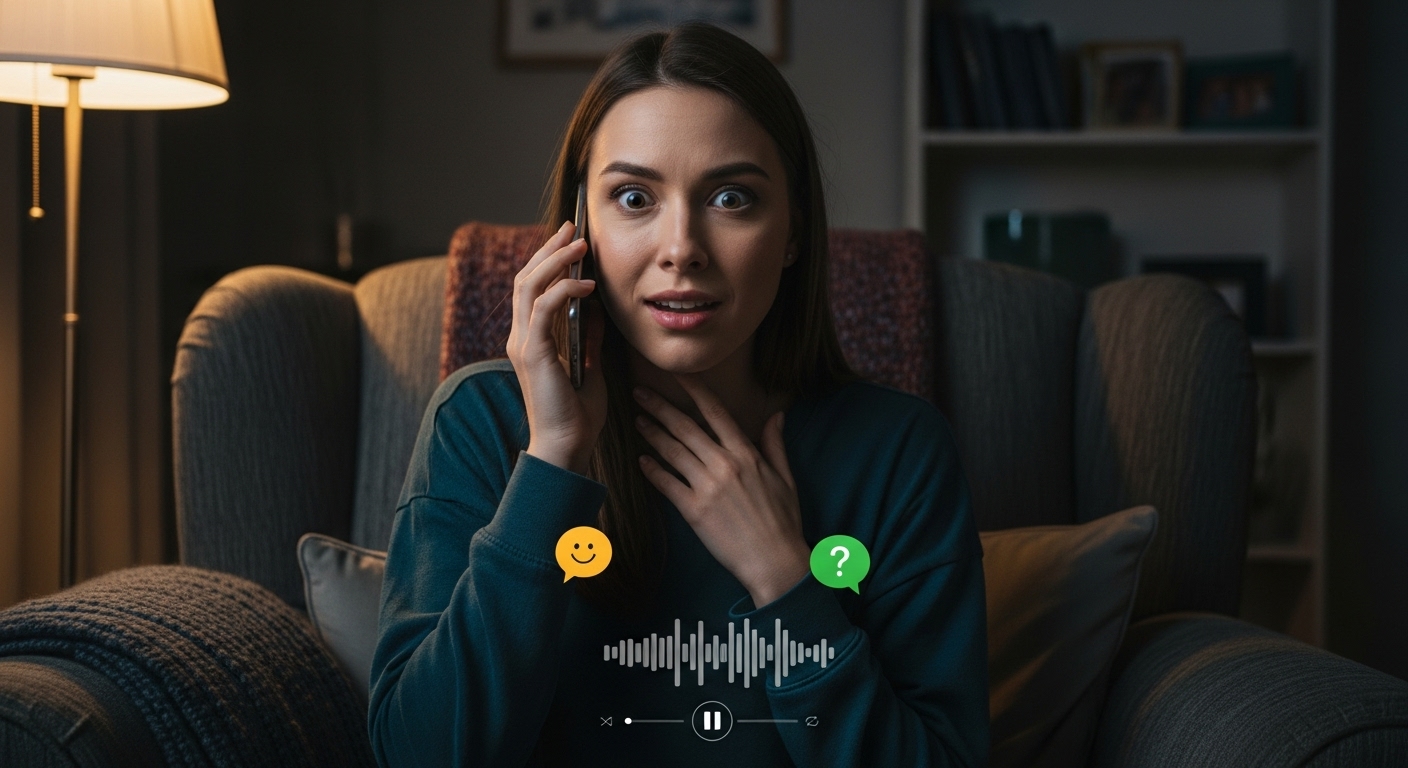
My sister secretly recorded a conversation with our parents and sent it to me with a taunt: “Guess who has a surprise for you?” I pressed play and froze.
My parents were laughing.
“She really thinks we love her? What we love is her money.”
I replied with one line: “So do I.”
Their surprise ended. Mine had just begun.
My name is Karen Wulette. I’m 32 years old, and three days ago, my sister sent me an audio file that shattered everything I thought I knew about family. The message came with a taunt—Guess who has a surprise for you. Four minutes and twenty-three seconds. That’s how long it took to destroy thirty-two years of believing I was loved.
In the recording, my parents laughed about me. “She really thinks we love her,” my mother said. “What we love is her money.” My father called me the naive one. My sister asked how long I’d keep paying.
For eight years, I gave my family $384,000. I thought I was being a good daughter. Turns out I was just an ATM with feelings.
Before I continue, if this story resonates with you, please take a moment to like and subscribe—but only if you genuinely want to hear what happened next. Where are you watching from right now? Drop your city and local time in the comments. I’d love to know who’s here with me.
Now, let me take you back four days, to Tuesday night, when my phone buzzed with a message that would change everything.
Tuesday, 9:47 p.m.—I was still at my desk on the forty-seventh floor of Willis Tower, reviewing quarterly projections for Lakefront Capital Partners. The Chicago skyline glittered through floor-to-ceiling windows, but I barely noticed anymore. After six years at the firm, the view had become wallpaper.
My phone lit up: Madison.
But I should explain something first. My life looked successful on paper: senior financial analyst, $127,000 annual salary, the corner of the open-plan office with the best light. But every month, like clockwork, a significant portion of that salary vanished into my family’s accounts.
It started eight years ago, three weeks after I landed my first real job. Mom called crying about an emergency. They needed $500 for a car repair. I transferred it within the hour, grateful I could finally help. That $500 became $1,000. Then $2,400 every month for their mortgage in Naperville. Then Madison’s tuition at DePaul—$78,000 over four years. Then living expenses because Dad’s back injury forced early retirement.
I never questioned it. Good daughters help their families. That’s what I told myself.
Every time I opened my banking app. Every time I calculated whether I could afford dinner out with friends—usually no. Every time I renewed the lease on my 450-square-foot studio apartment because saving for a down payment seemed impossible.
$384,200.
I know the exact number because I calculated it that night, sitting in my dim apartment, listening to my parents laugh about how easy I was to manipulate. But I’m getting ahead of myself.
That Tuesday night, I was still the version of Karen who believed she was loved—the version who saw Madison’s name on her phone and smiled, thinking maybe her little sister just wanted to chat.
I was wrong.
Madison is 26. She graduated from DePaul three years ago with a marketing degree I paid for, and she’s been “finding herself” ever since. That’s how Mom phrases it. Finding herself apparently requires living rent-free in our parents’ house, posting Instagram stories from brunch spots I’ve never been to, and cycling through entry-level jobs every eight months because she gets bored.
I used to defend her. She’s young. She’ll figure it out. Some people need more time.
What I didn’t know—what I couldn’t have known—was that while I was working sixty-hour weeks and eating microwave dinners alone in my studio, Madison was shopping at Nordstrom with a credit card attached to my account. Mom had added her as an authorized user six months ago. She never asked me.
I found out when I checked my statement after seeing the audio file’s timestamp. But that discovery came later.
That Tuesday, I still believed my family loved me. I still believed the sacrifices meant something. I still believed that when Mom called me her responsible one and Madison her free spirit, it was affection—not a code for who pays and who plays.
The family group chat that week had been typical. Madison complained about being broke while wearing a $400 jacket in her selfie. Mom reminded everyone about the thirty-fifth anniversary party on Sunday. Dad sent a thumbs-up emoji and nothing else.
And then, at 9:47 p.m. on a Tuesday, Madison sent me a private message. A single line: Guess who has a surprise for you.
Below it: an audio file. 4:23. File name: family talk.m4a.
I should have waited. I should have finished my work, gone home, listened with a glass of wine and emotional armor in place. Instead, I pressed play immediately.
I need you to understand what was supposed to happen that Sunday.
Mom had been planning her thirty-fifth wedding anniversary party for six months. The venue: Oak Brook Hills Country Club, the kind of place where membership costs more than my annual rent. Eighty-five guests were invited—aunts, uncles, cousins, neighbors from church, Dad’s former colleagues from the electrical union, Mom’s book club. Everyone who mattered in their social universe would be there, watching Patricia and Donald Wulette celebrate three and a half decades of marriage.
The event was scheduled for Sunday at 6:00 p.m. White tablecloths. Crystal chandeliers. A banner that read 35 Years of Love. Mom had chosen the menu, the flowers, the seating chart. She’d chosen her dress—navy blue with pearl accessories—three months in advance.
And she’d chosen the centerpiece of the evening: a speech from me, their eldest daughter, followed by the presentation of their special gift.
Here’s the thing. I didn’t plan that gift.
Two weeks before the recording, I’d noticed a charge on my Visa ending in 4721: Liberty Travel, $28,450.
A three-week European tour—Paris, Rome, Barcelona—departing in October.
When I called Mom to ask about it, she laughed. “Surprise! You’re giving us the trip of a lifetime for our anniversary. Isn’t that wonderful? We already told everyone.”
I was so stunned I didn’t argue. Classic Karen. Don’t make waves. Don’t embarrass anyone. Just absorb the cost and smile.
That was the plan: show up Sunday, give my speech, hand over the trip details, watch my parents beam while everyone applauded my generosity.
Then Madison sent me the file, and everything I thought I understood about being a good daughter burned to the ground in four minutes and twenty-three seconds.
I pressed play.
The recording was tiny, slightly muffled—captured on a phone hidden somewhere in our parents’ kitchen, based on the background clatter of dishes. I recognized the space immediately: the echo off the old tile, the hum of the refrigerator Dad keeps saying he’ll replace.
Mom spoke first. “She really thinks we love her.” A laugh—light, casual—like she was commenting on the weather. “What we love is her money.”
My chest compressed. I stopped breathing without realizing it.
Dad’s voice came next, with a chuckle I’d heard a thousand times, but never like this. “Well, she’s always been the naive one.”
Then Madison—my baby sister, the girl I’d carried on my shoulders at county fairs, taught to ride a bike, defended when kids at school were mean.
“How long do you think she’ll keep paying?”
Mom answered without hesitation. “As long as she believes we need her. That’s her weakness. She needs to feel needed.”
More laughter. The sound of a cabinet opening. Life continuing normally while they dismantled mine.
I stopped the recording at 4:12. I couldn’t hear the last eleven seconds. Not then.
My studio apartment was dark. The Chicago skyline glowed through my single window, indifferent to my collapse. I sat on the edge of my bed—just sat there, phone in hand, screen black for ten minutes without moving. No tears, no screaming. Just silence and the slow, devastating arithmetic of realizing that $384,000 hadn’t bought love. It had bought contempt.
My phone buzzed. Madison again: Did you listen?
I stared at her message for a long time. Then I typed back four words.
So do I.
I hit send, and something in me shifted.
I didn’t sleep that night. Instead, I listened to the recording three more times, taking notes on my laptop like I was preparing a financial audit—which, in a way, I was.
Every word. Every laugh. Every casual cruelty. I documented it all.
Then I opened my banking app. Eight years of transactions, thousands of line items. I created a spreadsheet at 1:00 a.m., categorizing every transfer I’d ever made to anyone with my last name:
Mortgage payments: $230,400.
Madison’s tuition: $78,000.
Living expenses: $47,300.
Emergency loans never repaid: $28,500.
The total glowed on my screen.
$384,200.
I thought about what that money could have been: a down payment on a condo, a retirement account, a vacation—one vacation anywhere in the world—a nicer apartment without roaches in the walls. Instead, I had a 450-square-foot studio and parents who called me naive behind my back.
At 3:00 a.m., I sent an email to Rebecca Torres. She’s been my best friend since we were roommates at Northwestern, back when I believed the world was fair and family meant everything. Now she’s a lawyer at Morrison and Associates, specializing in financial disputes.
I need to talk. It’s about my family and $380,000.
Her reply came at 3:12 a.m. She’d always been a night owl.
Coffee tomorrow, 8:00 a.m. Intelligentsia on Randolph. I’m already clearing my schedule.
At 3:47 a.m., Madison replied to my so do I message: What’s that supposed to mean? Then a string of laughing emojis.
I stared at them for a long time. My little sister, who’d sent me that recording not as a warning or an apology, but as entertainment—to see how I’d react, to watch me squirm.
I turned off my phone. For the first time in eight years, I chose silence over appeasement.
Wednesday, 8:00 a.m.—Intelligentsia Coffee, Randolph Street. Rebecca was already there when I arrived, two oat-milk lattes on the table and her legal pad out. That’s Rebecca: prepared for everything, even before she knows what she’s preparing for.
She’s 33, Cuban American, sharp enough to cut glass. We’d lived together for three years in a cramped off-campus apartment, eating ramen and dreaming about the lives we’d build. She’d gone on to Georgetown Law. I’d gone into finance. She’d never once asked me for money.
“Play it,” she said before I even sat down.
“I did.”
Rebecca listened with her lawyer face on—neutral, analytical, giving nothing away. When it finished, she sat back and let out a long breath.
“This is financial exploitation within a family context,” she said. “It’s more common than you’d think. But that doesn’t make it less devastating.”
She reached across the table and squeezed my hand. “I’m so sorry, Karen.”
I hesitated. “Is the recording legal? Madison made it in their house.”
“Illinois is a one-party consent state for recordings,” Rebecca said. “Madison was present, so technically she consented by being there. It’s admissible, if you ever needed it to be.”
Rebecca pulled out her phone. “Send me the file. I want to check the metadata.”
I AirDropped it to her. She opened it in some app I didn’t recognize, scrolling through data.
“Timestamp shows last Sunday at 2:34 p.m. No signs of editing or splicing.” She looked up. “This is authentic.”
The word hit me like a physical blow.
Authentic. My parents’ contempt verified by metadata.
“What do I do?” I asked.
Rebecca looked at me with the steady gaze that made her a terrifying opposing counsel. “First, you freeze that credit card today. Then you cancel that trip they booked without permission.”
“And then?” I asked.
She paused. “Then you decide what you want to happen next.”
Thursday, 8:00 a.m.—I called Chase Bank from my desk at work, keeping my voice low and professional while my heart hammered against my ribs.
“I need to freeze the Visa ending in 4721 immediately.”
The representative asked security questions. I answered on autopilot: yes, my mother’s maiden name; yes, the street I grew up on. Funny how family details become passwords—little keys to doors they could no longer open.
“Your card is now frozen, Ms. Wulette,” she said. “Is there anything else?”
8:15 a.m.—Liberty Travel.
“I need to cancel reservation number LT2847591, a European tour booked under Patricia Wulette.”
“I see that reservation, ma’am,” the agent said. “Are you the cardholder?”
“Yes. Karen Wulette. The charge was made without my authorization.”
A pause. Keyboard clicking.
“I can process that cancellation. You’re within the seventy-two-hour modification window, so you’ll receive a full refund. $28,450 will be credited within five to seven business days.”
8:32 a.m.—An email to payroll.
Please cancel the recurring monthly transfer of $2,400 to the account ending in 6672, effective immediately.
Three phone calls, two emails, forty-five minutes. That’s how long it took to dismantle eight years of financial dependence.
At 8:47 a.m., my phone buzzed with a notification from Chase: Declined transaction—Nordstrom. Card ending 4721.
Madison trying to use my card.
The timing felt almost poetic.
I stared at the notification, waiting for guilt to arrive—waiting to feel the familiar pull of but they’re family and you’re overreacting and what will people think?
Nothing came. Just a strange, hollow clarity.
For the first time in eight years, I hadn’t asked, What will Mom think? I’d asked, What do I need to survive this?
The answer was already in motion.
Thursday, 2:00 p.m.—Mom called.
I let it ring twice before answering. The first time in my life I’d ever hesitated.
“Karen, honey.” Her voice dripped sweetness, the kind I used to interpret as love. “Is something wrong with your credit card? Madison said it got declined.”
“I froze it.”
Silence. Three full seconds.
“You froze it?” A nervous laugh. “Right before our anniversary. Is everything okay, sweetheart?”
“I’m reviewing my finances, Mom. I just need to look at some charges.”
“What charges?” Her voice tightened. “The trip? That’s your gift to us, Karen. We already told everyone. Aunt Ruth, the Hendersons, the whole book club. They’re so impressed by your generosity.”
There it was. Not concern about me—concern about appearances.
“The trip I didn’t book,” I said, keeping my voice calm. “The $28,000 trip you charged to my card without asking.”
“We were going to tell you. It was supposed to be a surprise for you to give us.”
She spoke faster now, the charm curdling into something harder. “You always want to do nice things for us. We were helping you.”
“By spending my money without permission.”
“Karen, don’t be dramatic. It’s family. What’s yours is mine.”
I finished the sentence for her, my voice steady. “What’s mine is mine.”
The silence that followed was the longest of my life.
“I don’t know what’s gotten into you,” she said, and the temperature dropped—cold steel wrapped in velvet, the tone I’d learned to fear as a child. “But I hope you work through it before Sunday. The whole family will be there. Don’t embarrass us.”
Click. She hung up before I could respond.
I sat at my desk, phone in hand, and realized something: I’d never heard my mother truly angry at me before, because I’d never given her a reason until now.
Thursday, 7:00 p.m.—Madison FaceTimed while sitting in what used to be my childhood bedroom. I recognized the faded lavender walls, the window overlooking the backyard. Mom had converted it into a guest room years ago, but Madison had colonized it temporarily after graduation—three years ago.
“Sure,” she drawled, using the French she’d picked up from two weeks in Montreal. “You’ve caused quite the stir, haven’t you? Mom’s been stress-cleaning for three hours. Dad locked himself in the garage.”
She laughed, leaning back against my old pillows. “I have to say, I didn’t expect this reaction. You’re usually so accommodating.”
“Why did you send me that recording, Madison?”
She tilted her head, a smile playing at her lips. “Honestly? I wanted to see what you’d do. You’re always so perfect, so responsible, so I’m the good daughter. I was curious when you’d finally snap.”
“So this was entertainment for you.”
“Don’t be dramatic.” Same phrase Mom used. Same dismissive tone. “I thought you’d cry, call Mom, and everything would smooth over by Sunday. I didn’t think you’d actually do anything.”
“What did they tell the family about the money I send?”
Madison shrugged. “That you volunteer it. That you feel guilty for being more successful and want to help. That you insisted.” She examined her manicure. “The whole family thinks you’re desperately seeking their approval through your wallet.”
My chest tightened, but I kept my face neutral.
“Are you coming Sunday?” Madison asked. “Mom’s worried. Well—worried.” Air quotes. “She said if you don’t show up and act normal, she’ll call your boss. Mr. Harrison. Tell him you’re having a mental breakdown and the family’s concerned.”
I ended the call without saying goodbye, but not before I started my phone’s voice memo app.
Recording: 3 minutes 41 seconds.
Friday, I went to work like it was any other day—spreadsheets, meetings, a performance so convincing my colleague Sarah asked if I wanted to grab lunch.
“Can’t today,” I said. “Family stuff this weekend.”
She didn’t ask more questions. Work Karen and Real Karen had always been separate people. Today, they needed to stay that way.
During lunch, I locked myself in a conference room and printed documents: eight years of bank statements condensed into a twelve-page summary, the email confirmation from Liberty Travel showing the cancellation and pending refund, screenshots of Madison’s guess who has a surprise for you message, a transcript of the recording—each line marked with timestamps, certified by Rebecca.
I bought a red folder from the office supply closet. Red felt appropriate.
That evening, I knocked on Daniel Mercer’s door—apartment 4C, directly below mine. He’s 35, a freelance photographer, one of those genuinely kind people who remember your birthday without Facebook prompts. We’d become friends over shared laundry room complaints and occasional Thai takeout.
“Can I ask you a huge favor?” I said.
He leaned against his doorframe, concerned. “Anything.”
“I need someone to come with me to an event on Sunday. A family party. I can explain on the way, but I need a witness—someone who isn’t them.”
Daniel studied my face for a long moment. “This is serious.”
“The most serious thing I’ve ever done.”
“Then I’m in,” he said, no hesitation. “What time do we leave?”
We agreed on 5:00 p.m. Sunday.
As I turned to go, he handed me a business card. “My therapist—Dr. Ellen Park. Whatever happens Sunday, you should talk to someone professional afterward. Not because you’re broken. Because this stuff leaves marks.”
I took the card. “Thank you for not telling me to forgive and forget.”
“Some things,” Daniel said quietly, “shouldn’t be forgotten.”
Saturday, my phone became a battlefield.
9:00 a.m.—Aunt Ruth: “Karen, sweetheart, your mother called. She’s devastated. Whatever happened, I’m sure it’s a misunderstanding. Family forgives, dear. That’s what we do.”
11:30 a.m.—Uncle Frank: “Hey, kiddo. Your dad mentioned you’re having some financial troubles. Need a loan? I can wire you a few hundred to get through the month.”
Financial troubles. That’s how they framed it.
2:00 p.m.—Cousin Lisa: “Is it true you’re not coming to the anniversary? Everyone’s talking about it. Mom says Patricia’s been crying all day.”
4:30 p.m.—Grandma’s landline: “Karen, this is Grandma. I don’t understand what’s happening, but your mother is very upset. Please don’t make a scene tomorrow. The family’s reputation.”
I listened to each message without responding. The narrative was already solidified: Karen was having a breakdown. Karen was being selfish. Karen was jeopardizing the family’s special day because she had issues.
Mom had worked fast. In thirty-six hours, she’d contacted every relative, seeding a story that painted her as the victim and me as the unstable daughter who needed managing.
Then, at 6:47 p.m., a different message arrived—Grandma again, but this time a private voicemail, not the performative call she’d made earlier.
“Karin, it’s Grandma—alone this time.” Her voice was quieter, older. “I don’t know the whole story, and your mother… Patricia has always had her ways. Whatever you’re planning, just be careful, and know that I’ve always seen more than I’ve said.”
I saved that message. Something about it—the acknowledgment that my grandmother knew my mother wasn’t perfect—cracked something in my chest. Not doubt. Relief.
One person in that family, at least, could see the truth. I just had to make sure the others saw it, too.
Sunday, 10:00 a.m.—eight hours before the party. Mom called. This time I answered immediately.
“Karen.” No sweetness now, no honey—just steel wrapped in velvet. “I’m going to give you one last chance.”
“I’m listening.”
“You will come to the party. You will give your speech—the one I wrote for you, which I’ll email in an hour. You will smile and present our gift and act like the grateful daughter everyone knows you are.”
She paused, savoring the control. “And you will never mention that card situation again. Or I call Richard Harrison—your CFO. I found his number on LinkedIn.”
Her voice curled with satisfaction. “I’ll tell him my daughter is suffering from mental health issues—paranoia, delusions about her family. I’ll express deep concern for her stability at work.”
I let the threat hang in the air.
“You think I won’t?” Mom continued. “Patricia Wulette, devoted mother, worried about her troubled daughter. Who would doubt me, Karen? Everyone at that office will look at you differently. Every promotion, every project—they’ll wonder if you’re really stable.”
I should have been terrified. Six months ago, I would have been. Instead, I asked a question.
“Are you recording this conversation, Mom?”
She hesitated. “What?”
“Because I am.”
Silence. Complete, shocked silence.
“I’ve been recording since I answered,” I continued, keeping my voice steady and professional—the voice I used in board meetings. “Three minutes and forty-seven seconds so far. A recording of you threatening to sabotage my career unless I comply with your demands. Combined with the recording Madison sent me of you laughing about how I think you love me, I’d say I have quite a collection now.”
The line went dead.
I looked at my phone. Recording saved: 4 minutes 12 seconds.
For the first time, I’d used their tactics against them, and it felt like freedom.
Sunday, 2:00 p.m.—four hours until the party. Daniel and I sat at my small kitchen table eating sandwiches neither of us tasted.
“Walk me through it again,” he said.
“I show up,” I said. “I give a speech, but not the one she wants. I play the recording. I leave.”
I pushed lettuce around my plate.
“That’s the plan,” Daniel said. “And what’s your best-case scenario?”
I thought about it. Really thought.
“I don’t need them to apologize,” I said slowly. “I don’t expect them to change. I just need them to hear the truth from me, in front of everyone they’ve lied to—one time.”
“And worst-case?”
“They call me crazy,” I said. “They say I fabricated everything. They turn the whole family against me permanently.” I shrugged. “But I have the evidence. Bank records. Metadata. The recording Madison sent willingly.”
Daniel nodded, processing. He hadn’t judged. He hadn’t told me to take the high road or be the bigger person. He’d just asked what I needed and shown up.
“Can I be honest?” he said finally.
“Please.”
“Most people would want revenge—humiliation, blood.” He met my eyes. “You just want to be heard. That’s… actually really healthy. Messed up situation, healthy response.”
I laughed. The first real laugh in days. “My therapist will be thrilled.”
“Speaking of which,” he said, sliding Dr. Park’s card across the table, “I called her office. She has an opening Tuesday morning. I may have given her a preview.”
“You didn’t have to do that.”
“I know,” he said, smiling. “That’s why I did it.”
At 4:30, I put on a navy dress—simple, elegant battle armor. Daniel drove. The red folder sat in my lap, solid as a promise. We didn’t speak during the drive. Some silences say everything.
Oak Brook Hills Country Club—Sunday, 5:45 p.m. The parking lot was already full: BMWs, Lexuses, the occasional Mercedes. My parents’ social circle took presentations seriously. We’d borrowed Daniel’s Honda Civic, which felt like showing up to a black-tie event in jeans—appropriate somehow.
The grand ballroom glowed through tall windows: crystal chandeliers, white tablecloths, a banner in elegant script—35 Years of Love, Patricia and Donald—ten round tables, eighty-five guests, flower arrangements that probably cost more than my monthly grocery budget. This was my mother’s kingdom.
She stood at the entrance in her navy dress and pearls, greeting guests with the warm smile she’d perfected over decades of church functions and neighborhood barbecues: the devoted wife, the loving mother, the woman everyone admired.
She saw me approach. Her smile didn’t waver in front of witnesses, but her eyes went sharp.
“Karen.”
She pulled me into a hug, her arms like a vice, her lips at my ear. “You do anything to embarrass me tonight and I will destroy you.”
I hugged her back, keeping my voice equally low. “You’ve been doing that for eight years, Mom. Tonight, I’m just telling people about it.”
She released me, face frozen in that public smile. Only someone who knew her well would notice the white knuckles, the tension in her jaw.
“Mrs. Wulette,” Daniel said smoothly, extending his hand. “Lovely party. I’m Daniel—Karen’s friend. Thank you for having me.”
Mom’s smile flickered. She hadn’t expected a witness, but she recovered fast.
“Any friend of Karen’s is welcome.”
We moved into the ballroom. Aunt Ruth waved from a corner table. Uncle Frank nodded from the bar. Cousins I hadn’t seen in years whispered among themselves, probably repeating whatever story Mom had spread.
Eighty-five pairs of eyes. One red folder.
It was time.
I found my assigned seat at table three—close enough to see my parents at the head table, far enough that Mom could pretend we weren’t in active warfare. Daniel sat beside me. Aunt Ruth was across from us, along with Uncle Frank, Cousin Lisa, and two family friends whose names I’d never learned.
Everyone smiled. Everyone asked about my job. Nobody mentioned the elephant they’d all been briefed about.
“I heard you’re doing well at that investment firm,” Aunt Ruth said carefully. “Your mother says you’re very generous.”
“Does she?” I said.
Ruth shifted in her seat. “She mentioned you’ve been helping with the mortgage. That’s very kind, Karen.”
“Is that what she told you?” I kept my voice pleasant. “That I volunteer this money? That I insist on paying because I feel guilty about my success? That I beg them to let me help?”
The table went quiet. Even Uncle Frank stopped mid-sip of his whiskey.
“Well…” Ruth’s eyes darted toward the head table, where Mom was watching. “Something like that.”
“Interesting,” I said, and let the word hang.
I didn’t explain. I didn’t elaborate. I just returned to my salad and let them marinate in confusion.
From across the room, Madison stared at me. She was dressed in white—virginal, innocent, probably intentional. She looked nervous.
Good.
At 6:45, the event coordinator tapped the microphone.
“Good evening, everyone. On behalf of the Wulette family, thank you all for celebrating this wonderful milestone. Before dinner is served, we have a special presentation.” She consulted her cards. “Please welcome Karen Wulette, the couple’s eldest daughter, who will say a few words and present a very special gift.”
Applause—warm, unsuspecting applause.
I stood, picked up the red folder, caught Daniel’s eye. He nodded once.
I walked toward the stage, and eighty-five people had no idea what was coming.
Before I tell you what happened next, I want to pause here for a moment, because this—right now—is the point where most people would tell me to stay silent, keep the peace, be the bigger person, let the lies continue. Have you ever been in that position where everyone expects you to swallow your truth so they can stay comfortable?
Drop a comment and tell me: what would you do right now—give the speech my mother wrote, or tell the truth?
If you’re still here with me, hit that like button. Not for the algorithm—for every person who’s ever been told their pain doesn’t matter because it’s family.
Okay. Let me tell you what I said when I reached that microphone.
The microphone was cool in my hand, the spotlight warm on my face. I looked out at the crowd: aunts and uncles who’d watched me grow up, neighbors who’d attended my high school graduation, strangers who only knew the version of Karen my parents had marketed—the beautiful daughter, the generous one.
“Thank you all for being here tonight,” I said.
My voice came out steady, surprising given the earthquake happening inside my chest.
“Thirty-five years of marriage is an incredible milestone, and I have so many memories of this family.”
I paused, letting my eyes move across faces. “Summer camping trips. Christmas mornings. Dad teaching me to change a tire in the driveway.”
I saw my parents relax slightly. This sounded right. This sounded like what Mom had scripted.
“But tonight,” I said, “instead of talking about the past, I want to talk about the present. I want to talk about what family really means.”
The first ripple of confusion crossed the crowd.
“Eight years ago, I got my first real job. And I was so proud—so grateful—to finally be able to help my family.” I kept my voice calm, measured. “Mom needed help with the mortgage. Dad’s injury made things tight. Madison needed tuition. I was happy to contribute.”
Mom’s smile began to calcify. Dad went pale.
“And I did contribute,” I said. “Every month without fail. For eight years.”
I paused.
“I calculated the exact amount recently. Would you like to know what it is?”
No one answered. No one moved.
“$384,200.”
Gasps. Whispers. Aunt Ruth’s hand flew to her mouth.
“That’s how much I’ve given to this family,” I said, looking directly at my mother. “And last week, I learned exactly what that money bought me.”
Mom started to stand. I kept talking.
“Let me break it down,” I said, opening the red folder. “$2,400 a month for the mortgage. That’s $230,000 over eight years.”
The murmuring grew louder. People did mental math, expressions shifting from polite interest to genuine shock.
“$78,000 for Madison’s tuition at DePaul.” I glanced at my sister, who had frozen mid-reach for her water glass. “You’re welcome, by the way.”
“Karen!” Mom’s voice cut sharp across the ballroom.
“$1,500 a month in living expenses,” I continued over her. “$47,300, plus assorted emergencies totaling another $28,500—none of which were ever repaid.”
“This is not appropriate,” Mom said, standing now, moving toward the stage.
“And most recently,” I said, “a European vacation for $28,450—charged to my credit card without my knowledge—as a gift I was apparently giving you.”
“That was supposed to be a surprise,” Mom snapped, her public mask cracking.
“You agreed,” someone murmured.
“I never agreed to anything,” I said, and my voice stayed calm. “You told me about it after you’d already charged it and announced it to everyone.”
I looked at the crowd. “Has anyone here ever had someone spend nearly $30,000 on their credit card without permission and call it a gift you were giving them?”
Heads shook. Whispers intensified.
Aunt Ruth stood up. “Karen, sweetheart, this isn’t—”
“There’s more,” I said.
I pulled out my phone. “The money isn’t even the worst part.”
Mom lunged toward the stage steps. “She’s having an episode. I told you all she wasn’t stable.”
“On the contrary,” I said, connecting my phone to the sound system. “I’ve never been thinking more clearly.”
My thumb hovered over the play button.
“This is a recording my sister Madison sent me four days ago. She thought it was funny.”
I pressed play.
Mom’s voice filled the grand ballroom: “She really thinks we love her. What we love is her money.”
Eighty-five people stopped breathing.
Dad’s voice came next, laughing: “Well, she’s always been the naive one.”
Then Madison: “How long do you think she’ll keep paying?”
And Mom again, casual as discussing the weather: “As long as she believes we need her. That’s her weakness. She needs to feel needed.”
The recording played for forty-seven seconds before Mom screamed, “Turn it off! That’s fake. She fabricated it!”
I stopped the audio.
The silence that followed was unlike anything I’d ever experienced—not the polite quiet of a ceremony, but the stunned, airless vacuum of collective disbelief.
“It’s not fake,” I said calmly. “The file has metadata showing it was recorded last Sunday at 2:34 p.m. It’s been verified by an attorney. The timestamps are intact. There’s no editing, no splicing.”
I looked at Madison, still frozen at her table.
“And Madison,” I said, “would you like to tell everyone who recorded this—who sent it to me with the message guess who has a surprise for you and a gift emoji?”
Every head turned toward my sister.
She opened her mouth. Closed it.
Tears started streaming down her face.
Whether from guilt or the realization that she’d just become collateral damage in her own sabotage attempt, I couldn’t tell.
“Madison,” Uncle Frank’s voice was hoarse. “Is this true?”
She didn’t answer. She couldn’t.
I looked at my mother. She stood at the foot of the stage, mascara beginning to run, the perfect facade finally crumbling.
“You wanted me to give a speech tonight,” I said. “Consider this my speech. I told the truth—something this family has never done with me.”
The red folder sat open on the podium: $384,000 worth of receipts and one devastating recording.
The room erupted.
Mom charged up the steps. “You ungrateful—You’re ruining everything—”
“I’m not ruining anything,” I said, stepping back, keeping the podium between us. “I’m just not hiding it anymore.”
“That recording is a lie. I never—We never—”
“Mom,” I said, and my voice cut through her panic, “eighty-five people just heard your voice. You said my name. You laughed about me.”
Dad stood up from the head table, face crimson. “Karen, this is our anniversary—”
“And you called me naive,” I said. “Dad, you laughed while Mom said you only love my money.” I met his eyes. “Was that funny to you?”
He had no answer.
Madison bolted from the room, sobbing. One of her friends chased after her. The crowd began to fracture—some people frozen, others whispering urgently, chairs scraping, the whole room tilting into chaos.
Uncle Frank pushed back from his table and walked straight toward my mother.
“Patricia,” he said, voice rising, “is what she’s saying true about the money?”
Mom’s mouth worked soundlessly.
“Is it true?” Frank demanded. “How much have you taken from her?”
“I didn’t take anything,” Mom snapped. “She offered.”
“$384,000,” Frank repeated, like the number itself was an accusation.
I held up the summary sheet. “Eight years of bank records. Every transfer. Every emergency. It’s all documented.”
From the corner, a voice I didn’t expect—Grandma, still seated, speaking with quiet clarity.
“Patricia,” she said, “you told me Karen insisted on paying because she felt guilty. You told me she begged you to take the money.”
Mom spun toward her. “Mother, stay out of this.”
“I will not,” Grandma said, and her eyes were hard. “I spent sixty years building this family’s reputation, and you’ve been lying to all of us.”
Something cracked in Mom’s expression. For the first time in my life, I saw her without a script.
Voices swirled—accusations, denials, the scrape of chairs—but I found a strange pocket of calm at the center of it all. I picked up the red folder and stepped down from the stage.
“I’m not here for revenge,” I said, loud enough for those nearby to hear. “I’m here to set a record straight.”
Mom intercepted me at the foot of the stairs. Up close, I could see the panic beneath her rage, the desperate calculation of someone watching her carefully constructed world collapse.
“You’ve destroyed this family,” she hissed.
“No,” I said. “I’ve told the truth about it.”
I looked at the scattered guests—some leaving, some clustering in shocked conversation, some watching us like we were a car accident they couldn’t look away from.
“I want to be clear about something,” I announced to whoever was still listening. “I’m not asking for repayment. I’m not suing anyone. I’m not trying to punish.”
I placed the red folder on the nearest table.
“I’m simply done. No more monthly transfers. No more emergency loans. No more credit cards used without permission.”
I paused.
“If my parents need genuine help in the future—real help, not luxury vacations and shopping sprees—I’m willing to have a conversation. But it will be an honest one. The first honest conversation this family has ever had.”
Dad sank into the nearest chair, head in his hands. Mom stood rigid, vibrating with fury she couldn’t express in front of witnesses.
I turned to Grandma. “I’m sorry this happened at a party,” I said quietly. “But it was going to happen somewhere. At least now you know.”
She reached out and squeezed my hand. Her grip was stronger than I expected.
“I know,” she said. “I should have known sooner. I’m sorry I didn’t.”
I kissed her cheek, then walked toward the exit. The evening air hit my face like cold water. Daniel was right behind me—silent and solid.
We crossed the parking lot without speaking, gravel crunching underfoot, the sounds of the party—raised voices, someone crying—fading behind us.
I didn’t look back.
We’d almost reached his car when someone called my name.
“Karen, wait.”
Grandma stood at the country club entrance, leaning on her cane. The walk across the parking lot had cost her. I could see her breathing hard, but she’d come anyway.
I met her halfway.
“I wanted to say something,” she said. Her eyes were bright, though whether from tears or the evening chill, I couldn’t tell. “You were right. Your mother… I’ve made excuses for her my whole life. That’s just Patricia. She means well. Family is family.” She shook her head. “I should have seen it sooner. I should have protected you.”
“You didn’t know,” I said.
“I didn’t want to know,” Grandma corrected. “There’s a difference.”
She gripped my arm. “Don’t let her convince you that you’re the villain tonight. You told the truth. That took more courage than anything anyone in that ballroom has ever done.”
I hugged her carefully, mindful of her fragile frame. “Thank you, Grandma.”
She pulled back. “And don’t answer your phone for a few days. Trust me.”
I laughed, despite everything. “Sound advice.”
Daniel and I drove away as the sun set over Oak Brook. In the rearview mirror, I could see people trickling out of the country club, clustering in confused groups, probably trying to process what they’d witnessed.
“How do you feel?” Daniel asked.
I thought about it. Really thought.
“Like I’ve been holding my breath for eight years,” I said finally. “And I just exhaled.”
The Chicago skyline glittered ahead. For the first time, it felt like home.
My apartment had never felt quieter. I sat by the window at 10:00 p.m., the city lights blurring through glass that needed cleaning. My phone lay face down on the table. I’d silenced it hours ago after the notifications became unbearable.
Forty-seven missed calls, by my last count. Twenty-three text messages—probably more by now. I didn’t look.
Instead, I sat with the silence and let myself feel everything I’d been suppressing since Tuesday night. The grief came first—not for the confrontation, but for the family I’d thought I had.
The parents who’d held me as a baby, cheered at my graduations, told me they were proud. Had any of it been real, or had I always been an investment to them, valued only for returns?
The tears came without warning.
I hadn’t cried since listening to that recording the first time. Four days of logistics and planning and carefully maintained composure. Now, alone in my studio apartment with the city lights as my only witness, I finally broke.
I cried for the ten-year-old who just wanted her parents to be proud. I cried for the twenty-two-year-old who gave away her first paycheck trying to prove she was enough. I cried for the thirty-two-year-old who just learned that enough was never going to happen.
At 11:00 p.m., I called Rebecca.
“I did it,” I said, voice rough.
“I saw your dad called me twice,” she said. “Didn’t answer. How are you? Really?”
“I don’t know,” I admitted. “I think I’m sad, but also relieved.”
“Both can be true,” Rebecca said.
“Did I do the right thing?”
She was quiet for a moment. “You did the necessary thing. Those aren’t always the same, but tonight they were.”
I hung up and lay down on my bed. For the first time in years, I slept without dreaming about what I owed anyone.
The aftermath came in waves.
Monday, Aunt Ruth called, her voice completely changed from the family forgives message two days prior.
“Karen, I had no idea,” she said. “Your mother told us you insisted—that you felt guilty about your success and wanted to contribute. We all believed her.” She trailed off. “I’m so sorry I didn’t ask more questions.”
“Thank you for calling,” I said.
“I’m not calling just to apologize,” Aunt Ruth said, and her voice hardened. “I told Patricia what I think of her. We won’t be speaking for a while.”
Tuesday, an email from Madison—surprisingly long, surprisingly bitter.
You ruined my life. I lost my job because my boss is friends with Aunt Sarah and now everyone knows. Are you happy? You got your revenge.
I typed back four sentences.
You sent me that recording to watch me suffer. You laughed about it. Your choices, your consequences. I hope you learn from this.
Wednesday, three of Dad’s friends from church sent formal notes of apology—actual paper cards mailed to my apartment. They’d believed my parents’ version for years. They’d thought Karen Wulette was a desperate girl buying affection. Now they knew better.
The country club sent an invoice to my parents for the party, marked payment required within 14 days. Apparently having a public scandal at your event affects your membership standing. I learned this from Uncle Frank, who called to give me what he called “the situation report.”
“Your parents are refinancing the house,” he said. “Without your payments, they can’t cover the mortgage.” He paused. “I’m not saying that to make you feel guilty.”
“I don’t,” I said.
And I meant it.
Twelve family members had stopped speaking to my mother as of Wednesday night. I kept count—not for satisfaction, but for proof that the truth had consequences.
Two weeks after the party, Mom posted on Facebook a carefully crafted paragraph about family struggles and respecting privacy during difficult times. Comments poured in—mostly sympathy, a few probing questions, one pointed response from Cousin Lisa that got deleted within minutes.
The spin cycle was beginning.
I’d expected it. My mother had never met a narrative she couldn’t reshape.
But then she called me.
“Are you satisfied now?” Her voice was cold, controlled—the mask back in place, just cracked around the edges. “The whole church knows. My book club dropped me. Barbara Henderson won’t return my calls.”
“And that’s my fault,” she continued. “You publicly humiliated us, Karen, at our anniversary. Do you understand what you’ve done?”
“I told the truth, Mom,” I said. “Something you’ve never tried.”
“The truth?” She laughed bitterly. “You think anyone cares about truth? They care about appearances, respect, stability—things you destroyed in five minutes.”
“I destroyed them?” I asked, and let that hang. “You said on a recording that you don’t love me. You only love my money.”
“That was taken out of context.”
“What context makes that acceptable?”
Silence.
“I’m not apologizing,” she said finally. “We raised you, fed you, put a roof over your head for eighteen years. That costs money, too. You owe us.”
“Children aren’t debts to collect,” I said. “Mom, you wouldn’t understand. You’ve never sacrificed anything.”
I ended the call, but something unexpected happened that evening.
My phone rang again. A different number. Dad’s personal cell—the one he rarely used.
“Karen.” His voice was tired, older than I remembered. “I’m not calling to argue. I just… I wanted to say I’m sorry.”
I said nothing.
“Your mother’s wrong,” he continued. “I know that. I’ve always known it. I just never had the courage to say so.”
It wasn’t forgiveness, but it was a start.
I want to pause here and ask you something. If you’ve watched this far, you probably see yourself somewhere in this story. Maybe you’re the one who always pays. Maybe you’re the one everyone calls too sensitive when you finally speak up. Maybe you’ve been told that protecting yourself is the same as betraying your family.
Here’s what I’ve learned: boundaries aren’t walls. They’re doors. You get to decide who comes in.
Drop a comment and tell me—have you ever set a boundary that changed your life? What happened? And if this story has meant something to you, share it with someone who needs to hear it. Sometimes knowing you’re not alone is the first step.
Okay. Let me tell you what happened next.
One month after the party, I sat in Dr. Ellen Park’s office for my fourth session, the business card Daniel had given me now worn soft at the edges from handling.
“How does it feel,” she asked, “not to transfer that $2,400?”
I thought about it. The first of the month had passed three days ago. For the first time in eight years, I hadn’t moved money to my parents’ account. No mortgage payment. No living expenses. Nothing.
“Terrifying,” I admitted. “And also… light. Like I put down a backpack I didn’t realize I was carrying.”
Dr. Park nodded. “Guilt can feel like responsibility. They’re not the same thing.”
That afternoon, I did something I’d never done. I walked into a real estate office.
“I’m looking to buy a condo,” I told the agent, a cheerful woman named Sandra. “Two bedrooms. Lincoln Park area, if possible.”
She pulled up listings. With my salary—my full salary no longer siphoned away—and my credit score, I qualified for more than I’d imagined.
“You could be in a place by spring,” Sandra said. “Let me show you some options.”
I looked at pictures of sunlit kitchens and balconies overlooking tree-lined streets—spaces that were mine, truly mine. No one else’s name on the deed. No one else’s expectations built into the walls.
That evening, Daniel and Rebecca came over for dinner. I cooked—actually cooked, not microwaved—for the first time in months.
“To new beginnings,” Daniel said, raising his glass.
Rebecca clinked hers against it. “To Karen, who finally chose herself.”
I looked around my tiny studio, soon to be traded for something bigger. These two people—friends who’d shown up without conditions, without invoices—were my family now. The blood kind was optional. This kind was chosen.
Three months after the party, Dad sent an email. Not a text, not a call—an email, like he needed the distance of written words to say what he couldn’t speak aloud.
Karen, I’ve been thinking a lot about the last 32 years—about the kind of father I was and the kind I should have been. I always knew your mother went too far. I knew the money situation was wrong. I knew you were being used. And I said nothing. I told myself it was easier to stay quiet than to fight her. I told myself, “You seemed fine, so it must be okay.” Those were lies I told myself so I could sleep at night.
I don’t expect forgiveness. I don’t deserve it. But I want you to know that I love you. Not for your money—for you. I should have said that a long time ago. If you’re willing, I’d like to see you without your mother, just to talk.
I read the email three times before responding.
We met at a coffee shop near my apartment—neutral ground, my territory. He looked smaller than I remembered, grayer, like the last three months had aged him a decade.
“Thank you for coming,” he said. “I almost didn’t.”
We sat in silence for a moment. Then he started talking—not excuses, acknowledgements. He talked about his own father, who’d never said “I love you” once. He talked about marrying Patricia because she seemed strong and certain—everything he wasn’t. He talked about watching her control the family finances and telling himself it wasn’t his business.
“None of that makes it right,” he finished. “I just want you to understand why—even if understanding doesn’t change anything.”
“I can have a relationship with you,” I said carefully. “But not if Mom’s part of it.”
He nodded slowly. “I understand.”
Six months after the party, Mom never apologized. I didn’t expect her to. Through the family grapevine—mostly Aunt Ruth, who’d become my unexpected ally—I learned she’d rewritten the story entirely.
In her version, I’d had a mental breakdown. Stress from work. The recording was probably manipulated or taken out of context. She was the victim of an ungrateful daughter who turned on her own mother over a misunderstanding.
Some people believed her. That was fine. The people who mattered knew the truth.
Madison sent one final message before blocking me on everything.
I hope you’re happy with what you’ve done. You took everything from us. Mom cries every day. Dad barely talks. I had to move in with a friend because I can’t afford rent. This is all your fault.
I wrote a response in my notes app—typed it all out, every angry word, every justified defense—then deleted it without sending.
Instead, I wrote in my journal what Dr. Park had suggested: Madison made a choice when she sent that recording. She wanted to hurt me. She succeeded, but not in the way she intended. I can grieve the sister I thought I had without taking responsibility for the sister she chose to be.
The door wasn’t locked. If Madison ever wanted to have an honest conversation—one with accountability and growth—I’d listen. But I wasn’t going to chase her. I’d spent thirty-two years chasing my family’s approval. I was done running.
Some relationships can heal. Some can’t. The wisdom is knowing which is which, and accepting that you can’t control anyone’s choices but your own.
I chose peace. Whatever they chose was their business.
Six months after the party, in March, I signed the papers on a Wednesday afternoon: a two-bedroom condo in Lincoln Park with exposed brick walls and windows that caught the afternoon sun. My name on the deed. Nobody else’s.
The housewarming party was small—Rebecca, Daniel, a few colleagues from work who’d become actual friends. Dad came alone, awkward in the corner, but trying. And Grandma, who’d insisted on bringing her famous apple pie despite barely being able to walk.
“I’m proud of you,” she said, surveying the empty rooms that would soon be filled with furniture I’d chosen myself. “Not just for this place—for all of it. Even the party.” She smiled, that sharp intelligence still bright behind her aging eyes. “Especially the party. Someone needed to say what everyone was thinking. I’m just sorry it had to be you.”
Rebecca raised her glass as we gathered in the living room. “To Karen Wulette, who bought a condo, got an eight-percent raise, and started a blog that has—” she checked her phone—“12,000 subscribers, all in six months.”
The blog had been an accident. I’d started writing anonymously about financial boundaries and families, expecting maybe a handful of readers. Instead, the messages poured in—thousands of people who recognized themselves in my story, who’d given too much for too long to people who only loved what they could take.
I wasn’t alone. None of us were.
“To new beginnings,” Daniel said.
We clinked glasses.
Through the window, the March evening softened over the city I’d lived in for a decade but never quite claimed as mine. This apartment. These friends. This life. This was what I’d been paying for all along without knowing it—not their approval, my freedom.
One year after the party, I’m writing this from my living room, coffee cooling beside me, morning light spilling across the keyboard. The condo still smells faintly of the lavender candles Rebecca gave me last week.
A lot has changed.
I’m still a senior financial analyst, but I got promoted to lead a team of four. My salary increased. My savings account has actual savings in it. I went to Hawaii last month—my first real vacation in eight years.
The blog has grown. Eighteen thousand subscribers now. I write about boundaries, about financial abuse disguised as family duty, about the courage it takes to say no more. Every week I get emails from people who say they finally had the conversation with their own families. Some relationships survived it, some didn’t. All of them are more honest.
Grandma passed three months ago. I was there at the end, holding her hand. Mom didn’t come to the hospice. She and Grandma had stopped speaking after the party. I gave the eulogy. It was easier than I expected.
Dad and I meet once a month for coffee. It’s not the relationship I dreamed of as a child, but it’s real. He’s in therapy now, working through his own history of silence and avoidance. We don’t talk about Mom unless he brings it up, which is rare.
Madison is still out there somewhere, still not speaking to me. Maybe one day she’ll be ready to have an honest conversation. Maybe she won’t. Either way, my life moves forward.
That’s the thing nobody tells you about setting boundaries. It doesn’t fix everything. It doesn’t make the pain disappear. What it does is give you room to build something new.
And that’s enough. More than enough.
Before I go, I want to share something my therapist helped me understand.
My mother grew up poor—not tight-budget poor, but wondering if there would be dinner poor. That kind of childhood leaves marks. It creates a scarcity mindset, a desperate need to control resources, a belief that security comes from accumulation.
When I became successful, she didn’t see a daughter to be proud of. She saw a solution to a fear that had haunted her for sixty years.
Understanding that doesn’t excuse what she did, but it explains it.
And me—I was a textbook people-pleaser. I needed to be needed because somewhere deep down I believed that was the only way to be loved. Every time I sent money, I was really asking, Am I enough now? Do you see me yet?
The answer was always no. But I kept asking anyway because I didn’t know another way.
Here’s what I’ve learned, and what I hope you take from this story.
First: if someone only shows up when they need something, that’s not a relationship. That’s a transaction. You deserve better.
Second: being related by blood doesn’t automatically mean being loved. Love is shown through actions—through respect, through honoring boundaries. If those things are absent, the word family is just a label.
Third: setting a boundary might cost you a relationship. But if the relationship only existed because you had no boundaries, you didn’t lose anything real.
Now, I want to ask you something.