At my sister’s wedding, she mocked me in her speech. She lifted her champagne glass and said, “My sister is a single mother—unwanted by anyone.” The room laughed. My mom chimed in from her table, “She’s a used product.” Dad covered his mouth like he was trying not to make a sound, but his shoulders still shook.
Then the groom stood up, took the microphone, and the entire ballroom froze.
My name is Morgan Ingram. I’m thirty-two years old, an ER nurse, and a single mother. Three weeks ago, at my sister Vivien’s wedding in front of two hundred guests, she stood in a spotlight and turned my life into a punchline.
My five-year-old son, Ethan, was sitting right beside me, his small hand gripping mine. His eyes were wide with confusion as he watched adults—grown people in expensive clothes—laugh at his mother like it was entertainment.
But there was one person who didn’t laugh.
And what he did next changed everything.
Growing up in our four-bedroom colonial in Greenwich, Connecticut, I learned early that there were two types of daughters in the Ingram household: the princess and the workhorse. Vivien was the princess—four years younger, blonde like our mother, with the kind of effortless charm that made teachers forget about late assignments and boys forget about other girls. From the moment she could walk, she was Daddy’s little angel and Mommy’s mini-me.
I was the responsible one, which in Ingram family code meant I was the one who didn’t need attention because I could “handle it.” I didn’t understand then that being the one who could handle it wasn’t a compliment. It was a way of erasing me.
When prom came around, Vivien got a five-hundred-dollar Sherri Hill gown—blush pink, hand-beaded, the kind that made other girls gasp when she walked into the venue. When my prom came two years earlier, my mother looked at me over her reading glasses and said, “Morgan, you don’t need all that. You’re the simple type. It suits you.”
I wore a dress from the clearance rack at Macy’s. Sixty-three dollars. I still remember the number because I saved babysitting money to buy it myself.
Our bedrooms told the story, too. Vivien had the corner room with the balcony overlooking the garden—white furniture, fairy lights strung across the ceiling like something out of a magazine. My room was at the end of the hall next to the utility closet, furnished with hand-me-downs from our grandmother’s estate.
I didn’t hate Vivien for any of it. How could I? She was a kid benefiting from a system she didn’t create. But late at night, sometimes I would wonder what I had done wrong. What fundamental flaw existed in me that made my own parents look right through me?
I didn’t know then that this pattern would follow me all the way to her wedding day.
I met Kevin at twenty-four during my second year as an ER nurse at Hartford General. He was a pharmaceutical sales rep—charming, confident, the kind of man who made you feel like you were the only person in a crowded room. We married a year later.
My parents attended the wedding, but they spent most of the reception talking about Vivien’s upcoming internship at a prestigious PR firm in Manhattan. “She’s going places,” my mother kept telling the guests. “Both my girls are doing well, but Vivien—she’s something special.”
Even at my own reception, I felt like background noise to my sister’s future.
The marriage unraveled faster than I could have imagined. Kevin had a gift for making me feel small—questioning my choices, criticizing my appearance, isolating me from friends. By the time I discovered he was sleeping with his regional manager, I was seven months pregnant and had lost most of my sense of self.
The divorce was finalized when Ethan was fourteen months old. I was twenty-seven, alone, working night shifts while my son slept at a daycare that charged by the hour.
My mother’s response to the news was a long sigh, followed by, “I always worried you didn’t know how to keep a man happy. Vivien would never let this happen to her.”
My father said nothing. He never did.
Vivien texted me once during the whole ordeal. That sucks. But honestly, you always pick the wrong guys. Maybe try therapy.
No offer to help. No checking in on Ethan. No acknowledgement that I was drowning.
I didn’t need their pity, I told myself every night as I heated up instant noodles after a twelve-hour shift, Ethan asleep in his crib in our cramped one-bedroom apartment. I just needed them to stop treating my pain like something funny.
Daniel Mercer entered the picture two years before the wedding. Vivien met him at a charity gala—a black-tie event benefiting foster children. He was a children’s rights attorney, the kind who took pro bono cases for families who couldn’t afford representation. He carried himself in a quiet way, with kind eyes and a habit of actually listening when people spoke.
The first time I met him was at a family dinner at my parents’ house. Vivien had been dating him for three months and wanted to show him off. He shook my hand, noticed Ethan hiding behind my legs, and immediately crouched down to my son’s level.
“Hey, buddy,” he said, smiling. “I like your dinosaur shirt. Is that a T-Rex?”
Ethan beamed. No one in my family ever paid him that kind of attention.
Throughout dinner, I caught Daniel watching the family dynamics with a lawyer’s observant eye: the way my mother redirected every conversation back to Vivien, the way my father laughed at Vivien’s jokes but barely acknowledged mine, the way I automatically cleared the dishes while Vivien remained seated, checking her phone.
Later, as I was loading my car, Daniel appeared beside me.
“Does your family always treat you like that?” he asked quietly.
I was so startled I almost dropped Ethan’s diaper bag. “Like what?”
“Like you’re invisible.”
I forced a laugh. “That’s just how we are. Vivien’s the star. I’m the supporting cast.”
He didn’t laugh. He just nodded slowly, something unreadable in his expression. “You’re a good mother,” he said. “Ethan’s lucky to have you.”
Then he walked back inside.
I didn’t understand why those words made my eyes sting, or why for weeks afterward I kept replaying that brief conversation in my head like it was a secret message meant only for me.
The wedding invitation arrived in a cream envelope with gold calligraphy so thick and expensive it felt more like a royal summons than an invitation.
Vivien Marie Ingram and Daniel James Mercer request the pleasure of your company…
The venue was The Carlyle, a five-star hotel in Manhattan with a ballroom that had hosted senators, celebrities, and at least one minor European royal. Two hundred guests. Estimated budget one hundred fifty thousand dollars—funded entirely by my parents.
For context: when I got married, my parents contributed exactly two thousand dollars and complained about it for months afterward.
The invitation came with conditions.
Vivien called me two weeks before the wedding. “Morgan, I need to discuss some things.”
“Of course. What’s up?”
“First,” she said, “please wear something understated. Pastels or neutrals only. I don’t want anyone drawing attention away from me.”
I had planned to wear a deep green dress I’d been saving for. “Okay,” I said. “I can do that.”
“Second,” she paused. “Do you really have to bring Ethan? He’s five. He’ll probably get fussy and ruin the ceremony.”
“Vivien, I don’t have anyone to watch him. Kevin’s not in the picture.”
“Fine,” she cut me off. “But keep him quiet. And you’ll be at a table in the back so you can take him out quickly if he makes a scene.”
The morning of the wedding, my mother called. “Morgan, I’ve spoken with the event coordinator. You and the boy are at table twenty-three near the service entrance. Don’t make a fuss about it. This is Vivien’s day, and we can’t have any distractions.”
Distractions. That’s what my five-year-old son was to them.
I should have seen it then—the setup, the positioning, the careful orchestration of my humiliation—but I didn’t. I just wanted to survive the day.
The Carlyle ballroom was breathtaking: soaring ceilings dripping with crystal chandeliers, white roses cascading from every surface, a string quartet playing Vivaldi in the corner. The kind of wedding you see in bridal magazines, the kind that makes guests whisper about how lucky the couple must be.
I wore a dove-gray cocktail dress I’d found on sale—modest, forgettable, exactly what Vivien had demanded. Ethan looked adorable in his little navy vest and khakis, his hair neatly combed, clutching my hand as we walked into the overwhelming grandeur.
“Mommy, it’s so pretty,” he whispered, eyes wide.
“It is, baby,” I murmured. “Let’s find our table.”
Table twenty-three was exactly where my mother had promised—tucked in the far corner, half-hidden behind a pillar, so close to the kitchen doors I could hear the catering staff calling orders. The other guests at our table were distant cousins I’d met maybe twice in my life.
No one from my immediate family came to greet us.
I watched my parents make their grand entrance—my mother in champagne Valentino, my father in a perfectly tailored Armani suit. They worked the room like politicians, hugging, laughing, accepting compliments about their beautiful daughter—singular daughter.
Vivien swept in thirty minutes later in a Vera Wang gown that probably cost more than my annual rent. She was radiant, glowing, every inch the princess she’d always been. Her eyes found me across the room. She smiled, but it wasn’t warm. It was the smile of someone who’d already won and wanted you to know it.
On her way to the head table, she stopped at ours.
“Morgan,” she said, like my name surprised her. “You came?”
“Of course I came. You’re my sister.”
She glanced at Ethan, then back at me. “Just remember what I said about keeping him quiet.”
Then she was gone, swallowed by a crowd of admirers.
I caught a notification flash across my mother’s phone, left carelessly on a nearby table: Remember the plan?
My stomach tightened, but I told myself it was nothing.
The ceremony was beautiful. Vivien cried delicately perfect tears as she exchanged vows with Daniel. My parents beamed from the front row. Guests dabbed at their eyes with monogrammed handkerchiefs. I sat in the back with Ethan on my lap and tried to feel something other than hollow.
During cocktail hour, the photographer gathered the family for portraits. I started to stand, smoothing down my dress, when my mother appeared with a tight smile.
“Just the immediate family for this set, Morgan. Parents of the bride.”
“I’m her sister.”
“We’re doing a smaller grouping first,” she said. “You understand.”
I understood. I always understood.
Ethan tugged at my sleeve. “Mommy, why can’t we be in the picture?”
“We’ll take our own pictures later, sweetheart,” I whispered. “Smile for mommy.”
I held up my phone and snapped a photo of him, trying to ignore the burn behind my eyes.
At the reception, I watched from our distant table as aunts and uncles I’d known my whole life approached the head table to congratulate Vivien and Daniel. Not one of them stopped by to say hello to me.
“Morgan, is that you?” Aunt Linda—my mother’s sister—paused on her way to the bar. She looked uncomfortable. “I almost didn’t see you back here.”
“The seating chart’s creative,” I said, forcing lightness into my voice.
She glanced toward the head table, then back at me. Something like guilt flickered across her face. “Patricia’s always had her preferences,” she murmured. “I’m sorry, honey.”
Before I could respond, she was gone.
I noticed Daniel’s friend Mike setting up his phone on a small tripod at the edge of the dance floor, angled toward the stage. Probably streaming for relatives who couldn’t attend. I didn’t think much of it then.
I had no idea that phone would become the most important witness to what happened next.
The clinking of silverware against crystal silenced the room. The MC—a polished man in a three-piece suit—stepped up to the microphone.
“Ladies and gentlemen,” he said, “the bride would like to say a few words.”
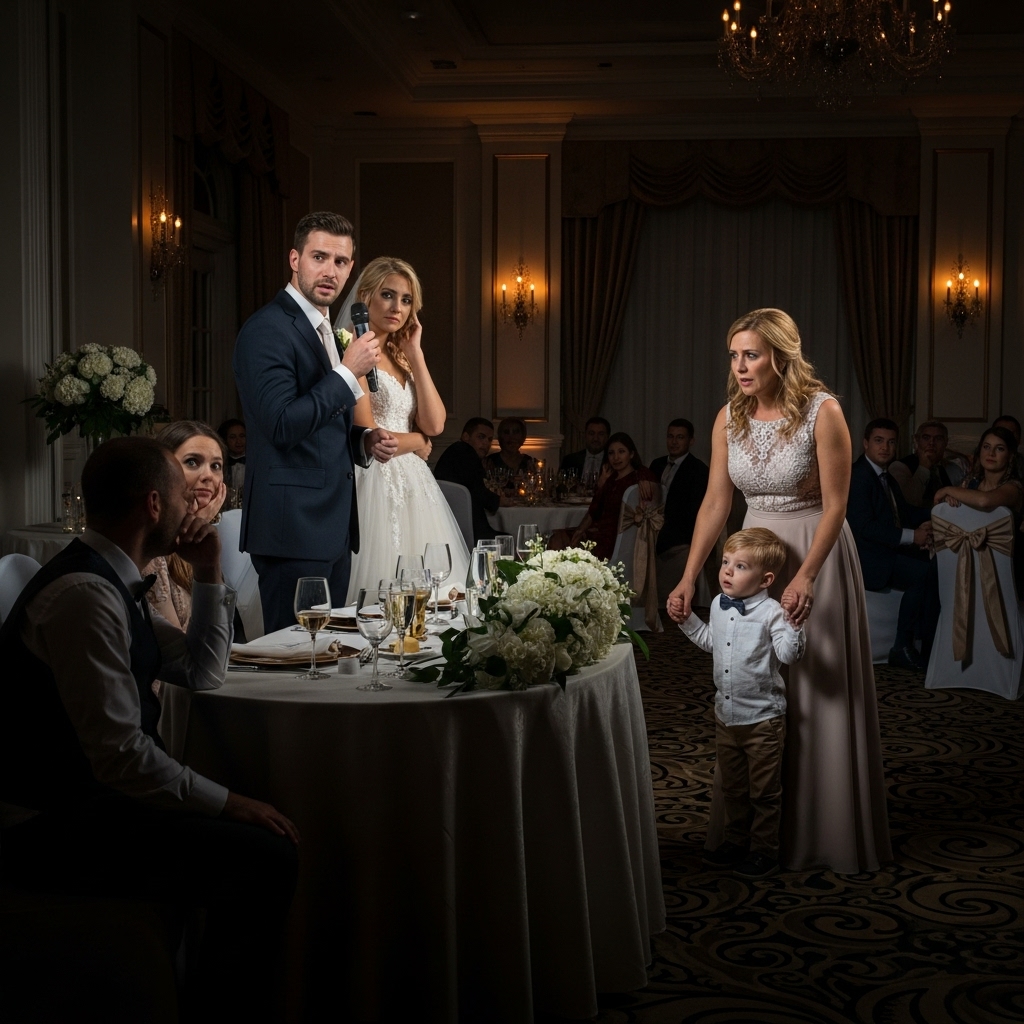
Applause rippled through the ballroom as Vivien rose, radiant under a dozen spotlights. She took the microphone with practiced ease, her Cartier bracelet catching the light.
“Thank you all so much for being here,” she began, her voice honey-sweet. “This is the happiest day of my life, and I’m so grateful to share it with everyone I love.”
She smiled at Daniel, who watched her with an expression I couldn’t quite read.
“First, I want to thank my incredible parents. Mom, Dad—you’ve given me everything. Your love, your support, your belief in me. I am who I am because of you.”
My mother pressed a hand to her heart, tears already forming. My father nodded proudly.
“And I want to talk about family,” Vivien continued, her tone shifting slightly. “About what family really means. About the lessons I’ve learned from watching everyone.”
Her eyes swept the room and landed on me. The warmth in her expression cooled.
Ethan perked up beside me. “Mommy, Aunt Viv is talking about you.”
“I know, baby,” I whispered, but something in Vivien’s smile made my blood run cold. It wasn’t affection. It wasn’t gratitude. It was anticipation.
“Morgan,” Vivien called out, her amplified voice bouncing off the chandeliers. “Could you stand up? I want everyone to see you.”
Two hundred faces turned toward our corner table. My legs felt like they were filled with concrete, but I stood. Ethan looked up at me, confused.
“There she is,” Vivien said, her smile widening. “My big sister—the one who taught me so many valuable lessons about life.”
She paused, like she was savoring it.
“See, my sister Morgan is a single mother.”
The words hung in the air—sharp and deliberate. A few guests shifted uncomfortably. Vivien’s smile didn’t waver.
“She got married young, had a baby, and then… well, things didn’t work out.” She tilted her head in mock sympathy. “Her husband left her. Couldn’t handle it, I guess. And now she’s alone.”
Scattered nervous laughter.
I felt my face flush hot.
“My sister is… unwanted,” Vivien continued, her voice carrying a theatrical sigh. “No man wants her. I mean, can you blame them? She’s got baggage now—a kid, the expenses, the whole mess.”
More laughter, bolder this time. A few of Vivien’s sorority sisters at a nearby table giggled into their champagne.
I couldn’t move. Couldn’t breathe.
Then, from the head table, my mother’s voice rang out clear as a bell. “She’s a used product.”
The room erupted.
Two hundred people laughing. My mother laughing. My father covering his mouth, shoulders shaking with barely contained amusement.
I looked down at Ethan. His small face was crumpled with confusion. His eyes darted between me and the laughing crowd.
“Mommy,” he whispered, his voice tiny and scared, “why is everyone laughing at you?”
I couldn’t answer. My throat had closed completely.
I saw the notes in Vivien’s hand—typed, prepared, rehearsed. This wasn’t a spontaneous joke. This was planned. Scripted. A coordinated attack disguised as a wedding speech.
But Vivien kept going, riding the wave of laughter. “Morgan taught me a valuable lesson,” she said. “She showed me exactly what not to do with my life. So really, I should thank her.”
She raised her champagne glass toward me. “To Morgan—my cautionary tale.”
The guests raised their glasses. Some were still laughing. Others looked uncomfortable, but said nothing.
And my five-year-old son watched his mother become a punchline.
Vivien wasn’t finished.
“You know, growing up, everyone always asked why Morgan and I were so different,” she said, pacing the stage like a performer hitting her stride. “Same parents, same house, same opportunities. But Vivien succeeded… and Morgan—well…” She gestured vaguely in my direction.
“I used to feel bad about it,” she continued. “Poor Morgan, always struggling. Poor Morgan can’t keep a man. Poor Morgan stuck in that sad little apartment with her sad little life.”
My mother nodded along, dabbing at her eyes—but they weren’t tears of sympathy. They were tears of laughter.
“But then I realized,” Vivien said, “some people are just meant to be warnings, not examples. And my sister… she’s the best warning I could ask for.”
Applause. Actual applause.
Ethan’s hand tightened around mine. His whole body was trembling. “Mommy, I want to go,” he whispered, his voice cracking.
“I know, baby,” I whispered back. “I know.”
But my legs wouldn’t move. I was frozen, pinned under the weight of two hundred judging eyes, my mother’s cruel laughter, my father’s complicit silence.
This was rock bottom. I thought this was the lowest point.
I was wrong.
Vivien raised her glass again. “Honestly, Mom’s right. Morgan is a used product—damaged goods.” She shrugged with theatrical innocence. “But hey, at least she’s here to see how a real success story ends.”
The laughter swelled.
Then movement.
Daniel pushed back his chair.
His jaw was tight. His eyes were fixed on Ethan—on my son’s small shaking form pressed against my side.
For a moment, I thought he was leaving. Walking out on his own wedding.
Instead, he walked directly toward the stage. Toward Vivien. Toward the microphone.
The laughter faltered, then died.
No one knew what was about to happen, including me.
Daniel moved with purpose, polished Oxford shoes clicking against the marble floor in the sudden silence. The string quartet stopped playing. Guests froze mid-sip, mid-whisper, mid-smile.
Vivien’s confident smile flickered.
“Daniel, baby, what are you—”
He didn’t answer. He didn’t even look at her. His eyes were locked on our table, on Ethan.
My son had buried his face against my hip, his small shoulders shaking with silent sobs. He didn’t understand why everyone was laughing at his mommy. He just knew it hurt.
Daniel saw that, and something in his expression hardened into steel.
He reached the stage in six strides. Vivien was still holding the microphone, her smile frozen in confusion.
“Daniel, sit down. I’m not finished—”
He took the microphone from her hand. Not grabbed. Not snatched. Just calmly, firmly removed it from her grip like confiscating a dangerous object from a child.
“Daniel,” Vivien’s voice pitched high with alarm, “what are you doing?”
The ballroom had gone completely silent—two hundred people holding their breath. I saw my mother half-rise from her seat, her face cycling through confusion, anger, and fear.
Daniel lifted the microphone to his lips.
“I apologize for the interruption,” he said, voice steady and clear. “But there’s something I need to say.”
He turned to look at me.
“Really look at me,” his eyes seemed to say—not through me, not past me, but directly at me.
Then he turned back to face the crowd.
“I’ve spent two years watching how this family treats Morgan Ingram,” Daniel said. “Two years of dinners where she’s ignored. Two years of holidays where she’s excluded. Two years of watching her be treated as less than nothing by the people who are supposed to love her.”
Vivien grabbed at his arm. “Daniel, stop. You’re embarrassing me.”
He stepped away from her touch. “No, Vivien. You did that yourself.”
His voice carried across the silent ballroom, steady as a courtroom closing argument.
“I’m a children’s rights attorney. I’ve dedicated my career to protecting kids from family trauma, from environments that damage them, from adults who should know better.”
He pointed toward our table, toward Ethan, still pressed against my leg, still trembling.
“That little boy is five years old. Five. And you just made him watch two hundred adults laugh at his mother. You called her unwanted. You called her damaged goods. You called her a used product—right in front of her child.”
His voice cracked with barely contained fury.
Silence. Absolute, ringing silence.
My mother’s face went pale. My father stared at his plate.
“I’ve spent my whole life fighting against exactly this kind of cruelty,” Daniel continued. “And I will not—I cannot—become part of a family that inflicts it.”
He turned to Vivien.
She was frozen, her perfect makeup suddenly garish under the harsh lights, her carefully crafted façade crumbling in real time.
“Daniel, please,” she whispered, and the microphone caught every word. “You’re overreacting. It was just a joke.”
“A joke?” Daniel’s laugh was hollow. “You planned this. You rehearsed this. You turned your own sister’s pain into entertainment.”
He stepped back, creating a visible chasm between them.
“I can’t marry you, Vivien,” he said. “I won’t.”
The collective gasp from two hundred guests was audible.
“And one more thing,” Daniel added, his eyes finding Mike’s phone still recording on its tripod. “My cousin Mike has been streaming this reception for family members in California who couldn’t attend. About fifty people have just witnessed exactly what kind of family I almost married into.”
He set the microphone down on the stage with a soft thud.
“I’m sorry for the disruption to your evening,” he said to the stunned guests. “The bar is still open. Please enjoy.”
Then he walked off the stage.
The dam broke.
My mother was on her feet, her Valentino gown swirling around her ankles as she stormed toward our table. Her face was twisted with rage—not at Vivien, not at herself.
At me.
“What did you do?” she hissed, jabbing a manicured finger in my direction. “What did you say to Daniel?”
“You ruined your sister’s wedding,” she spat. “You’ve always been jealous of her.”
My mother’s voice rose into a shriek that silenced the tentative murmurs beginning to ripple through the room. “You couldn’t stand to see her happy, could you? You had to poison Daniel against her!”
Vivien had collapsed into her chair at the head table, mascara tracking down her cheeks. Her carefully constructed moment of triumph had shattered into a very public nightmare.
My father appeared at my mother’s side, his expression hard. “What did you tell him, Morgan? Behind our backs? What did you say?”
“I didn’t tell him anything,” I said. “I barely spoke to him.”
“Liar,” Vivien’s voice cut through the ballroom. She was standing now, her Vera Wang gown seeming to mock the disaster unfolding around her. “You’ve been trying to turn him against me since day one. You couldn’t let me have one thing, could you? One perfect day.”
I felt the narrative shifting in real time. The guests who had been laughing minutes ago were now looking at me differently—not with sympathy, but with suspicion.
She must have done something.
Maybe the sister provoked this.
Poor Vivien.
I saw it happening: the rewriting of history right before my eyes. In a matter of minutes, I transformed from victim to villain in the minds of two hundred witnesses.
And I realized that if I didn’t leave right now, this would become my legacy—the jealous sister who destroyed her sibling’s wedding forever.
“If you’ve ever been in a situation where you were blamed for something you didn’t do, where people twisted the truth to make you the villain, comment I understand so I know I’m not alone,” the part of me that had learned to perform for survival wanted to say.
And if you want to know what I did next, like this video—because—
No. Not tonight.
Tonight, I looked down at Ethan. His face was red and blotchy from crying. His small hands were balled into fists against his chest. He was trying so hard to be brave, trying to understand why the world had suddenly become so loud and angry and scary.
And in that moment, something shifted inside me.
For thirty-two years, I had been the one who stayed quiet, the one who kept the peace, the one who absorbed every slight, every insult, every moment of being overlooked because fighting back “wasn’t worth the drama.”
But this wasn’t about me anymore.
This was about my son watching his mother be torn apart and doing nothing.
I stood up—not dramatically, not defiantly. I just stood, smoothed down my gray dress, and lifted Ethan into my arms.
I didn’t say anything to Daniel. I didn’t need to. He had eyes. He’d watched my family treat me like garbage for two years, and tonight, he finally decided he couldn’t live with it.
My mother’s mouth opened and closed like a fish. “You’re lying,” Vivien spat. “You’ve always been jealous, Morgan. Since we were kids—you can’t stand that I’m better than you.”
I didn’t argue. I didn’t defend myself. What was the point?
Instead, I turned and began walking toward the exit.
Behind me, I heard my mother’s voice, shrill with desperation. “Morgan, you come back here and apologize to your sister right now!”
I didn’t turn around.
Ethan wrapped his arms around my neck, his wet cheek pressed against mine. “Mommy,” he whispered. “Are we going home?”
“Yes, baby.”
“Good,” he said after a pause. “I don’t like it here.”
“I know, sweetheart,” I whispered, kissing his forehead. “Neither do I.”
The walk from table twenty-three to the ballroom exit was about forty feet. It felt like forty miles. I kept my back straight, my steps measured. Ethan clung to me, his face hidden against my shoulder.
Around us, two hundred guests sat in stunned silence, watching the drama unfold like a live theater performance they hadn’t paid to see.
I saw Daniel standing near the doorway. He wasn’t fleeing. He was waiting.
When I reached him, he stepped forward, blocking my path just long enough to speak.
“Morgan,” he said quietly, meant only for me. “I’m sorry. I should have said something years ago. I should have.”
“Don’t apologize,” I whispered, shifting Ethan on my hip. “You just saved my son from watching his mother get humiliated while everyone pretended it was fine. That’s more than anyone in my own family has ever done.”
He reached into his jacket pocket and produced a business card—simple white card stock, professional black text.
Daniel Mercer, Attorney at Law — Family and Children’s Rights.
“If you ever need anything,” he said, “legal help, a reference, anything at all—call me. Pro bono. I mean it.”
I took the card and tucked it into my purse. “Thank you,” I said, voice thick. “For Ethan.”
Behind us, I could hear Vivien’s voice rising in hysterics, my mother trying to calm her, my father issuing sharp commands to the bewildered wedding planner.
I didn’t look back.
I pushed through the ornate doors into the hotel corridor, my heels clicking on marble. As the noise of the ballroom faded behind us, Ethan lifted his head.
“Mommy,” he asked, “are you sad?”
I thought about the question—really thought about it.
“No, baby,” I said softly. “I’m not sad.”
For the first time in a very long time, I realized I wasn’t lying.
“How about pancakes when we get home?” I added.
His face lit up. “With chocolate chips?”
“All the chocolate chips you want.”
By the time I got Ethan bathed, fed, and tucked into bed with his favorite dinosaur, my phone had accumulated forty-seven missed calls—thirty-one from my mother, twelve from Vivien, four from my father.
I scrolled through the messages while sitting on the edge of my bed, still in my gray dress, still wearing the makeup I had applied so carefully that morning.
Mom, 10:47 p.m.: You ruined everything. Call me now.
Mom, 11:05 p.m.: Vivien is hysterical. Daniel left. This is all your fault.
Mom, 11:15 p.m.: Don’t you dare ignore me, Morgan Elizabeth Ingram.
Vivien, 11:23 p.m.: I will never forgive you for this. Never. You destroyed my life.
Dad, 11:45 p.m.: Your mother is very upset. You need to call her.
I set the phone face down on my nightstand.
Then I saw a message from an unexpected number.
It was Aunt Linda—my mother’s younger sister, the one who had approached me at the reception.
Aunt Linda, 12:02 a.m.: Morgan, I watched the stream from Mike’s phone. Honey, I am so sorry. I had no idea Patricia and Vivien were capable of something like this. I’m ashamed of my own sister right now. Please know you didn’t do anything wrong. I’m here if you need to talk.
I read it twice, then a third time.
It was the first acknowledgement from anyone in my family—extended or otherwise—that what happened to me was wrong. Not my fault. Not something I provoked or deserved.
Wrong.
The tears I’d held back all night finally came—quiet tears, the kind you cry when you’re relieved and heartbroken at the same time.
Someone had seen me. Really seen me.
And that single text meant more than thirty-two years of hoping my own mother would.
The screenshots arrived at 8:47 the next morning.
Rachel, my best friend since nursing school, had texted at 3:00 a.m.: Don’t read anything until you call me. Seriously. I have something you need to see.
By the time I woke up, Ethan was happily watching cartoons in the living room, and there were seventeen images waiting in my messages.
Rachel prefaced them with: A mutual friend’s daughter is dating one of your cousins. She saw the family group chat. Morgan—they planned this.
I opened the first screenshot.
It was a group chat titled Ingram Family. No Morgan. A chat I’d been removed from six months ago after asking why I wasn’t invited to Christmas Eve dinner. The messages were dated two weeks before the wedding.
Vivien: I’ve been working on my speech. I’m going to call her out in front of everyone. Make her see what a disappointment she is.
Mom: Just don’t go too far, sweetie. We don’t want to seem cruel.
Vivien: Mom, she deserves it. She shows up with that kid like she’s not ashamed of her life choices. Someone needs to put her in her place.
Mom: You’re right. She’s always been an embarrassment. Just make it funny. People love a good roast.
Dad: Just don’t mention me in it.
Vivien: Trust me—she won’t say anything back. She never does.
I stared at the screen until the words blurred.
They had planned it. Orchestrated it.
My mother had helped write the speech that called me a used product in front of two hundred people.
And my father—my quiet, passive father—had known and said nothing.
Rachel’s final message read: I’m so sorry, Morgan, but you needed to know. It wasn’t spontaneous. It was coordinated.
She was right. I did need to know.
Because now I understood: there was nothing left to save.
I sat with the screenshots for a long time. Ethan had fallen asleep on the couch, worn out from the chaos of the night before, his small chest rising and falling in peaceful rhythm. I watched him sleep and felt something settle inside me—something clear and cold and final.
For thirty-two years, I had been chasing something that didn’t exist: my mother’s approval, my father’s attention, my sister’s respect. I had bent myself into impossible shapes, trying to earn love that was never going to come. I accepted crumbs and called them enough. I let them treat me like a placeholder—a supporting character in my own life story.
And for what?
So they could plan my public humiliation as a wedding gift to themselves.
I closed the screenshots and opened a new document on my phone. I typed two words:
No contact.
That was it.
No dramatic confrontation, no tearful phone call demanding explanations, no attempt to make them understand the depth of their betrayal.
Just nothing.
I would stop calling, stop showing up to family events where I was only invited to be ignored, stop hoping that someday, somehow, they would look at me and see someone worth loving.
I wasn’t going to announce it. I wasn’t going to give them the satisfaction of a scene they could spin into more evidence of my instability or jealousy.
I would simply disappear from their lives the way they had always wanted me to—quietly, completely, permanently.
My phone buzzed with another call from my mother. I declined it and blocked the number.
Then Vivien’s number—blocked.
Then my father’s—blocked.
I looked at Ethan, still sleeping peacefully, and felt something unfamiliar loosen in my chest. Not anger. Not grief.
Relief.
“We’re going to be okay, baby,” I whispered. “I promise.”
They showed up three days later.
I was just getting home from work, Ethan chattering happily about the finger painting he’d done at daycare, when I saw them standing on the steps of my apartment building.
My mother in a cashmere coat. My father in his usual golf attire. Both of them looking like they’d taken a wrong turn into the wrong neighborhood.
“Morgan,” my mother said, her voice ice. “We need to talk.”
Ethan’s grip tightened on my hand. “Mommy, why is Grandma here?”
“I don’t know, sweetheart,” I said gently. “Go wait inside with Mrs. Patterson.”
My elderly neighbor had already appeared in her doorway, drawn by the tension in the hallway. She gave me a knowing look and held out her hand to Ethan. “Come on, honey,” she said. “I just baked cookies.”
Once he was safely inside, I turned back to face my parents.
“You blocked our numbers,” my mother said, her voice trembling with outrage. “After what you did to your sister, you blocked us.”
“After what I did?” I repeated, because the audacity almost made me laugh.
“You poisoned Daniel against Vivien,” she snapped. “You destroyed her wedding. The venue is demanding the full amount. The caterers won’t refund a dime. Do you have any idea how much money you’ve cost this family?”
I laughed anyway—sharp and bitter, a sound that made my mother flinch.
“I didn’t do anything,” I said. “Vivien stood up and called me unwanted in front of two hundred people. You called me a used product. Daniel made his own decision based on what he witnessed.”
“It was a joke,” my mother insisted, throwing her hands up. “A harmless joke.”
“In front of my five-year-old son,” I said, and my voice dropped into a calm that felt dangerous even to me. “You humiliated me in front of Ethan. He asked me why everyone was laughing at his mommy.”
For the first time, something flickered in my mother’s eyes—something almost like guilt.
But it vanished as quickly as it came.
“Vivien is devastated,” my mother pressed on, softening into what she probably thought was maternal concern. “Daniel won’t return her calls. The wedding photos are ruined. She’s talking about therapy, Morgan. Therapy. My baby girl.”
“Then therapy might be exactly what she needs,” I said.
My mother’s face hardened. “How dare you.”
I held up a hand. “I’m going to say this once, and then I want you to leave.”
She fell silent, shock flickering across her features. In thirty-two years, I had never interrupted her.
“I didn’t poison Daniel against Vivien,” I said. “I barely spoke to him. He made his choice because he watched how this family treats me—how you treat me—and decided he couldn’t be part of it.”
“That’s not—”
“I’m not finished,” I said, steady and unflinching. “You planned that speech. I’ve seen the group chat screenshots. You helped Vivien decide exactly what to say. You knew she was going to humiliate me—and you encouraged it.”
My mother went pale.
My father shifted uncomfortably, suddenly fascinated by a scuff mark on the hallway floor.
“Vivien is crying,” I continued. “Good. Maybe now she’ll understand what it feels like. I’ve been crying since I was twelve years old, trying to figure out why my own mother looked at me like a disappointment.”
“Morgan, that’s not fair—”
“You called me a used product,” I cut in quietly. “In front of my child. In front of two hundred people. And you’re standing here asking me to apologize.”
Silence stretched between us like a chasm.
“I love you,” I said, softer now. “I’ve spent my whole life loving you and hoping you’d love me back. But I can’t do this anymore. I won’t raise Ethan in an environment where he learns that abuse is acceptable if it comes from family.”
I stepped toward my door. “Please leave.”
If you’ve ever had to set a boundary with someone you loved—even when it broke your heart—comment boundaries so I know you understand. And if you want to hear what happened next, keep watching, because what I’m about to tell you proves something important. Sometimes walking away is the most powerful thing you can do.
Let me take you back to that hallway.
My mother’s face cycled through a dozen emotions in three seconds—disbelief, rage, hurt, calculation—before landing on her weapon of choice.
Tears.
“Morgan,” she said, voice cracking artfully, “you’re going to regret this. When I’m gone someday, you’ll wish you’d been a better daughter.”
The guilt trip. Classic Patricia Ingram.
A year ago, it would have worked. Six months ago, it would have made me apologize. Even a week ago, I might have hesitated.
But that was before she laughed at her own daughter being called worthless—before she added her own knife to the wound—before I watched my son’s face crumble as his grandmother turned his mother into a joke.
“Maybe,” I said. “Or maybe I’ll look back and know that I protected my child from the same damage you did to me.”
Mrs. Patterson’s door opened. Ethan peeked out, cookie crumbs on his chin.
“Mommy,” he asked, “are you coming?”
I smiled at him—a real smile, warm and sure. “Yes, baby. One minute.”
My mother lunged toward him, arms outstretched. “Ethan, sweetheart, come give Grandma a hug—”
I stepped between them. Not aggressively. Just firmly.
“No.”
The word hung in the air like a slap.
“He’s my grandson,” my mother snapped.
“He’s my son,” I said, and my voice didn’t shake. “And I decide who gets access to him.”
My father finally spoke, voice gruff with discomfort. “Morgan, your mother is upset. Let’s all just calm down—”
“Goodbye, Dad,” I said.
I took Ethan’s hand and guided him toward our apartment door. At the threshold, I turned back one last time.
My mother was crying—real tears now, or close enough. My father stood helplessly beside her.
“I’m not doing this to punish you,” I said. “I’m doing this because I finally understand that I deserve better than what you’ve given me.”
Then I closed the door and locked it.
The video spread faster than my mother could contain it.
Within a week, it made the rounds through the extended Ingram family—cousins, aunts, uncles, second cousins I’d never met—passed along like evidence in a trial.
Aunt Linda called me on a Tuesday evening.
“Morgan,” she said, “I just got off the phone with your uncle Robert in Sacramento. He saw the stream. Well… he used words I won’t repeat about your mother and Vivien.”
“I didn’t ask anyone to share it,” I said.
“You didn’t have to,” she replied. “Mike sent it to his mother, who sent it to her bridge club, who sent it to everyone else. Honey, you know how family gossip works.”
I did. It was the same network that had spread rumors about my divorce, my failure to keep a husband, my status as the family disappointment.
Now that network was working in my favor.
“Your mother tried to call me yesterday,” Aunt Linda continued. “Wanted me to help manage the narrative. I told her the narrative managed itself the moment she opened her mouth in front of two hundred witnesses and a camera.”
Despite everything, I felt a small, unexpected spark of satisfaction.
“How’s Vivien?” I asked.
Aunt Linda hesitated. “Not good. Daniel officially ended things. His family sent back the engagement gifts with a letter from their lawyer—something about irreconcilable value differences. Professional courtesy wrapped around devastating rejection.”
“And your mother?”
Aunt Linda sighed. “She’s been calling everyone trying to explain that it was just a joke that got out of hand. But people saw the video, Morgan. They heard her. No amount of spin changes what they witnessed.”
I pictured my mother desperately dialing relatives, trying to rebuild a reputation she destroyed in thirty seconds of gleeful cruelty.
“Let her spin,” I said quietly. “I’m done explaining myself to people who don’t want to understand.”
Vivien tried damage control two weeks after the wedding.
She posted a lengthy statement on Facebook—carefully worded, professionally crafted, probably reviewed by a PR friend.
I want to address the misunderstanding at my wedding… What was intended as light-hearted family humor was taken out of context…
It went on for six paragraphs, never once apologizing, never once acknowledging what she actually said.
The comments became a battlefield.
Vivien, I’ve seen the video. There was nothing playful about it.
You literally called your sister unwanted and your mom called her used goods. How is that a misunderstanding?
Girl, this ain’t it. Own your mistake.
Rachel sent me screenshots of the meltdown, though I’d already muted everything related to my family.
“She’s getting destroyed,” Rachel texted. “Her coworkers are asking questions. Someone said her boss called a meeting about professional conduct outside the workplace.”
I didn’t feel triumphant. I didn’t feel vindicated.
Mostly, I felt tired.
A few days later, Aunt Linda told me Daniel’s mother had called my mother directly. She said—according to Aunt Linda—“I didn’t raise my son to marry into a family of bullies. You should be ashamed of yourselves.”
Mrs. Mercer, a retired family court judge, had seen enough dysfunction in her career to recognize it instantly.
Vivien lost her fiancé. Her reputation crumbled. Her job was under scrutiny.
And I hadn’t done anything.
I hadn’t needed to.
The truth had been enough.
Daniel called me three weeks after the wedding. I almost didn’t answer. The number wasn’t saved, and I’d become wary of unfamiliar callers. But something made me pick up.
“Morgan,” he said, and his voice sounded tired. “It’s Daniel Mercer.”
I sat down on my couch, pulling a blanket over my legs. Ethan was asleep in the next room, and the apartment was quiet.
“Daniel,” I said softly. “Hi.”
“I hope I’m not overstepping by calling,” he said. “I wanted to apologize.”
“You already apologized at the hotel.”
“Not properly,” he exhaled. “I watched your family treat you like dirt for two years. Two years, Morgan. And I told myself it wasn’t my place to say anything—that Vivien would grow out of it, that they were just difficult.”
“You didn’t know how bad it was,” I said.
“I knew enough,” he replied, and I heard something harden in his voice. “I’m a children’s rights attorney. I’ve built my career on recognizing toxic family dynamics—and I stood by and let it happen because I was in love with someone who didn’t deserve that love.”
I didn’t know what to say. The rawness of his confession left me speechless.
“That night,” he continued, “when I saw Ethan’s face… God, Morgan. That little boy watching his mother get destroyed for entertainment. I couldn’t stay silent anymore.”
“You didn’t just stay silent,” I said. “You ended your own wedding.”
“It was the right thing,” he replied. “The only thing.”
He paused, then added, “I meant what I said about legal help. If you ever need assistance—custody issues, harassment, anything—I will help. No strings. No charge.”
“Why?” I asked, though I already knew.
“Because your son deserves to have someone in his corner,” Daniel said. “And so do you.”
Tears pricked my eyes, but they weren’t sad tears.
“Thank you,” I whispered. “For everything.”
Six months passed.
Strange how life rebuilds itself when you remove the people who keep tearing it down.
I got a promotion at work—Senior Charge Nurse, ER Department. My supervisor called me into her office on a random Tuesday and said, “Morgan, your patient satisfaction scores are the highest in the unit. You’re calm under pressure, you’re compassionate, and you’re exactly the kind of leader we need. Congratulations.”
I cried in the bathroom afterward—happy tears, the kind that sneak up on you when you’re finally starting to believe you might be worth something.
Ethan started kindergarten in September. He made friends quickly—a chatty little boy named Oliver and a quiet girl named Sophie who shared his obsession with dinosaurs. His teacher sent home a note after the first month.
Ethan is a joy to have in class. He’s kind, curious, and always willing to help others.
My apartment was still small—one bedroom, a kitchenette, creaky radiators—but it was ours. I hung Ethan’s artwork on every wall: crayon dinosaurs, finger-painted rainbows, and a wobbly portrait labeled mommy in purple marker.
It looked like home.
I started therapy once a week—fifty minutes of unpacking thirty-two years of being told I wasn’t enough. Dr. Chen, a soft-spoken woman with kind eyes, helped me understand something I’d never been allowed to believe.
“You were the scapegoat in a family system that needed someone to blame,” she said during our third session. “Your worth was never determined by their inability to see it.”
I also started dating again—casually, carefully. A nurse from the pediatric unit asked me to coffee, then dinner. Nothing serious. But the idea that someone might want to know me—the real me—felt revolutionary.
For the first time in my life, I wasn’t waiting for permission to be happy.
I was just happy.
The attempts at contact came in waves.
First, a birthday card for Ethan arrived two weeks late with no return address, though I recognized my mother’s handwriting. Inside was a hundred-dollar bill and a note: To our grandson. We miss you.
I put the money into Ethan’s college savings and recycled the card.
Then a text from an unknown number—Vivien using a friend’s phone.
Morgan, we need to talk. I’ve been doing a lot of thinking. Call me.
I didn’t call.
A few weeks later, a voicemail from my mother in that wounded-victim tone she’d perfected over decades.
“Morgan, this has gone on long enough. Family is family. You can’t just cut us out forever. I’m your mother. Don’t I deserve a chance to explain?”
I deleted it without finishing.
The hardest one came from my father.
He showed up at my workplace—something he’d never done in the eight years I’d been a nurse. I found him waiting in the lobby, looking uncomfortable and out of place among the worried families and beeping equipment.
“Five minutes,” he said when I approached. “Please.”
We stepped outside into the gray November afternoon.
“Your mother is struggling,” he said. “She cries every day. Vivien won’t leave her room. Thanksgiving was…” He trailed off.
“Was what, Dad?” I asked.
“Empty,” he admitted.
I waited.
“I know what happened wasn’t right,” he said, and the admission seemed to cost him something. “But your mother loves you in her own way. She doesn’t know how to—”
“Dad,” I cut in gently but firmly, “I spent thirty-two years waiting for Mom to love me in a way that didn’t hurt. I can’t wait anymore. And I won’t let Ethan grow up waiting too.”
He nodded slowly, something crumbling behind his eyes.
“I understand,” he said quietly.
And for the first time, I believed he did.
Today, as I record this, it’s been eight months since my sister’s wedding.
I’m sitting in our little apartment. Ethan is asleep in the next room, his nightlight casting dinosaur shadows on the ceiling. Tomorrow is his sixth birthday.
I have a homemade cake in the fridge—chocolate with too much frosting, just the way he likes it. I have a secondhand bike waiting in my neighbor’s storage unit, wrapped in a bow I tied three times to get right.
I got my promotion. I’m seeing someone—Michael, the pediatric nurse—who tells me I’m beautiful and means it in a way I’ve never heard before. I have friends who show up, a therapist who helps me unpack decades of damage, and an aunt who calls every Sunday just to check in.
And I have my son.
Last week, Ethan brought home a picture from school. It was a family tree assignment. While most kids drew grandparents and cousins and sprawling networks of relatives, Ethan drew just two figures: a tall woman with brown hair and a small boy beside her holding her hand.
“That’s our family, Mommy,” he said proudly. “Just us.”
I hung it on the refrigerator right at eye level.
My mother hasn’t stopped trying to reach me. Neither has Vivien. I get the occasional message through relatives, the rare handwritten letter that goes straight into the trash.
I don’t hate them. That’s the strange part.
I spent so long being angry—at the favoritism, the cruelty, the thousand small cuts of growing up invisible. But somewhere along the way, the anger faded into something quieter. Not forgiveness. Not reconciliation.
Just peace.
I chose myself. I chose my son. And that choice—hard as it was—saved us both.
Sometimes the bravest thing you can do is walk away.
If you told me a year ago that I’d cut off my entire family, I would have laughed or cried. Probably both. I grew up believing family was everything, that blood ties were unbreakable, that love meant enduring whatever treatment you received because that’s what daughters do—good daughters, loyal daughters.
I was wrong.
Family should be a safe place. A space where you’re celebrated, not tolerated. Where your presence is welcomed, not weaponized. Where your children can grow up knowing they’re enough exactly as they are.
My family wasn’t that. My family was a performance, and I was always cast as the understudy.
Here’s what I’ve learned: setting boundaries isn’t selfish. It isn’t cold. It isn’t abandoning the people who hurt you. It’s recognizing—finally, clearly—that you deserve better than what you’ve been given.
You don’t owe your loyalty to people who don’t respect you. Not your mother, not your father, not your sister, not anyone.
I used to think staying quiet made me strong—that absorbing every insult, every comparison, every public humiliation somehow proved my worth. Look how much I can take. Look how resilient I am.
But silence isn’t strength. Not when it’s born from fear. Not when it costs you your self-respect.
Real strength is walking away. Real strength is choosing yourself. Real strength is looking your mother in the eye and saying, “I deserve better than this.”
Ethan will grow up knowing his worth isn’t determined by how much criticism he can endure. He’ll learn that boundaries aren’t walls—they’re doors you get to control. He’ll understand that love doesn’t look like public mockery or strategic cruelty or “jokes” designed to wound.
That’s my legacy—not the Ingram family name. Just a mother who chose her son and herself.
For those wondering what happened to everyone else, here’s what I know.
Vivien started therapy, according to Aunt Linda. Real therapy with a licensed professional, working through issues that apparently run deeper than anyone realized. I don’t know the details, and I don’t need to. I hope she finds whatever she’s looking for. I hope she becomes someone capable of genuine kindness.
But that’s not my journey to witness.
My mother continues to call me difficult and unforgiving to anyone who will listen. She’s rewritten the narrative so thoroughly that some relatives believe the wedding incident was my fault—that I provoked Vivien, that Daniel was always unstable, that the whole thing was blown out of proportion.
I don’t correct them.
The people who matter know the truth.
My father sent me a text a few weeks ago. Just three words: I’m sorry.
No explanation. No excuses. No request to reconcile.
I read it, sat with it for a long time, then put my phone down and went about my day. Maybe someday I’ll respond. Maybe I won’t.
Healing isn’t linear, and forgiveness isn’t a requirement.
Aunt Linda has become the family I always needed. She drives down from Hartford every other month, takes Ethan to the children’s museum, loads me up with Tupperware of homemade soup, and never once pressures me to give my mother another chance.
“Family is who shows up,” she told me once over coffee in my cramped kitchen. “Not who shares your last name.”
She was right.
Daniel Mercer sent Ethan a dinosaur encyclopedia for his birthday. No note, no strings—just a gift from someone who remembered a scared little boy and wanted to make him smile.
Small kindnesses add up. They mean more than two hundred laughing guests ever could.
So that’s my story: a wedding that became a funeral—not for a marriage, but for thirty-two years of trying to earn love that was never coming. A five-year-old boy who taught his mother that some people are worth fighting for and some aren’t. A choice to walk away, not in defeat, but in victory.
I’m not telling you this because I want pity. I stopped needing pity somewhere between the forty-seventh missed call and the first morning I woke up without dreading my phone.
I’m telling you this because I know I’m not alone.
Some of you watching this have mothers who look through you. Sisters who compete instead of celebrate. Fathers who stay silent when they should speak up. Family gatherings that feel like minefields. Some of you have already walked away. Some of you are still trying to figure out how.
And some of you are still hoping—like I did for so long—that if you just try harder, love better, make yourself smaller, eventually they’ll see your worth.
They won’t.
Not because you’re not worthy—because they can’t.
And that’s not your failure to fix.
Thank you for listening to my story. If it resonated with you… if you’ve ever had to set boundaries with someone you loved, ever had to choose yourself over family expectations, ever wondered if you were strong enough to walk away…